
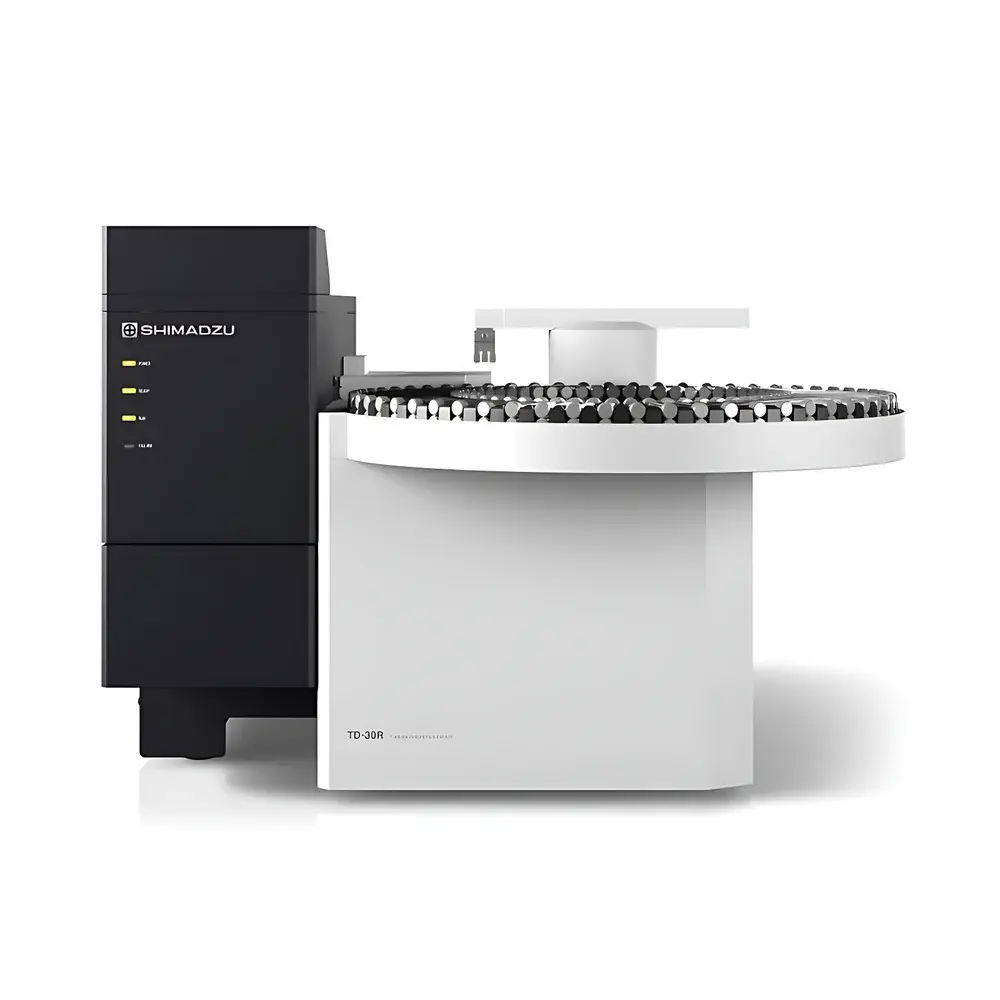
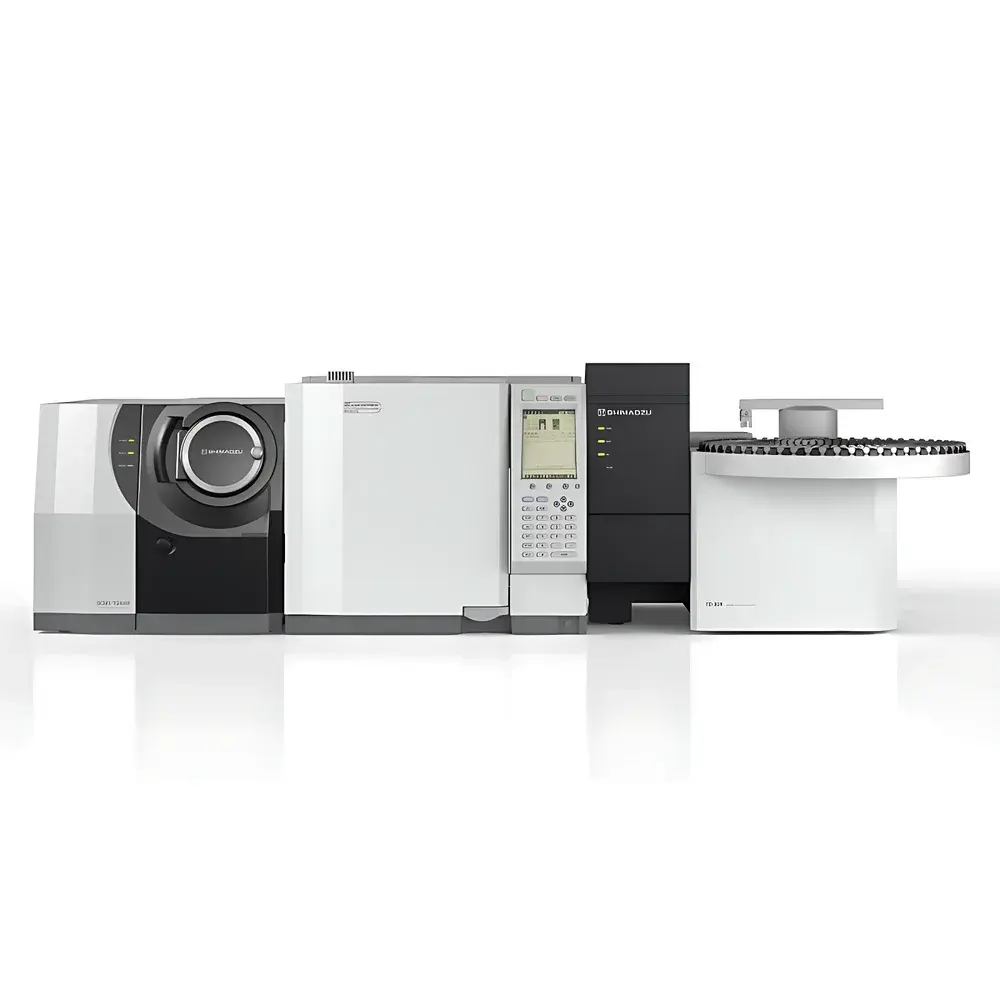
Shimadzu TD-30R Automated Thermal Desorption System
| Brand | Shimadzu |
|---|---|
| Origin | Japan |
| Manufacturer | Shimadzu Corporation |
| Type | Imported Instrument |
| Model | TD-30R |
| Instrument Category | Dual-Stage Thermal Desorber |
| Desorption Temperature Range | (Ambient + 15)°C to 430°C |
| Cold Trap Temperature | −40°C |
| Desorption Recovery Rate | >90% |
| Sample Capacity | 120 positions |
Overview
The Shimadzu TD-30R Automated Thermal Desorption System is a dual-stage, fully automated sample introduction platform engineered for quantitative trace volatile and semi-volatile organic compound (VOC/SVOC) analysis by gas chromatography (GC) or gas chromatography–mass spectrometry (GC–MS). It operates on the principle of controlled thermal desorption: analytes pre-concentrated onto sorbent-packed tubes are sequentially heated—first in the primary desorption stage (tube oven), then refocused in a cryogen-free cold trap—and finally injected as a narrow, solvent-free band into the GC inlet. This two-step thermal transfer ensures high sensitivity, minimal band broadening, and exceptional reproducibility—critical for compliance-driven applications such as EPA TO-17, ISO 16017-1, and ASTM D6196. Designed and manufactured in Kyoto, Japan, the TD-30R integrates Shimadzu’s legacy in analytical instrumentation with modern automation architecture, delivering robust performance across environmental monitoring, indoor air quality assessment, automotive cabin testing, food aroma profiling, polymer off-gassing evaluation, and fragrance chemistry research.
Key Features
- 120-position autosampler with overlapping analysis capability: Enables unattended batch processing while minimizing instrument idle time; one sample undergoes secondary desorption while the next is being thermally conditioned.
- Dual-stage thermal desorption without liquid cryogens: Integrated Peltier-cooled cold trap achieves −40°C operation, eliminating reliance on liquid nitrogen or dry ice and reducing operational complexity and cost-of-ownership.
- Optimized thermal transfer path: Ultra-short, fully heated transfer line (no cold spots) with rapid temperature ramping ensures quantitative transfer of compounds ranging from highly volatile C2 hydrocarbons to refractory SVOCs up to ~400°C boiling point.
- Electronic flow control (EFC) and pressure management: Precise carrier gas flow regulation across all stages, coupled with real-time pressure monitoring and automatic overpressure release, enhances system stability and tube integrity during desorption.
- Integrated sample backup function: Automatically transfers a portion of the original sample to a secondary tube prior to primary desorption—enabling re-analysis, method validation, or regulatory audit support.
- Comprehensive system diagnostics: Real-time leak detection, temperature/flow logging, and optional barcode scanning provide full traceability aligned with GLP and 21 CFR Part 11 data integrity requirements.
Sample Compatibility & Compliance
The TD-30R accepts standard 1/4-inch OD × 3.5-inch (6.35 mm × 89 mm) sorbent tubes—including multi-bed configurations (e.g., Tenax TA/Carbograph 1TD/Carboxen 1000)—and supports both single- and dual-tube modes. Its design conforms to international standards governing VOC analysis workflows, including but not limited to EPA Method TO-17 (Determination of Volatile Organic Compounds in Ambient Air Using Active Sampling Onto Sorbent Tubes), ISO 16017-1 (Indoor, ambient and workplace air — Sampling and analysis of volatile organic compounds by sorbent tube/thermal desorption/capillary gas chromatography), and ASTM D6196 (Standard Practice for Selecting Generic Sampling and Analysis Methods for Volatile Organic Compounds). All firmware and software modules support audit trails, electronic signatures, and user-access-level controls required under GxP and ISO/IEC 17025 laboratory accreditation frameworks.
Software & Data Management
Controlled via Shimadzu’s GC/LCMSsolution-based Thermal Desorption Module, the TD-30R offers intuitive method setup, real-time status monitoring, and synchronized data acquisition with connected GC or GC–MS systems. The software provides full parameter logging—including desorption temperatures, trap cooling profiles, flow rates, and leak test results—with timestamped records stored in encrypted binary format. Optional features include automatic internal standard spiking (via integrated gas-dilution module), barcode-driven sample tracking, and export-compatible report generation (PDF, CSV, XML) for LIMS integration. All data handling complies with FDA 21 CFR Part 11 requirements when configured with appropriate user authentication, audit trail activation, and electronic signature enforcement.
Applications
- Environmental laboratories performing ambient and stack emission monitoring per regulatory mandates
- Indoor air quality (IAQ) testing in commercial buildings, schools, and healthcare facilities
- VOC emissions profiling from automotive interior materials (e.g., dashboards, seat fabrics, adhesives)
- Residual solvent analysis in pharmaceutical excipients and packaging materials
- Aroma and flavor compound identification in beverages, dairy products, and essential oils
- Off-gassing characterization of polymers, composites, and 3D-printed resins
FAQ
Does the TD-30R require liquid nitrogen or other cryogenic coolants?
No. It utilizes a solid-state Peltier cooling system capable of maintaining the cold trap at −40°C without external cryogens.
Can the system perform both single- and dual-stage desorption in the same run?
Yes. The TD-30R automatically executes primary desorption, cold-trap focusing, and secondary flash desorption in a fully synchronized sequence.
Is the instrument compatible with third-party GC or GC–MS systems?
Yes. It features standardized GC interface hardware and supports common communication protocols (Ethernet, RS-232) for seamless integration with non-Shimadzu platforms.
What sample tube specifications are supported?
Standard 1/4-inch OD × 3.5-inch (6.35 mm × 89 mm) stainless steel or glass sorbent tubes; no proprietary tube formats required.
How is data integrity ensured for regulated environments?
Through configurable audit trails, role-based access control, electronic signatures, and immutable raw data storage—all compliant with 21 CFR Part 11 and ISO/IEC 17025 documentation requirements.





