
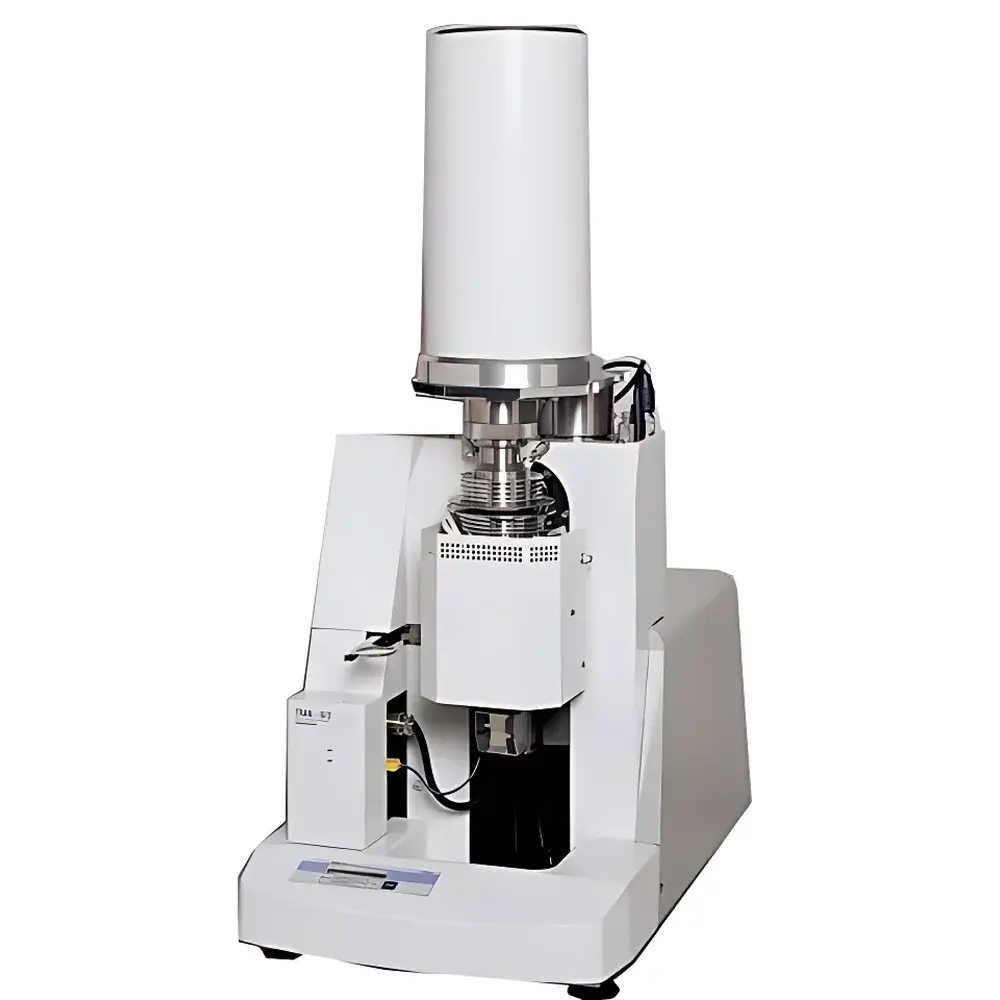
Shimadzu TMA-60/60H Thermomechanical Analyzer
| Brand | Shimadzu |
|---|---|
| Origin | Japan |
| Manufacturer Type | Original Equipment Manufacturer (OEM) |
| Import Status | Imported |
| Model | TMA-60/60H |
| Temperature Range | Ambient to 1000 °C / 1500 °C (optional cryo stage down to −150 °C) |
| Displacement Range | ±5 mm |
| Load Range | ±5 N |
| Sample Dimensions | Ø8 mm × 20 mm (cylindrical) or 5 mm (W) × 1 mm (T) × 20 mm (L) (rectangular) |
Overview
The Shimadzu TMA-60/60H Thermomechanical Analyzer is a high-precision, dual-mode thermal expansion and mechanical deformation measurement system engineered for rigorous materials characterization under controlled temperature conditions. Based on the fundamental principle of thermomechanical analysis—measuring dimensional changes (expansion, contraction, softening, creep, or stress relaxation) of solid or semi-crystalline samples as a function of temperature, time, and applied load—the TMA-60/60H delivers traceable, reproducible data essential for polymer development, ceramic sintering studies, composite interface evaluation, and pharmaceutical solid-state stability assessment. Its modular architecture supports both static (isothermal or dynamic ramp) and dynamic (modulated or oscillatory) loading configurations, enabling simultaneous acquisition of coefficient of linear expansion (CLTE), glass transition temperature (Tg), softening point, and viscoelastic compliance. The instrument operates across an industry-leading thermal range—from cryogenic conditions (−150 °C with optional liquid nitrogen cooling unit) up to 1500 °C (with high-temperature furnace and ceramic probe assembly)—making it suitable for advanced refractory, metallurgical, and aerospace-grade material qualification.
Key Features
- High-resolution digital displacement sensor with ±5 mm full-scale range and sub-micrometer resolution, ensuring accurate detection of nanoscale dimensional shifts in thin films, fibers, and brittle ceramics.
- Dual-load capability: programmable force application from −5 N (compression) to +5 N (tension), supporting both free-expansion and constrained-expansion modes per ASTM E831 and ISO 11359-2.
- Modular furnace design with rapid heating/cooling rates (up to 100 °C/min standard; customizable), coupled with precise PID temperature control (±0.1 °C stability at isothermal holds).
- Interchangeable probe systems—including quartz, alumina, and tungsten carbide tips—optimized for specific sample classes (e.g., low-stiffness polymers vs. high-modulus composites).
- Integrated inert gas purging (N2, Ar, He) with mass flow control to prevent oxidation or decomposition during high-temperature measurements.
- Robust mechanical architecture with vibration-damped optical baseplate and electromagnetic force compensation, minimizing environmental noise interference in long-duration creep experiments.
Sample Compatibility & Compliance
The TMA-60/60H accommodates diverse geometries: cylindrical specimens up to Ø8 mm × 20 mm, or rectangular strips measuring 5 mm (width) × 1 mm (thickness) × 20 mm (length). It supports rigid solids, elastomers, thermosets, glasses, sintered powders, and thin-film coatings—provided mechanical integrity is maintained within the load and thermal envelope. Data acquisition complies with GLP/GMP documentation requirements through timestamped, user-auditable measurement logs. Software export formats (CSV, ASCII, XML) are compatible with LIMS integration and satisfy FDA 21 CFR Part 11 electronic record and signature criteria when deployed with validated Shimadzu LabSolutions TMA software and access-controlled user accounts.
Software & Data Management
Controlled via Shimadzu LabSolutions TMA v2.x, the system provides intuitive method setup, real-time thermal–mechanical overlay visualization, and automated baseline correction algorithms. Key functions include multi-step temperature programs (ramp–hold–ramp), load modulation scheduling, derivative analysis (dL/dT), and CLTE calculation with reference standard calibration (e.g., fused silica, Invar). All raw and processed data are stored in a relational database with full audit trail—recording operator ID, instrument configuration, calibration history, and environmental parameters (ambient temperature, purge gas flow rate). Export options support direct import into MATLAB, OriginLab, or JMP for advanced statistical modeling and DOE-based thermal reliability forecasting.
Applications
- Thermal expansion profiling of polymer encapsulants in semiconductor packaging to predict delamination risk under thermal cycling.
- Quantification of sintering shrinkage kinetics in oxide and nitride ceramics for process optimization.
- Evaluation of dimensional stability in carbon-fiber-reinforced polymer (CFRP) laminates used in aircraft primary structures.
- Characterization of phase-transition-induced strain in shape-memory alloys (NiTi) across reversible martensitic transformation windows.
- Assessment of tablet coating integrity and excipient crystallinity shifts during accelerated stability testing (ICH Q1A–Q5E).
- Creep compliance mapping of high-performance thermoplastics (e.g., polyetherimide, PEEK) under sustained mechanical load at elevated service temperatures.
FAQ
What temperature accuracy and stability does the TMA-60/60H achieve across its operating range?
The system maintains ±0.5 °C accuracy from −150 °C to 600 °C, and ±1.0 °C from 600 °C to 1500 °C, verified per internal platinum resistance thermometer (PRT) calibration traceable to NIST standards.
Can the TMA-60/60H perform dynamic mechanical analysis (DMA) in addition to static TMA?
No—it is dedicated to thermomechanical expansion and creep/stress-relaxation measurement. For combined DMA/TMA functionality, Shimadzu recommends the DMS-6100 series with interchangeable modules.
Is ASTM E1135 or ISO 11359-1 compliance supported out-of-the-box?
Yes—preconfigured test methods, report templates, and uncertainty calculation modules align directly with these standards for coefficient of thermal expansion determination.
How is probe calibration performed, and how often is it required?
Calibration uses certified reference materials (e.g., NIST SRM 736) and is recommended before each high-accuracy campaign or after probe replacement; automated calibration routines are embedded in LabSolutions TMA.
Does the system support purge gas switching during a single experiment?
Yes—via optional multi-gas selector valve, enabling sequential N2/air/O2 environments within one thermal program to study oxidation-driven dimensional changes.



