
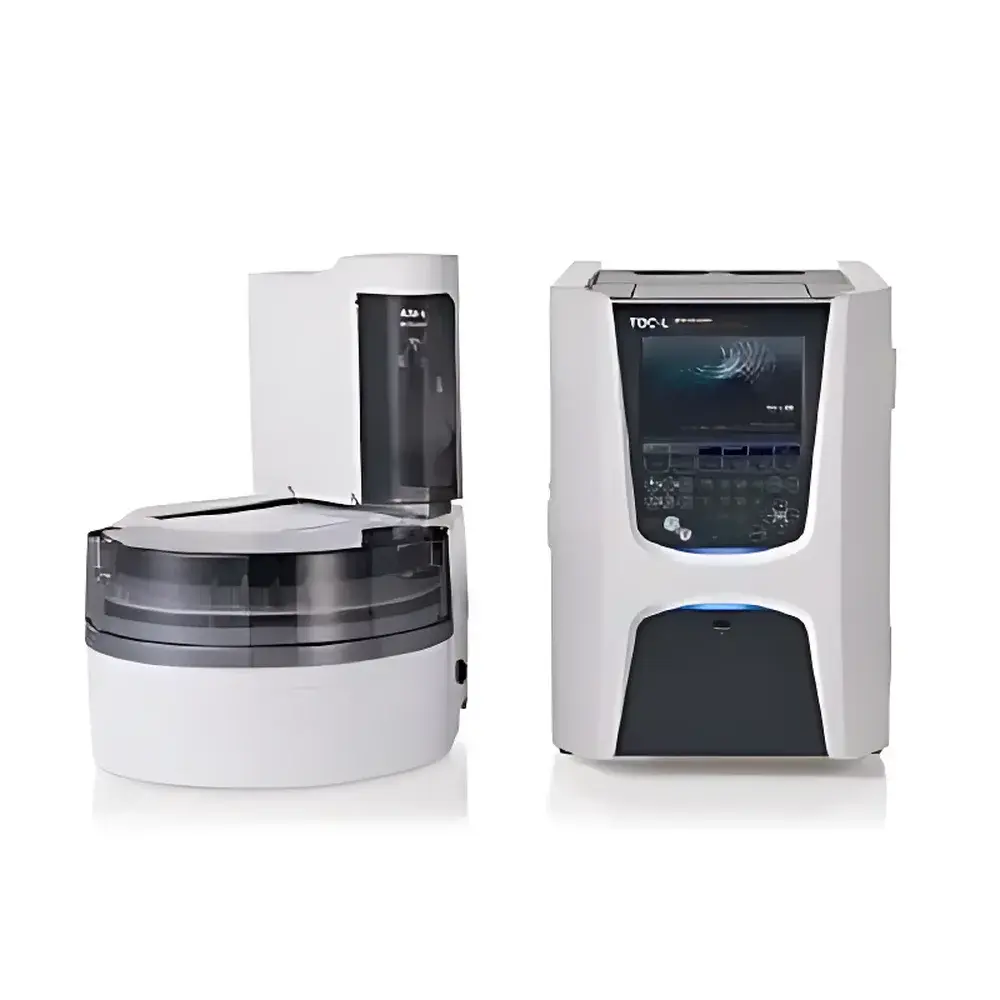
Shimadzu TOC-L Series Total Organic Carbon Analyzer
| Brand | Shimadzu |
|---|---|
| Origin | Japan |
| Manufacturer Type | Original Equipment Manufacturer (OEM) |
| Product Origin | Imported |
| Model | TOC-L |
| Instrument Type | Laboratory TOC Analyzer |
| Oxidation Method | High-Temperature Catalytic Combustion Oxidation (680 °C) |
| Measurement Range | 4 μg/L to 30,000 mg/L |
| Detection Principle | CO₂ quantification via Non-Dispersive Infrared (NDIR) detection after catalytic combustion |
| Power Savings | Up to 36% vs. prior generation (8 h/day, 5 days/week) |
| Footprint Reduction | Width reduced from ~440 mm to 340 mm |
Overview
The Shimadzu TOC-L Series Total Organic Carbon Analyzer is a laboratory-grade instrument engineered for precise, reliable, and regulatory-compliant quantification of total organic carbon in aqueous samples. It employs high-temperature catalytic combustion oxidation at 680 °C — a robust, universally accepted oxidation method that ensures complete mineralization of both soluble and insoluble organic compounds into carbon dioxide. The generated CO₂ is then measured using a high-stability non-dispersive infrared (NDIR) detector, delivering exceptional accuracy across an ultra-wide dynamic range of 4 μg/L to 30,000 mg/L. This range enables seamless analysis of ultrapure water (e.g., pharmaceutical process water per USP and EP 2.2.44), wastewater effluents, surface waters, and highly saline matrices such as seawater or brine — all within a single platform. The system’s design adheres to fundamental principles of trace carbon analytics: quantitative oxidation efficiency, minimal memory effect, low baseline drift, and high reproducibility — critical attributes for laboratories operating under ISO/IEC 17025, EPA Method 415.3, ASTM D7573, and pharmacopeial guidelines.
Key Features
- High-efficiency 680 °C catalytic combustion module with platinum-based catalyst, ensuring >99% oxidation efficiency for refractory and particulate-bound organics.
- Integrated NDIR detector with temperature- and pressure-compensated signal processing for long-term stability and sub-ppb-level sensitivity.
- Full-color high-resolution LCD touchscreen interface (800 × 480 pixels) supporting intuitive navigation, real-time chromatogram visualization, and on-device method editing.
- Flexible data output: direct USB printing support (no proprietary thermal printer required), USB mass storage for raw data export (CSV, PDF, XML), and optional Ethernet connectivity for networked lab integration.
- Energy-optimized architecture featuring adaptive standby mode, reducing average power consumption by up to 36% compared to previous-generation TOC-L systems under standard 40-hr/week operation.
- Compact footprint: 340 mm width (23% reduction) achieved via vertical integration of the TN (Total Nitrogen) unit above the main chassis — minimizing bench space without compromising service accessibility or thermal management.
Sample Compatibility & Compliance
The TOC-L series accommodates a broad spectrum of sample types including deionized water, purified water (PW), water for injection (WFI), municipal and industrial wastewater, groundwater, seawater, and high-salinity process streams. Optional accessories — such as the salt-tolerant combustion tube kit and low-volume injection module — extend operational capability to challenging matrices while maintaining calibration integrity. The system supports full audit-trail functionality compliant with FDA 21 CFR Part 11 when paired with Shimadzu LabSolutions software, enabling electronic signatures, user access control, and immutable data archiving. Routine performance verification aligns with USP , EP 2.2.44, and JP 17 standards, and method validation documentation is provided per ICH Q2(R2) requirements.
Software & Data Management
LabSolutions TOC software provides comprehensive instrument control, automated sequence execution, peak integration, calibration curve management, and customizable reporting templates. All raw chromatographic data, method parameters, operator logs, and QC results are timestamped and stored with cryptographic hash integrity. Audit trail records include user ID, action type (e.g., “calibration performed”, “data exported”), timestamp, and IP address (if network-enabled). Data export formats meet LIMS interoperability standards (ASTM E1467, HL7) and support automated transfer to enterprise quality management systems (QMS). Raw files retain native resolution for retrospective reprocessing without loss of fidelity.
Applications
- Pharmaceutical manufacturing: PW/WFI monitoring per Annex 1 and EU GMP Chapter 5; cleaning validation residue testing.
- Environmental laboratories: EPA-approved compliance testing for drinking water (Method 415.3), wastewater discharge permits (NPDES), and ambient water quality assessment.
- Power generation: Boiler feedwater and condensate purity assurance in thermal and nuclear facilities.
- Electronics industry: Ultrapure water certification for semiconductor wafer fabrication (SEMI F63).
- Academic and research labs: Kinetic studies of organic degradation, carbon flux analysis in biogeochemical cycles, and method development for emerging contaminants.
FAQ
What oxidation method does the TOC-L use, and why is it preferred for regulatory applications?
It uses high-temperature (680 °C) catalytic combustion oxidation, which achieves near-complete conversion of all organic carbon forms — including humic substances, colloids, and suspended solids — into CO₂. This method is mandated in EPA 415.3 and widely accepted in pharmacopeias due to its demonstrated robustness and minimal matrix interference.
Can the TOC-L analyze seawater or other high-salinity samples?
Yes — with the optional high-salt combustion tube and optimized rinse protocol, the system maintains accuracy and minimizes chloride-induced carryover, enabling routine analysis of seawater, brackish water, and desalination plant influents/effluents.
Is the TOC-L compliant with 21 CFR Part 11 for electronic records and signatures?
When operated with LabSolutions TOC v5.9 or later and configured with role-based user accounts, audit trail logging, and digital signature modules, the system meets all technical and procedural requirements for Part 11 compliance.
How is data backed up and archived?
Raw data, methods, and reports can be saved directly to USB drives in standardized formats (CSV, PDF/A-2, XML). Network-enabled units support scheduled backups to secure file servers or cloud-based repositories via SFTP or HTTPS protocols.
What maintenance intervals are recommended for routine operation?
Catalyst tube replacement is recommended every 12–18 months depending on sample load; NDIR detector zero calibration is performed automatically before each run; weekly system suitability checks (e.g., sucrose and 1,4-benzoquinone standards) are advised per USP .







