
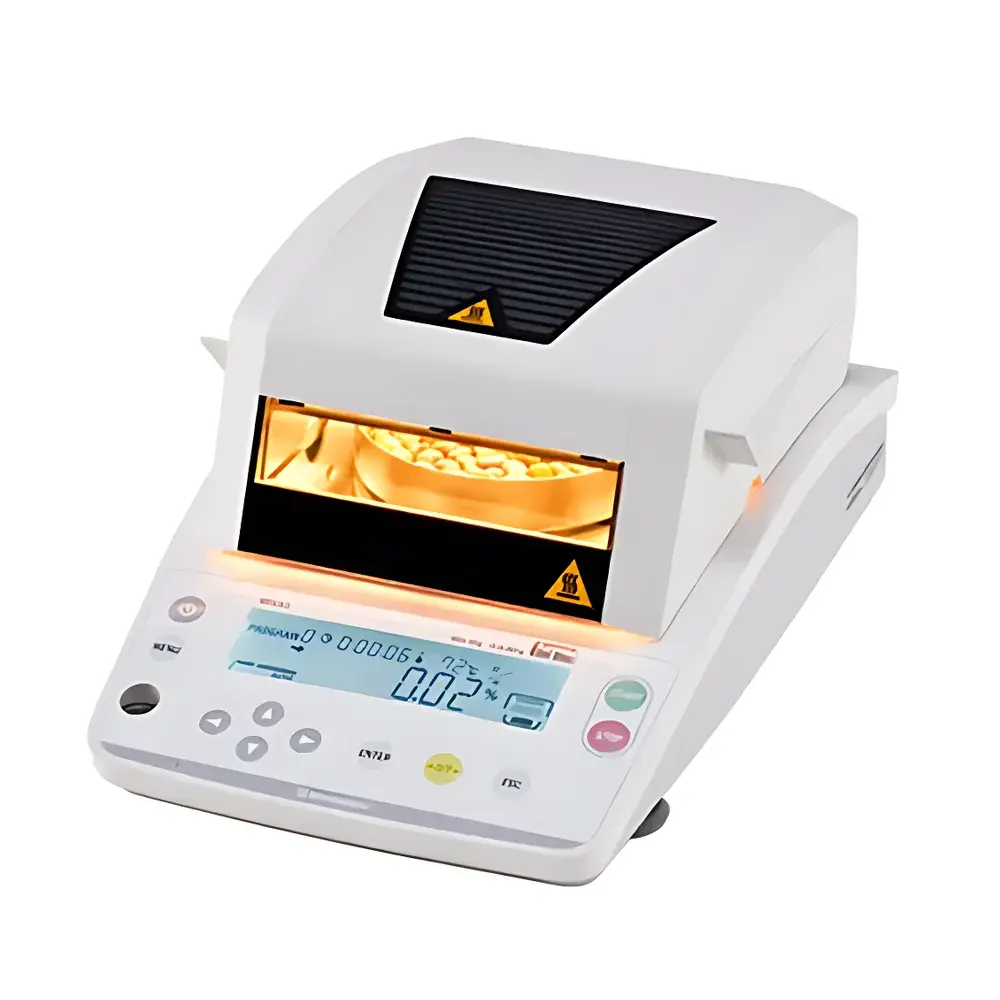
Shimadzu Unibloc MOC63U Infrared Moisture Analyzer
| Brand | Shimadzu |
|---|---|
| Model | Unibloc MOC63U |
| Heating Source | Halogen Lamp |
| Temperature Range | 50–200 °C |
| Minimum Sample Weight | 0.001 g |
| Display | Backlit LCD |
| Interfaces | RS-232C, USB, DATA I/O |
| Data Export | Direct to Microsoft Excel via Windows Pass-Through Window |
| Measurement Modes | Auto-Stop, Time-Stop, Standard/Fast/Slow/Step Drying |
| Dimensions (L) | 202 mm |
Overview
The Shimadzu Unibloc MOC63U Infrared Moisture Analyzer is a precision laboratory instrument engineered for rapid, reproducible quantification of moisture content in solid and semi-solid samples using halogen lamp-based thermogravimetric analysis. Unlike conventional moisture analyzers relying on quartz or ceramic heaters, the MOC63U integrates Shimadzu’s proprietary Unibloc monolithic sensor module — a thermally isolated, high-stability weighing system co-integrated with heating and temperature sensing elements. This architecture minimizes thermal drift and mechanical interference during dynamic mass loss monitoring, delivering high repeatability (<0.01% RSD for repeated measurements under controlled conditions) even across ambient temperature fluctuations. The device operates on the principle of loss-on-drying (LOD): sample mass is continuously recorded while subjected to controlled infrared heating; moisture content is calculated as the percentage mass loss relative to initial weight, following ASTM E1447, ISO 18894, and USP <921> guidelines for thermogravimetric moisture determination.
Key Features
- Unibloc Monolithic Sensor Architecture: A single-unit load cell and heater assembly eliminates inter-component thermal expansion mismatch, ensuring long-term calibration stability and minimal zero-point drift over extended operation cycles.
- Halogen Lamp Heating System: Provides uniform, controllable radiant heat with fast thermal response (typical ramp time to setpoint: <30 s), enabling precise drying profile execution without overshoot or localized charring.
- EASY Mode Automation: Initiates heating automatically upon lid closure — eliminating manual start commands and reducing operator-dependent variability in measurement timing and sequence initiation.
- Multi-Strategy Drying Control: Supports five configurable drying logic modes: Auto-Stop (terminates when mass change falls below user-defined threshold), Time-Stop (fixed duration), and three preset rate profiles (Standard, Fast, Slow) plus customizable Step-Drying sequences for complex matrices requiring staged thermal treatment.
- Windows Pass-Through Data Interface: Native integration with Microsoft Windows allows real-time, drag-and-drop export of raw mass/time data directly into Excel worksheets — bypassing proprietary software intermediaries and supporting immediate statistical analysis, charting, and GLP-compliant reporting workflows.
- Compact Industrial Design: Footprint-optimized housing (202 mm length) with integrated backlit LCD ensures clear readability under varied lab lighting; all interfaces — RS-232C, USB 2.0, and dedicated DATA I/O — are front-accessible for seamless peripheral connectivity.
Sample Compatibility & Compliance
The MOC63U accommodates a broad range of sample types including pharmaceutical powders (APIs, excipients), foodstuffs (grains, dairy powders, spices), polymers, ceramics, and chemical reagents. Its 0.001 g minimum weighable mass supports low-mass applications such as tablet coating analysis or catalyst moisture screening. The instrument complies with essential regulatory frameworks for quality-controlled environments: its data handling architecture supports audit trail generation per FDA 21 CFR Part 11 requirements when used with validated Excel templates; thermal performance aligns with ISO/IEC 17025 calibration traceability protocols; and routine operation satisfies GMP Annex 11 and EU GMP Chapter 4 documentation expectations for analytical instrumentation.
Software & Data Management
No standalone software installation is required. All measurement parameters — target temperature, drying mode, stop criteria, and sample ID — are configured via the onboard menu interface. Real-time mass vs. time curves are displayed during analysis, with final results (moisture %, dry weight %, mass loss curve timestamp) stored internally (up to 200 records). Data export occurs natively through the Windows Pass-Through function: users open Excel, position cursor in target cell, and press the instrument’s “Export” key — triggering direct ASCII-formatted data injection without macros or drivers. RS-232C and USB ports support connection to label printers (for GLP-compliant result labeling) or LIMS systems via standard serial-to-TCP/IP gateways. Optional Shimadzu LabSolutions Lite modules enable centralized instrument fleet monitoring and CSV batch export for enterprise-level data aggregation.
Applications
- Pharmaceutical QC: Moisture verification of hygroscopic active ingredients prior to tableting or lyophilization.
- Food Safety Testing: Rapid compliance checks against Codex Alimentarius moisture limits in flour, milk powder, and dried fruits.
- Materials Science: Quantifying residual solvent in polymer pellets or binder moisture in ceramic green bodies.
- Academic Research: Method development for LOD optimization in novel biomaterials or battery electrode coatings.
- Contract Laboratories: High-throughput sample processing with automated Excel logging for auditable client reports.
FAQ
Does the MOC63U require periodic recalibration with external weights?
Yes — daily zero calibration is recommended before first use; span calibration using certified test weights (e.g., 10 g Class M2) should be performed weekly or after relocation, per ISO 9001 internal calibration procedures.
Can the instrument store custom drying methods for different sample categories?
Yes — up to 10 user-defined methods can be saved, each with unique temperature, mode, and stop condition settings, accessible via numeric shortcut keys.
Is the halogen lamp replaceable by the end user?
Yes — lamp replacement requires no tools and takes <2 minutes; Shimadzu supplies OEM lamps with calibrated spectral output to maintain measurement consistency.
How does the Unibloc sensor mitigate convection-induced weighing errors?
By integrating the heater and load cell within a thermally symmetric monolithic block, air current effects from surface heating are minimized, and thermal mass stabilization reduces buoyancy-driven fluctuations during rapid mass loss phases.
Is USB connection compatible with Windows 11 and macOS?
USB functions as a virtual COM port — fully supported on Windows 7–11; macOS compatibility requires third-party terminal emulation software for raw data capture, though Excel export remains Windows-exclusive via Pass-Through.
Related Products





