
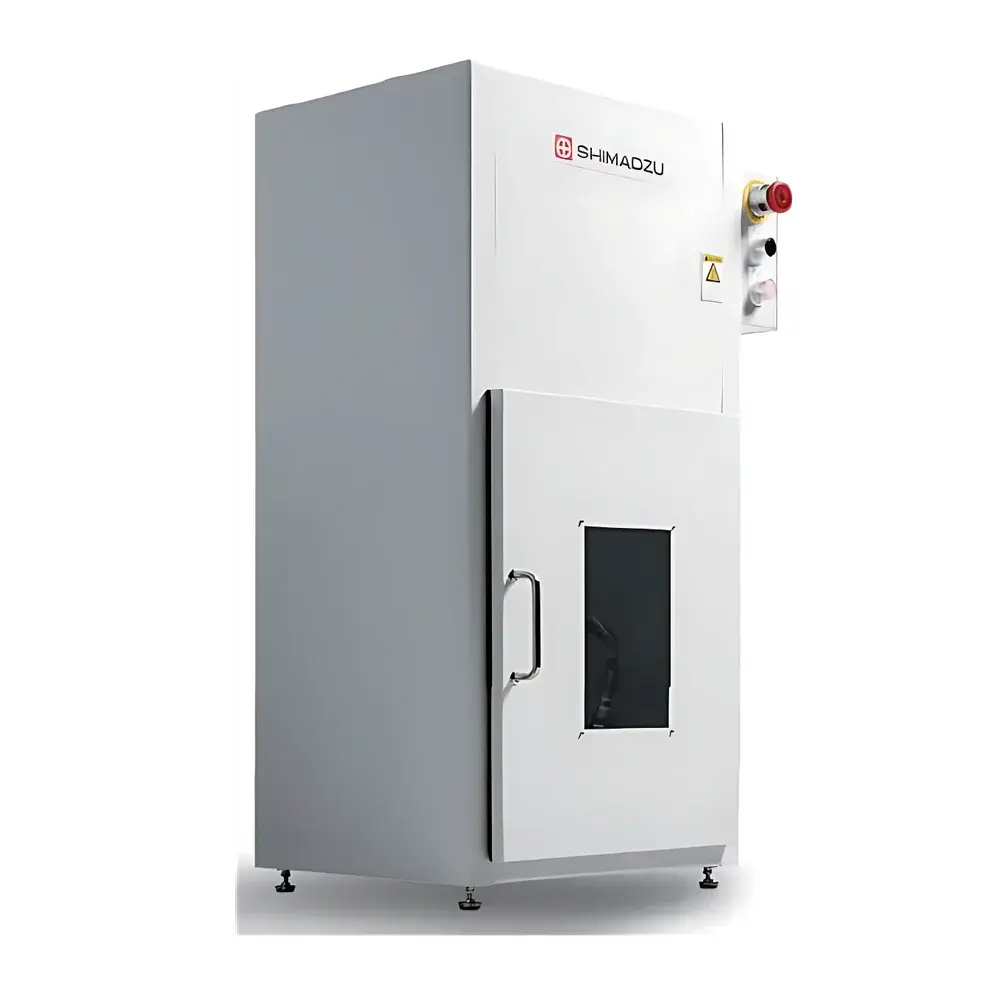
Shimadzu USF-2000A Ultrasonic Fatigue Testing System
| Brand | Shimadzu |
|---|---|
| Origin | Japan |
| Manufacturer Type | Original Equipment Manufacturer (OEM) |
| Product Origin | Imported |
| Model | USF-2000A |
| Pricing | Available Upon Request |
Overview
The Shimadzu USF-2000A Ultrasonic Fatigue Testing System is a high-frequency resonant fatigue testing instrument engineered for ultra-long-life fatigue evaluation of metallic materials under controlled cyclic loading. Operating on the principle of longitudinal ultrasonic resonance, the system utilizes piezoelectric transducers to generate a stable 20 kHz (±500 Hz) sinusoidal vibration waveform. This mechanical excitation is amplified via a tuned horn-resonator assembly and transmitted directly to the specimen, inducing high-cycle fatigue at accelerated rates while maintaining precise control over stress amplitude and mean stress conditions. Unlike conventional servo-hydraulic or electromagnetic fatigue testers operating at frequencies below 500 Hz, the USF-2000A enables fatigue testing in the 10⁷–10¹⁰ cycle regime—critical for assessing the “ultra-high-cycle fatigue” (UHCF) behavior observed in aerospace alloys, turbine discs, bearing steels, and other safety-critical structural components. Its resonant architecture ensures minimal energy dissipation, enabling sustained operation at stress amplitudes exceeding 1000 MPa with low power consumption—typically less than 1.5 kW during continuous duty.
Key Features
- Resonant frequency stability: Precisely maintained at 20 kHz ±500 Hz via closed-loop phase-locked feedback control, ensuring consistent test conditions across extended durations.
- Amplitude controllability: Specimen end-face displacement amplitude adjustable from ±5 μm (at 10% amplifier output) to ±50 μm (at 100% output), calibrated in real time using integrated non-contact displacement sensors.
- Load ratio control: Capable of generating fully reversed loading (R = –1), defined as σmin/σmax = –1, with zero-mean stress condition enforced through symmetric waveform generation and mechanical boundary design.
- Stress calculation methodology: Nominal stress amplitude derived from measured displacement amplitude, specimen geometry (cross-section, length, boundary conditions), and material elastic modulus—fully traceable per ASTM E466 and ISO 1099 guidelines.
- Integrated PC-based control: All test parameters—including frequency tuning, amplitude setpoint, run duration, and data logging intervals—are configured and monitored via Shimadzu’s proprietary FatigueTest software running on Windows OS.
- Compact benchtop footprint: Designed for laboratory integration without dedicated foundation requirements; includes built-in cooling circuit and acoustic shielding compliant with ISO 7779 noise emission standards.
Sample Compatibility & Compliance
The USF-2000A accommodates cylindrical or dog-bone specimens with standardized geometries per ASTM E2714, ISO 12106, and JIS Z 2274. Typical specimen lengths range from 30 mm to 80 mm, with gauge diameters between 3 mm and 10 mm. The clamping interface employs threaded fixation at the resonator base, allowing rapid specimen exchange and reproducible boundary conditions. The system supports both polished and as-machined surface conditions, facilitating studies on surface defect sensitivity—including inclusion-initiated crack nucleation in high-strength steels. It conforms to GLP-compliant data integrity requirements: audit trails, electronic signatures, and 21 CFR Part 11–ready configuration are available upon software licensing. Calibration certificates traceable to NMIJ (National Metrology Institute of Japan) are provided with each unit shipment.
Software & Data Management
FatigueTest software provides synchronized acquisition of displacement amplitude, resonance frequency drift, temperature at critical nodes, and real-time stress estimation. Data export supports CSV, MATLAB (.mat), and universal HDF5 formats for post-processing in third-party analysis environments. Automated test sequencing enables unattended execution of multi-step protocols—including stepwise amplitude ramping, hold-time insertion, and conditional termination based on frequency shift thresholds (>0.1% deviation triggers alarm). Raw waveform data (16-bit resolution, 1 MS/s sampling) is archived alongside metadata (operator ID, environmental conditions, calibration status), satisfying ISO/IEC 17025 documentation requirements for accredited testing laboratories.
Applications
- Determination of fatigue limits beyond 10⁹ cycles in Ti-6Al-4V, Inconel 718, and case-hardened steels used in gas turbine blades and landing gear.
- Quantification of microstructure-sensitive fatigue thresholds influenced by non-metallic inclusions, porosity, or surface roughness.
- Validation of physics-based UHCF life prediction models requiring experimental data at ≥10⁸ cycles.
- Accelerated qualification testing of additive-manufactured metal parts where process-induced defects dominate failure initiation.
- Interlaboratory round-robin studies coordinated under ASTM Committee E08 on Fatigue and Fracture.
FAQ
What is the maximum achievable stress amplitude with the USF-2000A?
Stress amplitude depends on specimen geometry and material properties; for standard 6-mm-diameter steel specimens, nominal stresses up to 1200 MPa have been routinely achieved under R = –1 conditions.
Can the system perform tests at load ratios other than R = –1?
No—the mechanical resonance design inherently enforces zero-mean loading; alternative R-ratios require external bias mechanisms not supported by this platform.
Is specimen heating during prolonged testing monitored and compensated?
Yes: an embedded thermocouple at the specimen gauge section feeds real-time temperature data to the control loop; automatic amplitude reduction is triggered if ΔT exceeds 15°C to prevent thermal softening artifacts.
Does the system comply with ISO 1099 for high-cycle fatigue testing?
Yes—the hardware architecture, calibration protocol, and software validation package are aligned with ISO 1099:2017 Annex A for ultrasonic fatigue testing systems.
What maintenance intervals are recommended for long-term reliability?
Piezoelectric stack inspection and horn surface reconditioning are advised every 2000 operational hours; full system recalibration is required annually or after any mechanical impact event.



