
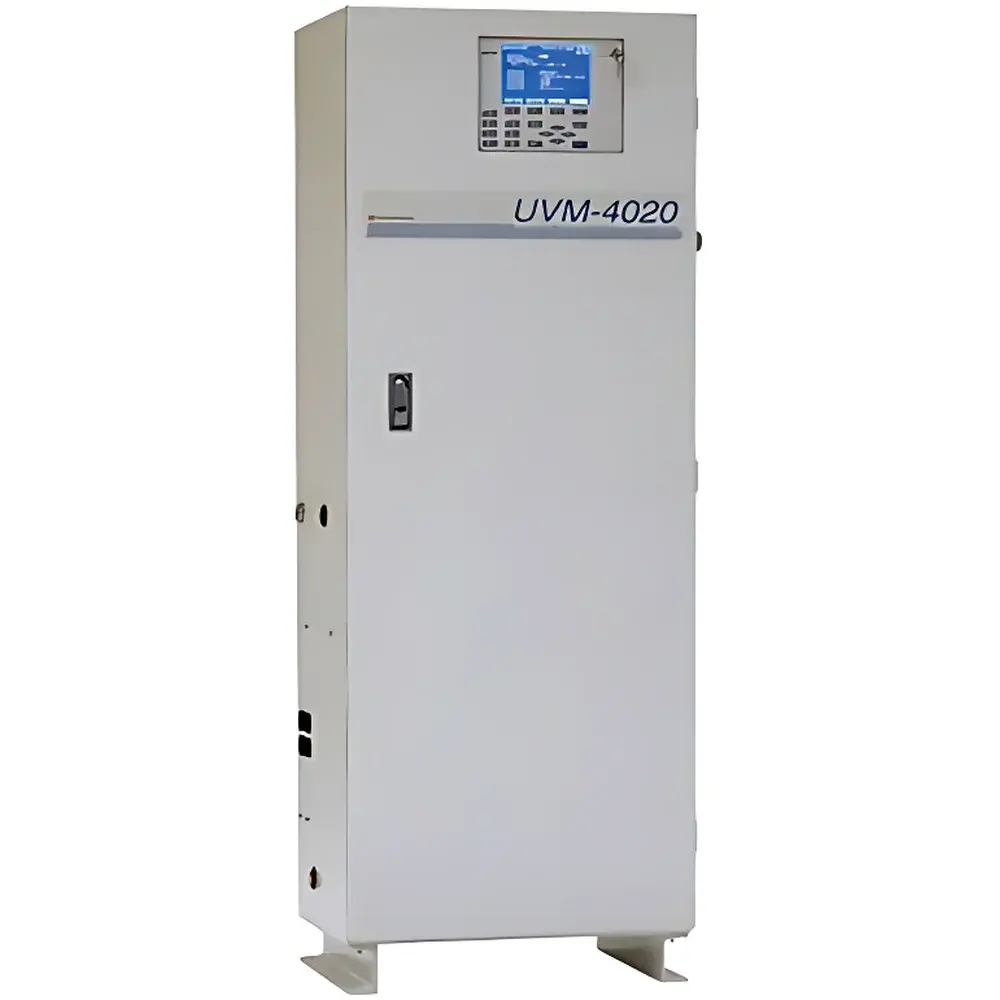
Shimadzu UVM-4020 Online UV Absorption-based COD Analyzer
| Brand | Shimadzu |
|---|---|
| Origin | Jiangsu, China |
| Manufacturer Type | Direct Manufacturer |
| Product Origin | Domestic (China) |
| Model | UVM-4020 |
| Instrument Type | Online Analyzer |
| Measurement Principle | Weighted Multi-Wavelength Ultraviolet Absorption Spectrophotometry (243 nm, 254 nm, 265 nm, 275 nm, 290 nm) |
| Calibration | Automatic zero/span calibration with standard solutions (optional) |
| Measurement Ranges | 0–400 SAC, 0–200 SAC, 0–80 SAC |
| Cycle Time | 1 min (minimum), adjustable from 10 to 720 min |
| Output Parameters | COD, BOD, TOC, SAC |
| Preloaded Conversion Formulas | 30 built-in empirical equations |
| Auto-Cleaning Interval | User-configurable timer-based internal tubing flush |
| Power Supply | 220 V ±10 V, 50/60 Hz, ~100 VA |
| Operating Environment | 5–40 °C, ≤90% RH (non-condensing, non-freezing) |
| Sample Flow Rate | 1–2 L/min |
| Max. Sample Pressure | ≤50 kPa |
| Installation | Indoor only |
Overview
The Shimadzu UVM-4020 Online UV Absorption-based COD Analyzer is an industrial-grade, real-time water quality monitoring system engineered for continuous measurement of organic load in aqueous matrices without chemical reagents. It operates on the principle of weighted multi-wavelength ultraviolet absorption (WMW-UV), simultaneously acquiring absorbance data at five discrete wavelengths—243 nm, 254 nm, 265 nm, 275 nm, and 290 nm—to resolve spectral interference from turbidity, nitrate, humic substances, and aromatic compounds commonly present in complex wastewater streams. Unlike conventional single-wavelength UV254 instruments, the UVM-4020 applies empirically validated weighting coefficients to each channel, enabling robust quantification of specific organic carbon fractions correlated with Chemical Oxygen Demand (COD). This physics-based optical approach eliminates reliance on hazardous oxidants (e.g., potassium dichromate), avoids electrode fouling or catalyst degradation, and delivers stable baseline performance over extended unattended operation—making it suitable for regulatory-compliant, long-term deployment in effluent discharge points, drinking water intakes, and process water loops.
Key Features
- Multi-wavelength UV photometric detection (243/254/265/275/290 nm) with temperature-compensated LED light sources and high-stability photodiodes
- Real-time, reagent-free COD estimation via 30 preloaded, application-specific conversion algorithms—including separate models calibrated for municipal influent, refinery wastewater, textile dye effluent, and surface water
- Configurable measurement cycle from 1 minute (for rapid process feedback) to 12 hours (for low-drift environmental surveillance)
- Automated zero- and span-calibration capability using user-supplied standard solutions; optional integration with external calibration station
- Programmable auto-cleaning sequence that flushes optical flow cell and sample tubing at user-defined intervals to minimize biofilm accumulation and particulate deposition
- Integrated SAC (Spectral Absorption Coefficient) output with selectable range (0–80, 0–200, or 0–400 SAC units), traceable to NIST-traceable UV reference standards
- Modular design compliant with IP54 enclosure rating for indoor control room installation; no external venting or waste handling required
Sample Compatibility & Compliance
The UVM-4020 is validated for direct analysis of raw and treated waters across diverse matrices: potable source water, river/lake surface water, municipal wastewater (influent and effluent), petroleum refinery effluents, saline industrial discharges (up to 20 g/L TDS), and dyehouse wastewater containing residual azo dyes. It meets functional equivalency requirements outlined in ISO 15705:2002 (Water quality — Determination of COD — Spectrophotometric method) when paired with site-specific validation protocols. While not a replacement for laboratory-standard dichromate reflux (ISO 6060), its output supports trend analysis, early-warning detection, and mass balance verification under EPA Method 410.4 (UV Absorbance as a Surrogate for Organic Load) and China’s HJ 353–2019 technical specification for online water quality monitoring systems. Data integrity conforms to GLP-aligned audit trail logging, with time-stamped events for calibration, cleaning, range switching, and alarm conditions.
Software & Data Management
The embedded firmware supports Modbus TCP and RS-485 (Modbus RTU) communication protocols for seamless integration into SCADA, DCS, or cloud-based IoT platforms. All measurements, diagnostic logs, and maintenance timestamps are stored locally on a non-volatile SD card (8 GB included) with configurable retention policies (default: 90 days). Remote configuration and firmware updates are supported via secure HTTPS interface. The instrument generates standardized CSV exports containing timestamp, raw absorbance values per wavelength, calculated SAC, and derived parameters (COD, BOD, TOC) with uncertainty flags. Optional Shimadzu LabSolutions Environmental Suite provides advanced multivariate regression modeling tools for local algorithm development and performance validation against reference lab data—fully compatible with FDA 21 CFR Part 11 requirements when deployed with electronic signature and role-based access controls.
Applications
- Municipal Water Utilities: Continuous monitoring of raw water intake for algal bloom early warning; real-time assessment of coagulation efficiency at treatment plants; compliance reporting at wastewater discharge outfalls
- Industrial Effluent Control: Process optimization in petrochemical refineries (e.g., monitoring biodegradability shifts in sour water strippers); regulatory compliance tracking in textile mills with variable dye chemistry
- Environmental Agencies: Long-term trend analysis of organic pollution in rivers and reservoirs; integration into national water quality information systems (e.g., China’s National Surface Water Monitoring Network)
- Research & Education: High-frequency kinetic studies of advanced oxidation processes (AOPs); validation of QSAR models linking UV spectral signatures to biodegradation potential
- Smart Infrastructure: Edge-enabled deployment in distributed sensor networks where power autonomy, chemical-free operation, and low maintenance are critical design constraints
FAQ
Does the UVM-4020 require daily manual intervention or reagent replenishment?
No. It operates fully autonomously with no consumables beyond periodic replacement of the quartz flow cell (recommended every 24 months under typical municipal use) and optional calibration standards.
Can the instrument differentiate between biodegradable and recalcitrant organic fractions?
Not directly. However, its multi-wavelength response enables empirical discrimination—e.g., elevated 243/290 nm ratio often correlates with low-molecular-weight carboxylic acids, while dominant 254 nm absorption suggests aromaticity—supporting semi-quantitative process diagnostics.
Is factory calibration sufficient for regulatory reporting?
Factory calibration establishes baseline accuracy. For compliance applications, users must perform site-specific correlation studies per ISO/IEC 17025 guidelines and document traceability to certified reference materials.
How does turbidity affect measurement reliability?
The WMW algorithm inherently corrects for scattering-induced attenuation through cross-wavelength compensation; validation data show <±5% deviation up to 100 NTU in representative wastewater samples.
What cybersecurity measures are implemented in the embedded OS?
Firmware includes TLS 1.2 encryption for remote access, disabled default credentials, configurable password policies, and automatic session timeout—aligned with IEC 62443-3-3 SL1 requirements for industrial control devices.







