
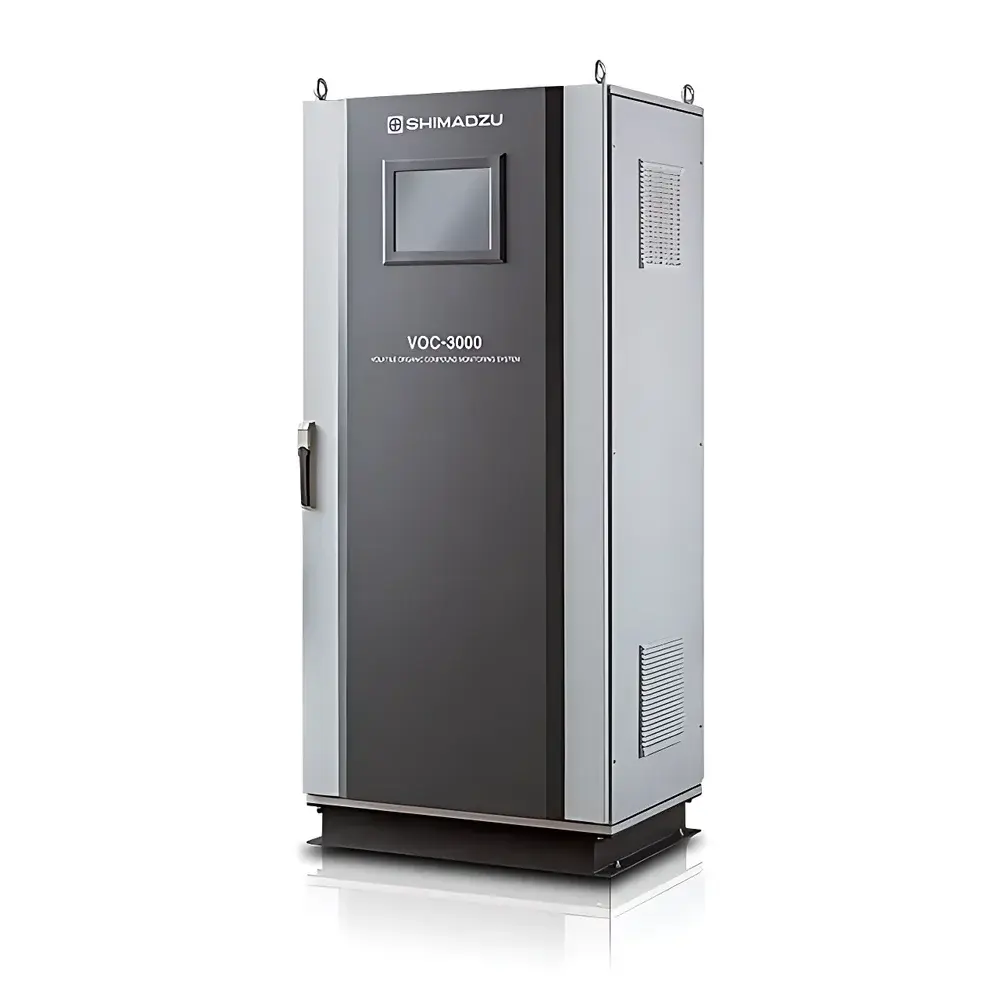
Shimadzu VOC-3000 Online Volatile Organic Compounds (VOCs) Monitoring System
| Brand | Shimadzu |
|---|---|
| Origin | Jiangsu, China |
| Manufacturer Type | Manufacturer |
| Product Category | Domestic |
| Model | VOC-3000 |
| Detection Principle | Photoionization Detection (PID) for TVOC |
| Instrument Type | Online Analyzer |
| Typical Configuration | Integrated Multi-Parameter VOC Monitoring System |
| Measurement Range | 0–50 ppm (TVOC and individual components) |
| TVOC Repeatability | ≤3% |
| TVOC Zero Drift | ≤5% F.S./4 h |
| TVOC Span Drift | ≤5% F.S./4 h |
| Speciated VOC Quantification Repeatability | ≤3% |
| Speciated VOC Zero/Span Drift | ≤5% F.S./4 h |
| Power Supply | 220 VAC, 50 Hz, 2000 W (excluding heated sampling line) |
| Dimensions (Analyzer) | 853 × 639 × 1874 mm |
| Weight (Analyzer) | ~270 kg |
| Operating Temperature | 5–40 °C |
| Relative Humidity | ≤80% RH |
| Sampling Probe Length | 500–2000 mm (customizable) |
| Temperature Range (Temp-Pressure-Flow Sensor) | 0–300 °C |
| Pressure Range | −10 to +10 kPa |
| Flow Velocity Range | 0–30 m/s |
Overview
The Shimadzu VOC-3000 Online Volatile Organic Compounds (VOCs) Monitoring System is an integrated, continuous emission monitoring solution engineered for regulatory compliance and process optimization in industrial stack and duct applications. It employs dual-mode detection architecture: real-time total volatile organic compound (TVOC) quantification via high-sensitivity photoionization detection (PID), and time-resolved speciation of priority aromatic hydrocarbons—including benzene, toluene, ethylbenzene, and xylene isomers (o-, m-, p-xylene)—using gas chromatography coupled with PID (GC-PID). This hybrid approach satisfies both broad-spectrum screening and compound-specific reporting requirements mandated under national and regional air quality management frameworks. The system concurrently acquires auxiliary flue gas parameters—temperature, static pressure, and volumetric flow velocity—enabling dynamic calculation of mass emission rates (g/h or kg/day) in accordance with EPA Method 204, ISO 11843-4, and China’s HJ 1013–2018 standard for VOCs CEMS. Designed for unattended operation in demanding industrial environments, the VOC-3000 integrates heated sampling lines, Nafion-based moisture removal, and catalytic scrubbers to ensure measurement integrity across variable matrix conditions.
Key Features
- Dual-detection architecture: Simultaneous TVOC monitoring (PID) and automated GC-PID speciation triggered by user-defined concentration thresholds or fixed time intervals (e.g., hourly, daily)
- Real-time mass emission calculation: Integrated temperature/pressure/flow sensor suite enables stoichiometric conversion of volumetric concentrations to mass-based emission rates per regulatory reporting formats
- Industrial-grade human-machine interface: 10.1-inch high-brightness LCD display provides at-a-glance visualization of TVOC concentration, chromatographic peak profiles, component-specific concentrations, and cumulative hourly/daily/monthly emission totals
- Robust environmental adaptation: Enclosure rated IP54; operational range 5–40 °C ambient, ≤80% RH non-condensing; heated sampling probe (up to 2000 mm customizable length) and insulated transport line (40 W/m) prevent condensation and adsorption losses
- Secure remote access: Embedded web server supports HTTPS-enabled browser-based monitoring from PCs, tablets, and smartphones; data export compliant with MODBUS TCP and OPC UA protocols for SCADA integration
- Self-diagnostic capability: Automated zero/span verification, detector response validation, and chromatographic retention time stability tracking with event logging aligned to ISO/IEC 17025 traceability requirements
Sample Compatibility & Compliance
The VOC-3000 is validated for continuous analysis of hot, humid, and particulate-laden exhaust streams from petroleum refining, chemical synthesis, coating application, pharmaceutical manufacturing, and printed circuit board production. Its GC-PID module resolves C6–C10 aromatic compounds in complex matrices without interference from aliphatic hydrocarbons or oxygenated VOCs (e.g., acetone, ethanol), leveraging selective ionization energy (10.6 eV lamp) and optimized column thermal programming. The system meets China’s HJ 1013–2018 technical specification for VOCs online monitoring systems and aligns with EU Directive 2010/75/EU (IED) Annex VI monitoring performance criteria. All firmware and data handling routines support audit-ready electronic records, including timestamped calibration logs, maintenance alerts, and raw chromatogram archives—fully compatible with GLP/GMP data integrity expectations and 21 CFR Part 11 electronic signature readiness when deployed with validated IT infrastructure.
Software & Data Management
Shimadzu’s VOC-Manager™ software provides centralized configuration, diagnostics, and reporting. It features configurable alarm thresholds (TVOC exceedance, flow deviation, detector saturation), automated report generation in PDF/CSV formats compliant with local environmental bureau templates (e.g., MEP Form 12-2), and bidirectional communication with provincial environmental monitoring platforms via MQTT or HTTP POST. Raw chromatograms and quantitative results are stored with SHA-256 hash integrity verification; database retention supports ≥18 months of high-frequency (1-min interval) data with automatic rollover and compression. Audit trails record all user actions—including method changes, calibration events, and data exports—with immutable timestamps and operator ID linkage. Optional cloud synchronization enables multi-site fleet monitoring and predictive maintenance analytics using historical drift trends and component lifetime modeling.
Applications
- Regulatory compliance monitoring for VOCs emission permits under China’s “Three-Year Action Plan for Blue Sky Defense” and provincial VOCs charging schemes
- Source apportionment studies in petrochemical complexes using time-resolved speciation data to identify dominant emission contributors (e.g., storage tank breathing vs. reactor venting)
- Process optimization in automotive paint shops: correlating solvent composition shifts with drying oven exhaust profiles to minimize overspray and improve capture efficiency
- Leak detection and repair (LDAR) program support through rapid identification of fugitive sources during routine stack surveys
- Validation of abatement system performance (e.g., RTO, activated carbon adsorbers) via pre- and post-treatment concentration differentials and destruction efficiency calculations
- Environmental impact assessment (EIA) baseline and post-commissioning monitoring for new manufacturing facilities in electronics and synthetic leather sectors
FAQ
What VOC species does the GC-PID module specifically quantify?
The system is factory-calibrated for benzene, toluene, ethylbenzene, and the three xylene isomers (ortho-, meta-, para-), with optional extension to styrene, chlorobenzene, or other C6–C10 aromatics upon method validation.
Is the system certified for use in hazardous areas (e.g., Zone 1/2)?
The analyzer cabinet is non-explosion-proof; however, the heated sampling probe and associated cabling may be configured with ATEX/IECEx-certified components for installation in classified zones—subject to site-specific risk assessment and third-party certification.
How frequently must the GC column be replaced?
Under typical industrial exhaust conditions (≤50 ppm total organics, low particulate load), the fused-silica capillary column demonstrates ≥12 months of stable retention time and resolution; replacement intervals are tracked automatically and reported via VOC-Manager™.
Can the system interface with existing DCS or PLC networks?
Yes—native support for MODBUS TCP, PROFIBUS DP, and OPC UA ensures seamless integration into plant-wide automation architectures without requiring middleware gateways.
Does the system meet U.S. EPA Performance Specification 18 (PS-18) requirements?
While not formally PS-18 certified, its measurement uncertainty (<3% RSD), drift specifications (≤5% F.S./4 h), and speciation capability satisfy the technical equivalency benchmarks outlined in PS-18 Appendix B for GC-based VOC analyzers used in Title V permit applications.







