
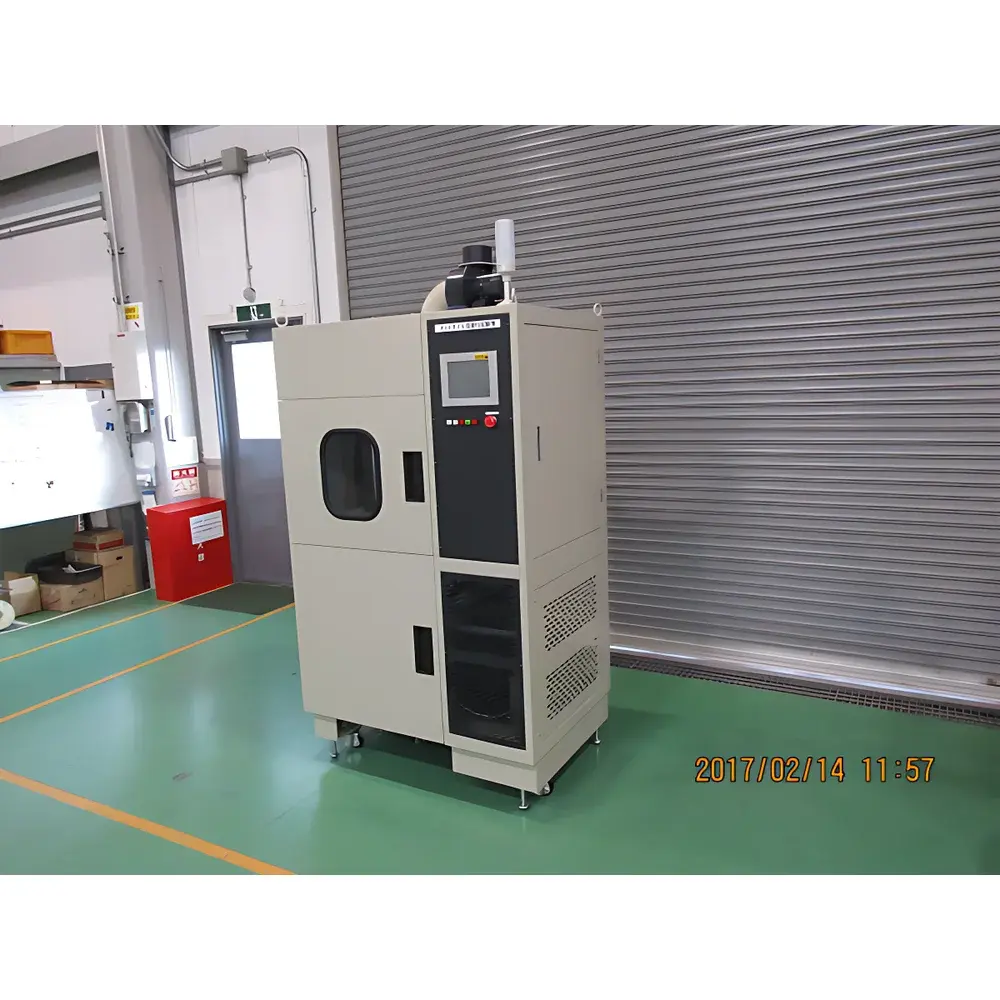
Shimokawa Hot Oil Test Machine PH-500D
| Key | Origin: Japan |
|---|---|
| Model | PH-500D / PH-500DW |
| Temperature Range (High-Temp Bath) | 50–260 °C |
| Temperature Range (Low-Temp Bath) | 10–25 °C |
| Temp. Uniformity (High-Temp Bath) | ±1 °C |
| Temp. Uniformity (Low-Temp Bath) | ±5 °C |
| Temp. Stability (High-Temp Bath) | ±1 °C |
| Temp. Stability (Low-Temp Bath) | ±2 °C |
| Heating Rate (High-Temp Bath) | ~50 min to reach max temp |
| Bath Dimensions (High-Temp) | 130 × 460 × 390 mm (W×D×H) |
| Bath Dimensions (Low-Temp) | 130 × 460 × 305/390 mm |
| Sample Max Size | 250 × 200 × 1.6 mm |
| Conductivity Measurement Channels | 1 or 2 (standard), up to 10 (optional) |
| Resistance Meter Ranges | 0–30 mΩ, 0–300 mΩ, 0–3 Ω, 0–30 Ω, 0–300 Ω |
| Refrigerant | R404A (ODP = 0) |
| Compressor Power | 600 W, air-cooled |
| Heating Power | 3 kW |
| Agitator Power (each bath) | 90 W, 4-blade impeller |
| Specimen Transfer Motor | 60 W (X/Y/Z motion) |
| Exhaust Port Diameter | Φ125 mm |
| Net Weight | 400 kg |
| Compliance | JIS C5012 (PCB thermal shock testing) |
Overview
The Shimokawa PH-500D Hot Oil Test Machine is an engineered thermal shock evaluation system designed specifically for reliability assessment of printed circuit boards (PCBs) under controlled, high-temperature oil immersion conditions. It operates on the principle of rapid thermal cycling between precisely regulated high-temperature (50–260 °C) and low-temperature (10–25 °C) oil baths, enabling accelerated life testing in accordance with JIS C5012 — the Japanese Industrial Standard governing thermal shock testing for electronic substrates. Unlike vapor-phase systems, the PH-500D utilizes thermally stable heat-transfer oil as the medium, delivering faster thermal response, superior temperature uniformity (±1 °C in the high-temp bath), and repeatable immersion-based stress application. Its dual-bath architecture—comprising independent high- and low-temperature zones with dedicated agitators and PID-controlled heating/cooling circuits—ensures minimal thermal lag and high reproducibility across test cycles. The system supports both single-point and multi-channel (up to 10 channels, optional) real-time conductivity monitoring during immersion, making it suitable for detecting micro-crack formation, interlayer delamination, and via integrity degradation in multilayer, flexible, and double-sided PCBs.
Key Features
- Compliance with JIS C5012 thermal shock test methodology for PCB qualification and process validation
- Dual independent oil baths with high-precision temperature control: ±1 °C stability and uniformity in the 50–260 °C high-temp zone; ±2 °C stability and ±5 °C uniformity in the 10–25 °C low-temp zone
- R404A refrigerant-based cooling system (ODP = 0), fully compliant with Montreal Protocol requirements for ozone-safe operation
- Integrated exhaust recirculation and optional mist removal unit to maintain laboratory air quality and meet local occupational hygiene standards (e.g., ISO 14644-1 Class 8 cleanroom-compatible exhaust handling)
- Motorized XYZ specimen transfer mechanism (60 W servo drive) enabling precise, programmable immersion timing and dwell control
- Modular resistance measurement capability: standard single- or dual-channel milliohm meter (0–30 mΩ to 0–300 Ω ranges), expandable to 10-channel continuous monitoring for statistical process control (SPC) applications
- Robust stainless-steel bath construction with optimized geometry (130 × 460 × 390 mm high-temp bath) for consistent thermal mass and minimized edge effects
- Compact footprint (1070 × 720 × 2090 mm) with integrated air-cooled condensing unit — no external chiller or water supply required
Sample Compatibility & Compliance
The PH-500D accommodates standard PCB formats up to 250 mm × 200 mm × 1.6 mm, including rigid FR-4, polyimide-based flex circuits, HDI structures, and sequential lamination assemblies. Its immersion-based thermal shock protocol satisfies qualification requirements for automotive electronics (AEC-Q200), aerospace PCBs (AS9100-relevant thermal validation), and medical device manufacturing (ISO 13485-aligned reliability testing). While not inherently 21 CFR Part 11-compliant, the system’s analog resistance outputs and optional digital logging interface support integration into validated environments when paired with qualified data acquisition software and audit-trail-enabled PCs. Documentation packages include calibration certificates traceable to JCSS (Japanese Calibration Service System) standards and full mechanical/electrical safety certification per PSE and CE directives (EN 61000-6-2/6-4, EN 61010-1).
Software & Data Management
The PH-500D operates via a front-panel HMI with programmable cycle sequencing (soak time, transfer speed, dwell duration, number of cycles). For advanced data handling, optional RS-232 or Ethernet interfaces enable connection to external SCADA or LIMS platforms. Resistance readings are output as analog voltage signals (0–10 V) or Modbus RTU/TCP streams, compatible with industry-standard DAQ systems (e.g., National Instruments CompactDAQ, Keysight DAQ970A). Optional temperature and resistance logging software provides timestamped CSV export, trend visualization, and pass/fail threshold alarms — supporting GLP/GMP documentation workflows when deployed with controlled electronic records procedures. All firmware updates are delivered via secure USB media with version-controlled release notes.
Applications
- Thermal shock qualification of PCBs prior to high-volume manufacturing (NPI phase)
- Evaluation of solder mask adhesion, copper trace fatigue, and via barrel reliability under repeated thermal stress
- Process window validation for lead-free reflow profiles and post-assembly cleaning chemistries
- Failure analysis correlation: correlating in-situ resistance drift with cross-sectional SEM/EDS findings
- Supplier qualification testing for laminate and prepreg materials (e.g., thermal expansion coefficient mismatch assessment)
- Accelerated aging studies for EV battery control modules and power electronics substrates
FAQ
What standards does the PH-500D directly support?
The system is configured and calibrated to execute thermal shock tests per JIS C5012. It also aligns with IPC-TM-650 2.6.7 (thermal shock – liquid-to-liquid) and can be adapted for ASTM D5229/D5229M (composite matrix resins) with minor procedural adjustments.
Is the R404A refrigerant compliant with current EU F-Gas Regulation?
R404A has a GWP of 3922 and is subject to phase-down under EU Regulation (EU) No 517/2014. Shimokawa offers retrofit kits for R450A or R452A as lower-GWP alternatives upon request — contact technical support for compatibility verification.
Can resistance measurements be synchronized with temperature logging?
Yes. The optional dual-channel configuration allows simultaneous recording of resistance and bath temperature at user-defined intervals (minimum 100 ms resolution), with time-stamped alignment in exported data files.
What maintenance intervals are recommended?
Oil bath fluid analysis every 500 operating hours; refrigerant pressure and agitator bearing inspection every 1,000 hours; full calibration verification annually or after any major component replacement.
Is remote monitoring supported out-of-the-box?
Basic remote status monitoring (bath temperatures, cycle counter, error codes) is available via Modbus TCP. Full remote control and real-time data streaming require the optional Ethernet I/O module and licensed supervisory software.



