
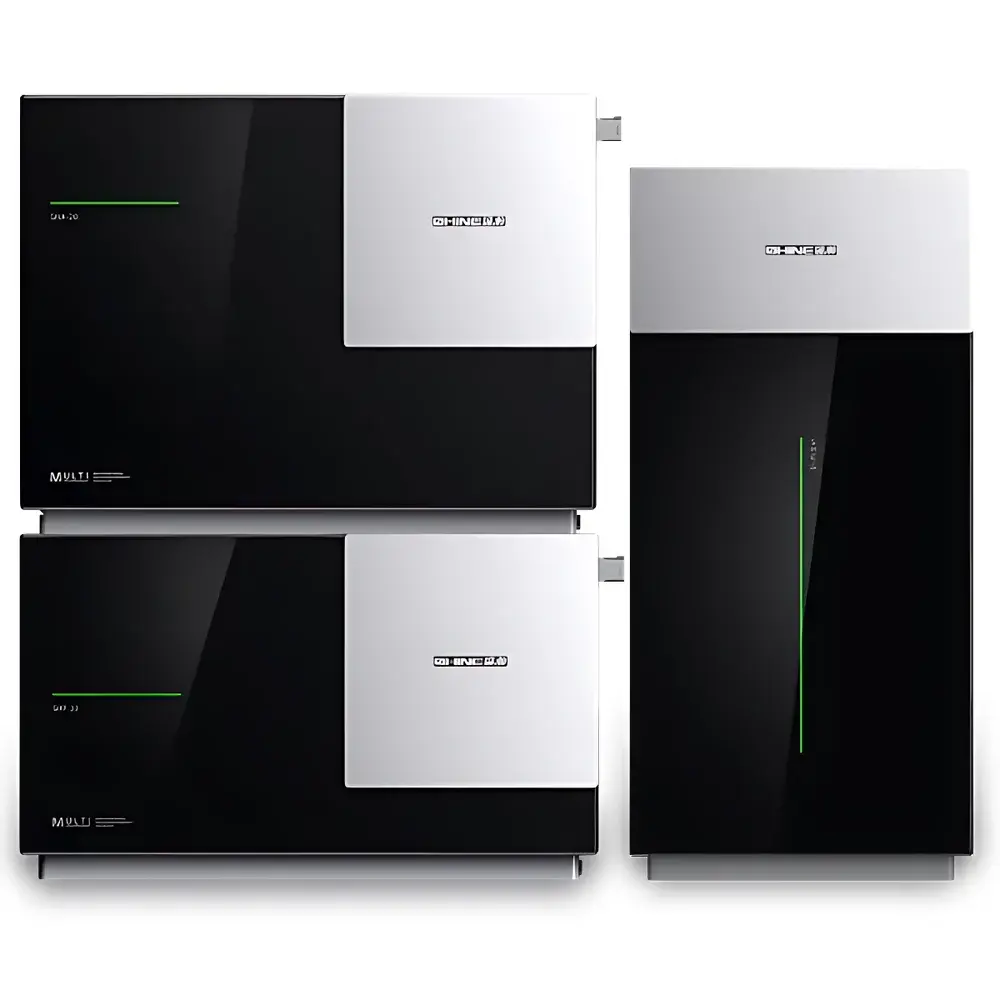
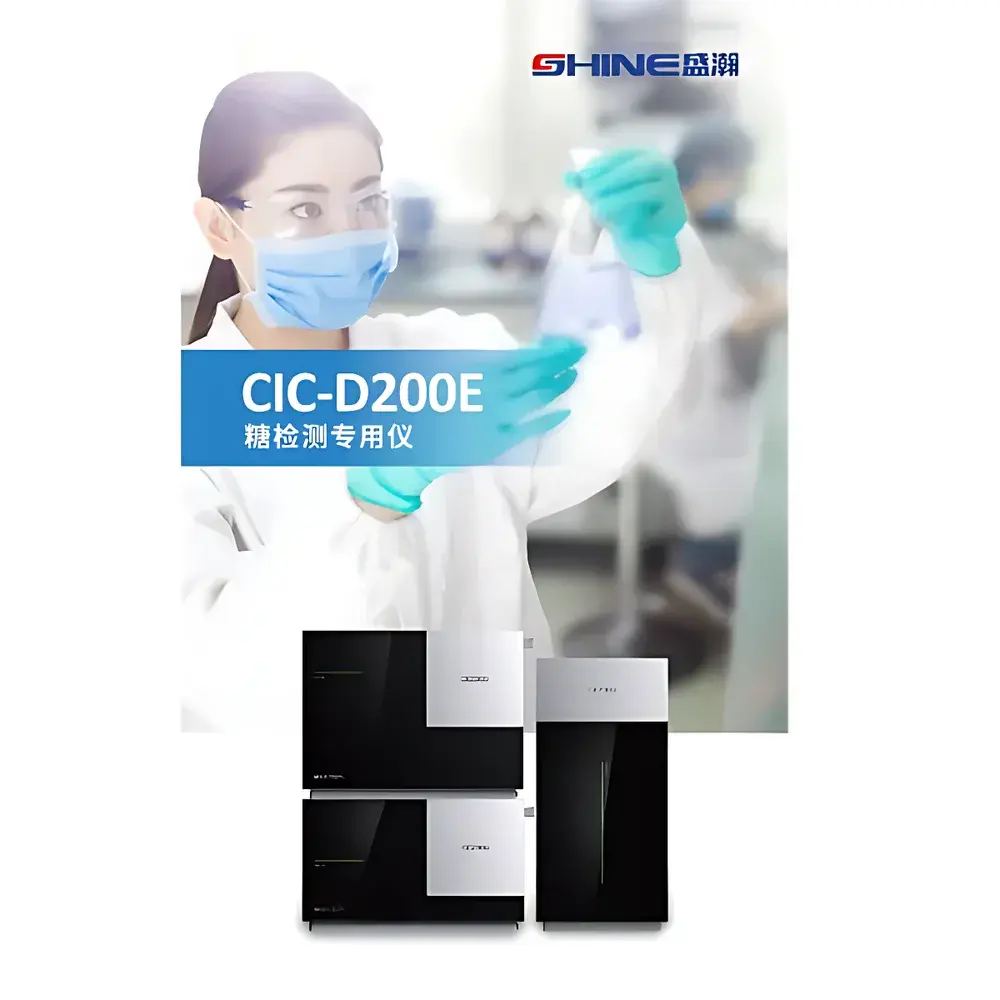
ShineCIC CIC-D200E Dedicated Sugar Analysis System
| Brand | ShineCIC |
|---|---|
| Origin | Shandong, China |
| Manufacturer Type | Direct Manufacturer |
| Product Category | Domestic |
| Model | CIC-D200E |
| Instrument Type | Laboratory Benchtop Ion Chromatograph |
| Application Specificity | Dedicated for Carbohydrate (Monosaccharide, Disaccharide, Polyol) Analysis |
| Auto-sampler Capacity | 60 or 120 positions |
| Injection Modes | Full-loop, Partial-loop, and Non-destructive (Needle-in-loop) |
| Detection Principle | Pulsed Amperometric Detection (PAD) with Triple-mode Electrochemical Control (DC, Pulsed, Integrated) |
| Column Oven Integration | Built-in, Temperature-Controlled (30–60 °C, ±0.1 °C stability) |
| Gradient Pump | Multi-channel High-Pressure Mixing System, Max Pressure: 41.4 MPa (6000 psi), pH Tolerance: 0–14, Compatible with Organic Solvents (e.g., Acetonitrile, Methanol, Ethanol) |
Overview
The ShineCIC CIC-D200E Dedicated Sugar Analysis System is a benchtop ion chromatograph engineered specifically for the high-precision, routine quantification of carbohydrates—including glucose, fructose, sucrose, lactose, maltose, sorbitol, and xylitol—in complex matrices such as food extracts, pharmaceutical formulations, fermentation broths, and biological fluids. Unlike general-purpose ion chromatographs, the CIC-D200E integrates a purpose-built electrochemical detection architecture optimized for weakly ionizable, non-chromophoric sugars that lack UV absorbance and cannot be reliably detected by conductivity or UV-Vis methods. Its core analytical principle relies on pulsed amperometric detection (PAD) coupled with high-efficiency anion-exchange chromatography using alkali-stable, high-capacity pellicular or microbead-packed columns. The system operates under isocratic or gradient elution with sodium hydroxide or sodium acetate–sodium hydroxide mobile phases, enabling baseline separation of structurally similar isomers (e.g., glucose vs. fructose) with reproducible retention times and sub-ppm detection sensitivity.
Key Features
- Triple-mode electrochemical detection module supporting direct current (DC), pulsed amperometric (PAD), and integrated charge-collection modes—each selectable via software to optimize signal-to-noise ratio and electrode fouling resistance for specific analytes.
- Integrated column oven with active temperature control (30–60 °C, ±0.1 °C) and minimized internal volume (<15 µL) to ensure thermal equilibrium, reduce band broadening, and enhance peak symmetry and resolution—critical for co-eluting sugar pairs.
- High-pressure, multi-channel gradient mixing pump capable of sustained operation up to 41.4 MPa (6000 psi), featuring chemically inert fluidic pathways compatible with pH 0–14 eluents and common organic modifiers including acetonitrile, methanol, and ethanol.
- Modular auto-sampler architecture offering configurable capacity: 60-position or 120-position trays; supports full-loop, partial-loop, and non-destructive needle-in-loop injection—preserving precious samples while maintaining quantitative accuracy across wide concentration ranges (0.01–1000 mg/L).
- Real-time LED status indicators and embedded diagnostics provide immediate visual feedback on pump pressure, detector voltage, column temperature, and valve sequencing—reducing operator dependency and facilitating rapid troubleshooting.
Sample Compatibility & Compliance
The CIC-D200E is validated for direct analysis of aqueous extracts from diverse sample types without derivatization: fruit juices, dairy products, infant formula, starch hydrolysates, cell culture supernatants, and glycoprotein digests. Sample preparation typically involves centrifugation, filtration (0.22 µm nylon membrane), and dilution in deionized water or low-conductivity buffer. The system meets essential requirements for regulated environments: its firmware supports audit-trail-enabled method storage, user-level access control (three-tier permissions), and electronic signature capability compliant with FDA 21 CFR Part 11 when deployed with validated LIMS integration. While not pre-certified to ISO/IEC 17025, the instrument’s performance specifications align with ASTM D6919 (Standard Test Method for Determination of Anions in Water by Ion Chromatography) and USP / guidelines for elemental impurity testing where carbohydrate profiling supports excipient characterization.
Software & Data Management
Controlled via ShineCIC ChromaLink v3.x—a Windows-based, GxP-ready platform—the CIC-D200E provides intuitive method development tools, real-time chromatogram overlay, automated peak integration using second-derivative algorithms, and customizable report templates compliant with GLP documentation standards. Raw data files (.raw) are stored in vendor-neutral format with embedded metadata (instrument ID, operator, date/time stamp, sequence ID, calibration history). The software includes built-in calibration curve generation (linear, quadratic, or weighted least-squares), QC flagging (e.g., retention time drift >0.05 min, peak area RSD >3% across replicates), and export options for CSV, PDF, and XML (for LIMS ingestion). All method changes and data modifications are logged with timestamped, user-attributed entries to support traceability during internal audits or regulatory inspections.
Applications
- Quality control of sweeteners and functional carbohydrates in food & beverage manufacturing.
- Monitoring monosaccharide consumption and metabolite accumulation in microbial fermentation processes.
- Stability-indicating assays for sugar-based excipients in solid oral dosage forms per ICH Q5C.
- Characterization of enzymatic hydrolysis kinetics (e.g., invertase, lactase, amylase activity assays).
- Quantitative profiling of reducing and non-reducing sugars in plant tissue extracts for agricultural research.
FAQ
Is the CIC-D200E compatible with carbohydrate-specific columns from other vendors?
Yes—provided the column dimensions (e.g., 4 × 250 mm), packing chemistry (e.g., Dionex CarboPac PA20, Metrosep Carb 1), and maximum operating pressure are within the system’s specifications (≤41.4 MPa), third-party columns may be used with appropriate method revalidation.
Does the system support post-column addition for enhanced PAD sensitivity?
No—the CIC-D200E uses direct-flow PAD without post-column reagent delivery; sensitivity is achieved through optimized waveform programming and low-noise potentiostat design.
Can the auto-sampler be upgraded from 60 to 120 positions post-purchase?
Yes—hardware and firmware upgrades are available through ShineCIC authorized service centers, subject to mechanical compatibility verification.
What maintenance intervals are recommended for the electrochemical flow cell?
Gold working electrode polishing is advised every 200 injections or biweekly under continuous use; reference electrode refilling and gasket replacement are scheduled quarterly per operational log.
Is method transfer possible from older ShineCIC models (e.g., CIC-200)?
Yes—retention times and gradient profiles are largely transferable; however, PAD waveform parameters and column oven equilibration times may require minor optimization due to improved thermal stability and detector response linearity in the D200E platform.





