
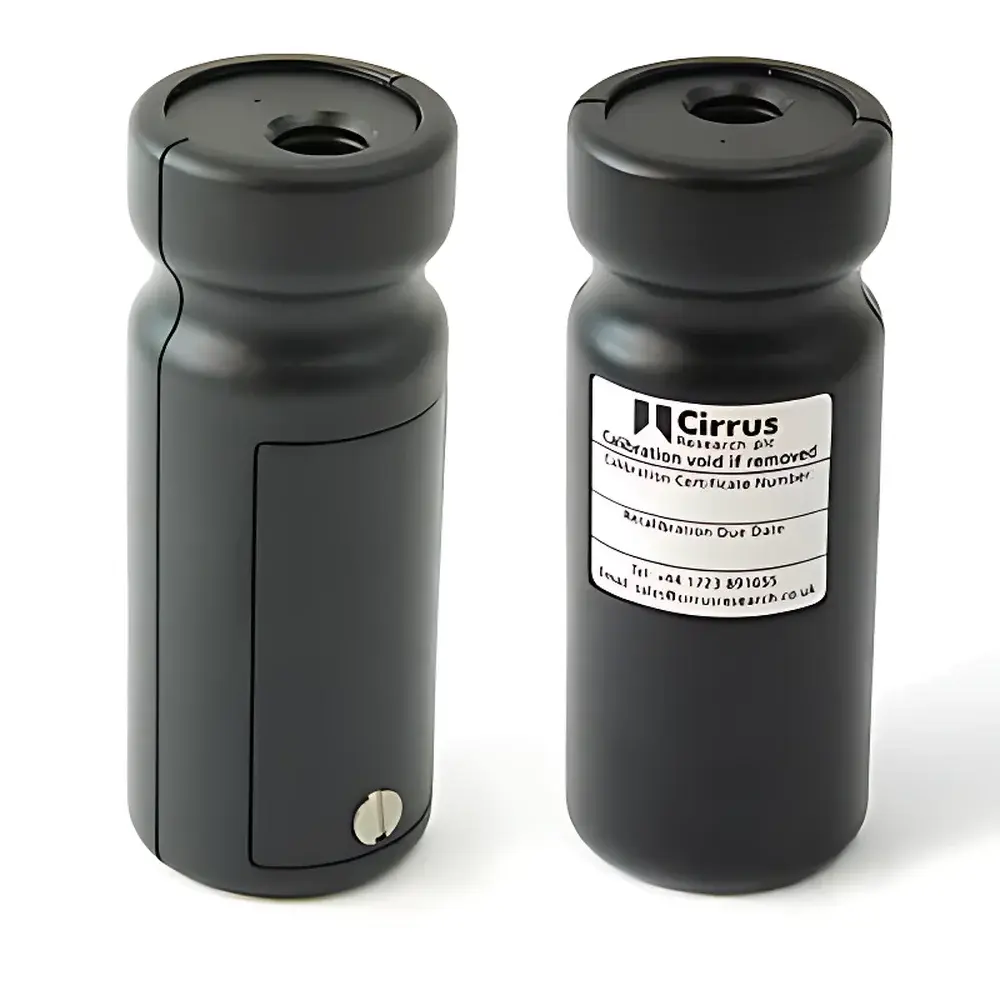
Shins CR:514/CR:515 Precision Acoustic Calibrator
| Brand | Shins |
|---|---|
| Origin | United Kingdom |
| Model | CR:514 (Class 2) / CR:515 (Class 1) |
| Sound Pressure Level | 94 dB ±0.4 dB (CR:514) / 94 dB ±0.2 dB (CR:515) @ 1 kHz |
| Frequency | 1 kHz |
| Microphone Compatibility | 1/2″ electret condenser microphones |
| Distortion | <1% |
| Operating Conditions | 23 °C, 101.3 kPa, 65% RH |
| Dimensions | 138 mm × Ø47 mm |
| Weight | 220 g (incl. battery) |
| Power | Replaceable alkaline battery |
| Auto-shutoff | 3 min (configurable disable) |
| Compliance | IEC 60942:2003 (Class 1 & Class 2), EN 50081-1, EN 50082-1, EN 61010-1:1993 (Pollution Degree 2) |
Overview
The Shins CR:514 and CR:515 are portable, hand-held acoustic calibrators engineered for traceable, field-deployable calibration of sound level meters (SLMs), noise dosimeters, and other electroacoustic measurement instruments conforming to IEC 61672 and ISO 9612. These devices operate on the principle of generating a stable, sinusoidal 1 kHz tone at a precisely defined sound pressure level (SPL) in a closed-coupled cavity—enabling rapid functional verification and periodic adjustment of microphone sensitivity prior to and after measurement campaigns. Unlike reference-class laboratory calibrators requiring environmental control, the CR:514/CR:515 deliver metrologically robust performance under typical ambient conditions (23 °C, 101.3 kPa, 65 % RH), making them ideal for routine pre-use checks in occupational hygiene, environmental noise monitoring, industrial compliance, and building acoustics applications.
Key Features
- Two-tiered metrological classification: CR:514 meets IEC 60942:2003 Class 2 requirements (±0.4 dB tolerance); CR:515 satisfies Class 1 (±0.2 dB), supporting calibration of high-accuracy SLMs used in regulatory reporting and accredited laboratories.
- Stable 94 dB SPL output referenced to 20 µPa at 1 kHz, optimized for 1/2″ electret condenser microphones—the industry-standard transducer size for handheld SLMs.
- Low harmonic distortion (<1 %) ensures minimal spectral contamination during calibration, preserving signal integrity for both analog and digital instrumentation chains.
- Integrated auto-shutoff (3-minute default) extends battery life; user-selectable disable mode permits extended continuous operation during multi-instrument verification workflows.
- Compact cylindrical form factor (138 mm × Ø47 mm) and lightweight design (220 g with battery) enable one-handed operation and seamless integration into field kits or lab calibration carts.
- Green LED status indicator confirms active calibration mode and provides visual feedback during device activation and timeout sequences.
- Compliant with electromagnetic compatibility (EN 50081-1, EN 50082-1) and safety standards (EN 61010-1:1993, Pollution Degree 2), ensuring safe operation in industrial and laboratory environments.
Sample Compatibility & Compliance
The CR:514/CR:515 are designed exclusively for use with 1/2″ free-field or pressure-response microphones mounted in standard couplers (e.g., IEC 61094-4 compliant adapters). They are not suitable for 1/4″ or 1″ microphones without appropriate mechanical adapters, nor for open-field or diffuse-field calibration configurations. Each unit ships with an individual calibration certificate traceable to UKAS-accredited national standards, documenting as-delivered SPL accuracy, frequency deviation, and linearity across temperature and humidity ranges specified in IEC 60942 Annex B. The devices support GLP/GMP-aligned workflows through documented calibration intervals, certificate retention, and audit-ready traceability—fully compatible with ISO/IEC 17025–accredited laboratories performing external calibration services.
Software & Data Management
As standalone hardware calibrators, the CR:514/CR:515 require no firmware updates, host software, or data logging functionality. All operational parameters—including SPL stability, timing logic, and power management—are implemented in hardened analog/digital circuitry to eliminate dependency on external computing resources. This architecture ensures deterministic behavior, immunity to OS-level vulnerabilities, and uninterrupted operation in offline or hazardous-area settings. Calibration certificates include unique serial numbers, date of issue, accredited reference standard IDs, and uncertainty budgets per ISO/IEC 17025 Clause 7.6—facilitating automated record-keeping in LIMS or electronic quality management systems (eQMS). No driver installation or USB connectivity is required; device verification relies solely on physical coupling and audible/visual confirmation.
Applications
- Routine pre- and post-measurement verification of Class 1 and Class 2 sound level meters in occupational noise assessments (OSHA 1910.95, EU Directive 2003/10/EC).
- Field calibration of noise mapping systems and fixed environmental monitoring stations prior to long-term deployment.
- Quality assurance in manufacturing facilities producing acoustic test equipment, including microphone manufacturers performing final product testing.
- Teaching and training labs where students require repeatable, low-risk calibration references aligned with international syllabi (e.g., ISO/TR 25417, ANSI S1.40).
- Regulatory inspections by environmental protection agencies requiring documented instrument verification prior to enforcement measurements.
- Validation of acoustic data acquisition systems integrated into vibration/noise analysis platforms (e.g., Brüel & Kjær, Siemens Simcenter).
FAQ
What is the difference between CR:514 and CR:515?
The CR:514 is certified to IEC 60942:2003 Class 2 (±0.4 dB tolerance), intended for calibration of general-purpose sound level meters. The CR:515 meets Class 1 (±0.2 dB), required for high-accuracy instruments used in legal metrology, accreditation, and emission compliance reporting.
Can these calibrators be used with 1/4″ microphones?
No. The CR:514/CR:515 are mechanically and acoustically optimized for 1/2″ microphones only. Use with smaller transducers requires a certified adapter meeting IEC 61094-4 dimensional tolerances and introduces additional uncertainty not covered by the device’s stated specification.
Is the calibration certificate included with purchase?
Yes—each unit ships with a manufacturer-issued calibration certificate traceable to UKAS-accredited primary standards, including measured SPL, uncertainty budget, environmental conditions, and validity period.
How often should the calibrator itself be recalibrated?
Annual recalibration is recommended per ISO/IEC 17025 and IEC 60942 Clause 8.3. Recalibration must be performed by an accredited laboratory using a reference standard microphone calibrated against national metrology institute (NMI) standards.
Does the auto-shutoff interfere with calibration protocols requiring longer durations?
No—the auto-shutoff can be disabled via internal jumper configuration (detailed in the user manual), enabling continuous output for extended verification sequences or custom test routines.







