
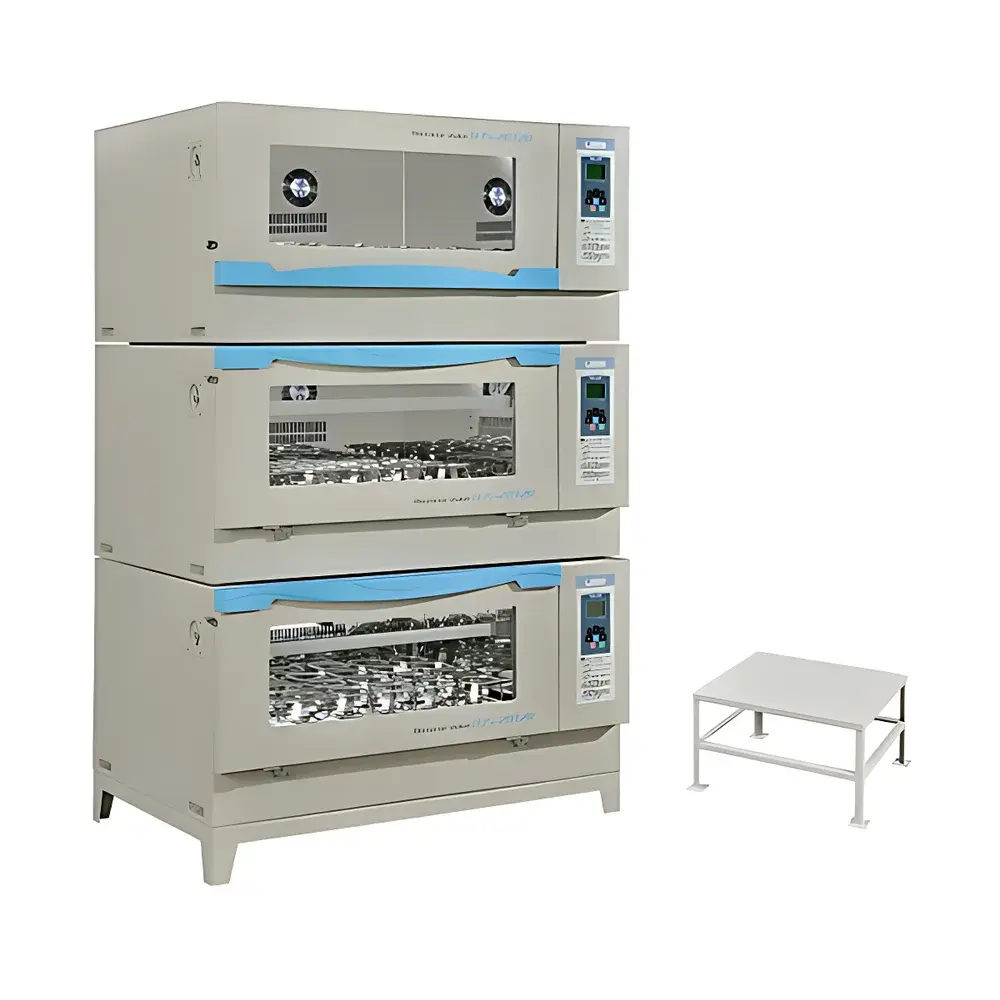
Shiping DJS-2016/DJS-2016R Stackable High-Capacity Full-Temperature Orbital Shaker
| Brand | Shiping |
|---|---|
| Origin | Shanghai, China |
| Model | DJS-2016 / DJS-2016R |
| Temperature Range | 4°C to 60°C |
| Oscillation Frequency | 50–300 rpm |
| Frequency Accuracy | ±1 rpm |
| Orbit Diameter | Φ25 mm |
| Timer Range | 0–500 h |
| Tray Dimensions | 920 × 540 mm |
| Capacity | up to fifteen 2 L flasks |
| Tray Quantity | 1 |
| Cooling System | CFC-free R134a refrigerant |
| Heating Power | 800 W |
| Cooling Power | 200 W |
| Total Power Consumption | 1120 W |
| Net Weight | 180 kg |
| Chamber Material | Electropolished 316L stainless steel mirror finish |
| Control System | PID microprocessor with environmental scanning chip |
| Display | Dual-line LCD (temperature & speed) |
| Programming | 8-segment programmable ramping profiles |
| Safety Features | Independent over-temperature, over-speed, leakage current, and motor overheat protection |
| Certifications | Compliant with IEC 61010-1, ISO 13485 design principles for lab equipment |
Overview
The Shiping DJS-2016/DJS-2016R is an engineered full-temperature orbital shaker designed for high-throughput, long-duration incubation and mixing applications in academic research laboratories, biopharmaceutical QC/QA environments, and clinical diagnostics facilities. It operates on the principle of controlled orbital motion—generating uniform, low-shear agitation via a patented single-axis balanced drive mechanism—to ensure reproducible suspension homogeneity across diverse biological and chemical sample types. Unlike conventional reciprocating or vortex shakers, this system delivers consistent Φ25 mm circular motion at precisely regulated frequencies (50–300 rpm, ±1 rpm accuracy), minimizing shear-induced cell damage during microbial culture, mammalian cell expansion, or protein solubilization protocols. Its fully integrated thermal management system—combining Peltier-assisted cooling (4°C minimum) and high-efficiency resistive heating (up to 60°C)—enables precise temperature maintenance within ±0.1°C accuracy and ±0.5°C uniformity across the entire chamber volume. The unit’s stackable architecture supports vertical integration of up to three units without requiring additional floor space—critical for labs constrained by footprint but demanding scalable throughput.
Key Features
- Stackable modular design: Three units can be vertically aligned using reinforced support frames and integrated alignment guides—occupying only the footprint of a single shaker (1410 × 820 mm).
- PID-controlled microprocessor with environmental scanning chip: Continuously monitors ambient fluctuations and dynamically adjusts thermal output and motor torque to maintain setpoint stability under variable load conditions.
- Single-axis balanced drive mechanism (Chinese Patent ZL2018XXXXXXX): Eliminates mechanical vibration transmission, enabling silent operation (20,000 hr MTBF).
- Electropolished 316L stainless steel chamber: Resistant to corrosion from organic solvents, acidic/basic reagents, and sterilants—validated per ASTM A967 for passivation integrity.
- Large-capacity tray (920 × 540 mm): Supports standardized configurations including fifteen 2 L Erlenmeyer flasks, twenty-four 1 L bottles, or sixty 250 mL vessels—optimized for ISO/IEC 17025-compliant media preparation workflows.
- Dual-line LCD display with real-time dual-parameter readout: Simultaneously shows actual chamber temperature and oscillation speed—plus optional ambient temperature overlay for GLP audit traceability.
- Eight-segment programmable protocol engine: Each segment independently defines target rpm, dwell time, acceleration slope, and temperature setpoint—enabling complex multi-phase assays such as synchronized induction-expression-purification sequences.
- CFC-free R134a refrigeration system: Meets EU F-Gas Regulation (EU) No 517/2014 and EPA SNAP program requirements for low-global-warming-potential (GWP = 1430) cooling agents.
Sample Compatibility & Compliance
The DJS-2016R accommodates standard laboratory vessels—including glass and polycarbonate flasks, PETG culture bottles, and silicone-sealed bioreactor bags—without compromising sealing integrity or optical clarity. Its chamber geometry and airflow dynamics comply with ISO 15189 Annex A.3.2.3 for incubator uniformity validation, supporting temperature mapping per ASTM E2297-21. The system meets electrical safety standards IEC 61010-1:2010 (Class I, Pollution Degree 2) and electromagnetic compatibility requirements per IEC 61326-1:2020. Optional UV-C germicidal lamp (254 nm) and humidity sensor modules are available for applications requiring sterile workspace maintenance or moisture-sensitive assays (e.g., hybridization, enzymatic digestion). All firmware logic implements non-volatile parameter retention and power-fail recovery—ensuring continuity during utility interruptions per FDA 21 CFR Part 11 §11.10(d) data integrity provisions.
Software & Data Management
While the DJS-2016R operates autonomously via its embedded PID controller, optional RS-485 Modbus RTU interface enables integration into centralized lab automation platforms (e.g., LabVantage, STARLIMS). Logged operational data—including timestamped temperature history, speed profile execution logs, alarm event codes, and door-open duration—is stored in internal flash memory with cyclic overwrite protection. Audit trails include operator ID (via optional RFID reader), parameter change timestamps, and firmware revision metadata—fully compliant with ALCOA+ principles for raw data attribution. Exportable CSV reports support post-hoc statistical process control (SPC) analysis per ISO 7870-2:2013. Calibration certificates for temperature and speed sensors are issued with NIST-traceable references upon factory commissioning.
Applications
- Mammalian and insect cell culture: Maintaining suspension cultures of CHO, HEK293, Sf9 cells under tightly controlled O2/CO2-compatible conditions when paired with gas-permeable vessel systems.
- Microbial fermentation: Aerobic growth of E. coli, Bacillus subtilis, and yeast strains across scalable volumes—from seed train expansion to production-scale inoculum preparation.
- Diagnostic assay development: Homogenizing immunoassay plates, facilitating antigen-antibody binding kinetics, and supporting ELISA wash steps with programmable agitation cycles.
- Extraction and solubilization: Enhancing solvent-based compound recovery from botanical matrices or tissue homogenates while preserving thermolabile analytes.
- Hybridization and staining: Uniform reagent distribution during Southern/Northern blotting, FISH, or histological processing—reducing edge effects and improving signal-to-noise ratios.
- Environmental microbiology: Incubating water and soil samples per ISO 9308-1:2014 for Escherichia coli enumeration under standardized shaking parameters.
FAQ
What is the maximum flask size supported on the DJS-2016R platform?
The standard configuration accommodates up to fifteen 2 L Erlenmeyer flasks (total volume ≤30 L), arranged in a staggered grid pattern to optimize airflow and thermal exchange.
Does the unit support remote monitoring or network connectivity?
Yes—optional RS-485 Modbus RTU interface allows integration with building management systems (BMS) or LIMS; Ethernet/WiFi modules are available as field-upgrade kits.
How is temperature uniformity validated across the chamber?
Shipment includes a 9-point temperature mapping report per ASTM E2297-21, conducted using calibrated PT100 probes at defined spatial coordinates.
Can the shaker operate continuously for extended durations (e.g., >72 h)?
Yes—the system is rated for continuous duty cycle operation with automatic thermal derating and motor winding temperature monitoring.
Is the stainless steel chamber suitable for use with aggressive cleaning agents such as 70% ethanol or 1% sodium hypochlorite?
Yes—electropolished 316L stainless steel exhibits full resistance to these agents per ASTM G150-19 electrochemical pitting tests.




