
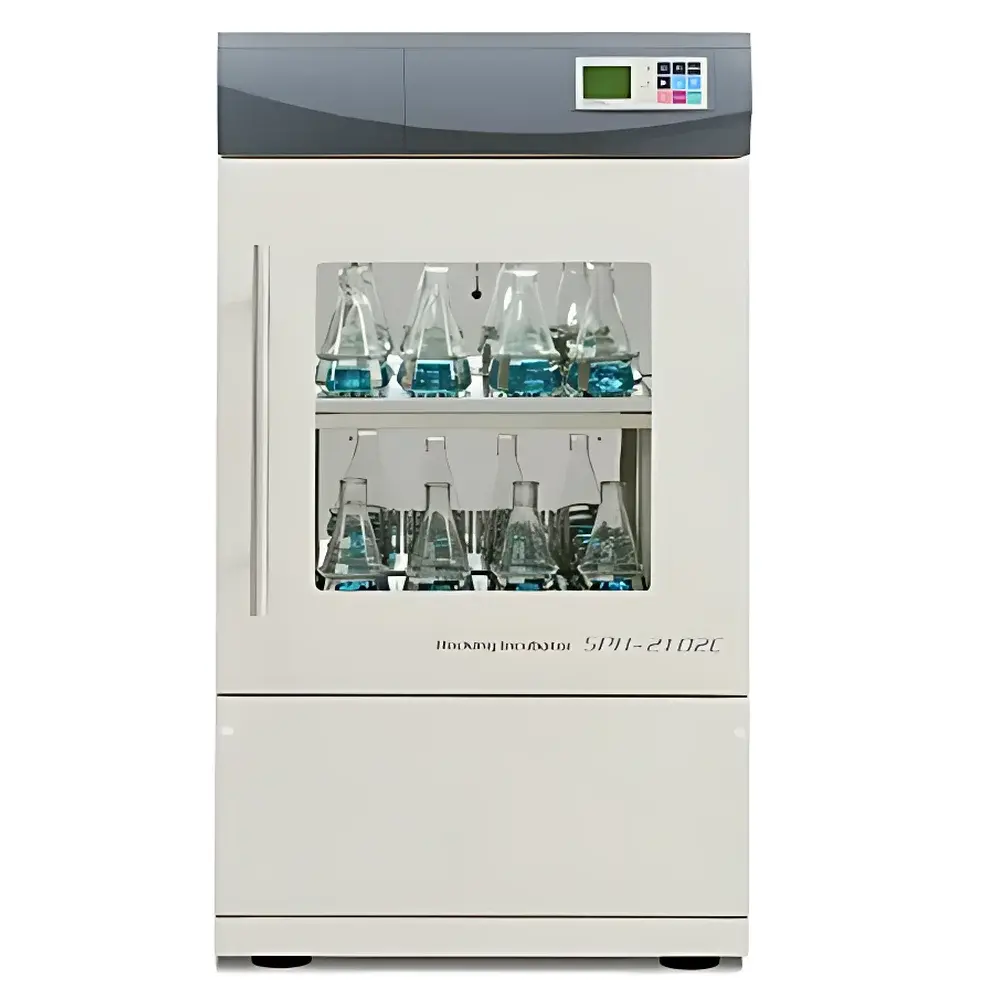
ShiPing SPH-1102C / SPH-2102C Vertical Dual-Shelf Full-Temperature Incubated Orbital Shaker
| Brand | ShiPing |
|---|---|
| Origin | Shanghai, China |
| Model | SPH-1102C / SPH-2102C |
| Temperature Range | 4°C–60°C |
| Oscillation Frequency | 40–300 rpm |
| Amplitude | Φ25 mm |
| Timer Range | 0–500 h |
| Shelf Quantity | 2 |
| Display | LCD dual-display (setpoint & real-time values) |
| Control Algorithm | PID microprocessor-based environmental scanning controller |
| Cooling System | CFC-free R134a refrigerant |
| Heating Power | 500 W |
| Cooling Power | 200 W |
| Total Power Consumption | 600 W (SPH-1102C) / 830 W (SPH-2102C) |
| Chamber Dimensions (W×D×H) | 600 × 440 × 650 mm |
| External Dimensions (W×D×H) | 700 × 600 × 1250 mm |
| Net Weight | 150 kg (SPH-1102C) / 165 kg (SPH-2102C) |
| Chamber Material | Mirror-finish imported stainless steel |
| Housing Material | Reinforced cold-rolled steel with electrostatic powder coating |
| Safety Certifications | Over-temperature/over-speed audible-visual alarm, independent thermal cutoff, door-open stop, leakage current protection, motor overheat protection, auto-restart after power recovery |
Overview
The ShiPing SPH-1102C and SPH-2102C are vertically configured, dual-shelf incubated orbital shakers engineered for precise temperature-controlled agitation in life science laboratories and bioengineering applications. These instruments operate on the principle of orbital motion—generating uniform circular oscillation at programmable frequencies—to ensure consistent suspension, homogenization, and aeration of biological samples across two independently accessible shelves. Designed for full-temperature operation from 4°C to 60°C, the units integrate a high-efficiency, environmentally compliant R134a refrigeration system with precision PID-controlled heating, enabling stable thermal environments even during extended incubation cycles up to 500 hours. The vertical architecture optimizes floor space without compromising capacity—each shelf accommodates up to 48 × 50 mL flasks or 12 × 1000 mL bottles—making them suitable for both high-throughput screening and pilot-scale bioprocess development. All models feature a front-access single-door design with tempered glass viewport and internal LED illumination, facilitating non-intrusive visual monitoring while maintaining chamber integrity.
Key Features
- Vertical dual-shelf configuration with independent access—maximizing workspace efficiency and sample throughput per unit footprint.
- PID-based microprocessor controller with environmental scanning capability ensures ±0.1°C temperature accuracy and ±1°C uniformity across the chamber.
- Orbital oscillation drive system utilizing patented single-axis balanced transmission—minimizing mechanical vibration, acoustic noise (<55 dB), and energy consumption.
- Wide-speed range (40–300 rpm) with ±1 rpm resolution, supported by a brushless AC induction motor rated for continuous operation and zero maintenance.
- LCD backlit dual-display interface showing real-time temperature, speed, elapsed time, and remaining timer—fully programmable with eight-segment curve scheduling.
- Comprehensive safety architecture: independent over-temperature cutoff, door-interlocked shutdown, motor overheat detection, earth-leakage protection, and automatic restart after power interruption.
- CFC-free refrigeration (R134a), conforming to international environmental directives including EU F-Gas Regulation and Montreal Protocol compliance standards.
Sample Compatibility & Compliance
The SPH-1102C/2102C supports standard laboratory vessels—including Erlenmeyer flasks, test tubes, culture bottles, and multi-well plates—across volumes from 50 mL to 1000 mL. Its stainless-steel chamber (mirror-finished AISI 304) resists corrosion from common reagents used in cell culture, protein expression, plasmid purification, hybridization, and diagnostic assay workflows. The instrument meets general laboratory safety requirements per IEC 61010-1:2010 and incorporates design elements aligned with GLP-compliant environments: parameter memory retention, audit-ready operational logs (via optional RS485/USB data export), and traceable calibration points for temperature and speed. While not pre-certified for FDA 21 CFR Part 11, its logging and password-protected settings support validation protocols required under ISO/IEC 17025 and USP analytical instrument qualification frameworks.
Software & Data Management
The embedded controller provides local data handling via non-volatile memory that retains all user-defined parameters—including speed profiles, temperature ramps, and timer settings—during power loss. Optional PC connectivity (RS485 or USB interface) enables remote monitoring and batch export of time-stamped temperature and rotation logs in CSV format. Firmware supports firmware-upgradable functionality for future protocol enhancements. For regulated environments, third-party LIMS or ELN integration is achievable through Modbus RTU or ASCII command sets. Real-time clock synchronization, dual temperature display (setpoint vs. chamber), and configurable alarm thresholds facilitate routine QC documentation without external instrumentation.
Applications
These shakers serve critical roles in microbial cultivation, recombinant protein expression in E. coli and yeast systems, antibiotic susceptibility testing, enzyme kinetics studies, immunoassay plate washing, nucleic acid hybridization, and small-volume bioreactor seeding. Their low-temperature capability (4°C) supports cold-active enzyme assays and chilled sample stabilization, while the upper 60°C limit accommodates thermophilic culture expansion and accelerated solubility or extraction protocols. The dual-shelf layout allows parallel experiments under identical conditions—e.g., control vs. induced cultures—or staggered time-point sampling without cross-contamination risk.
FAQ
What is the minimum operating temperature, and how is sub-ambient cooling achieved?
The unit achieves stable operation down to 4°C using a sealed R134a vapor-compression refrigeration circuit integrated with PID-regulated heating—ensuring precise setpoint maintenance without condensation buildup.
Can the shaker accommodate flasks larger than 1000 mL?
Standard mounting fixtures support up to 1000 mL vessels; custom clamping solutions for oversized containers (e.g., 2 L Fernbach flasks) are available upon request and require mechanical verification for rotational balance.
Is humidity control available as a factory option?
Humidity sensing is offered as an add-on module; active humidification requires external steam injection via optional inlet port—intended for specialized mammalian cell culture applications where chamber RH must be maintained above 70%.
How does the “auto-restart” function behave after power failure?
Upon restoration of mains power, the instrument resumes the previously active program—including remaining timer duration, target temperature, and oscillation speed—without manual reinitialization.
Are calibration certificates provided with shipment?
Factory-installed NIST-traceable temperature and speed calibration reports are available as an optional service; on-site verification kits compatible with ISO/IEC 17025-accredited labs can be supplied separately.




