
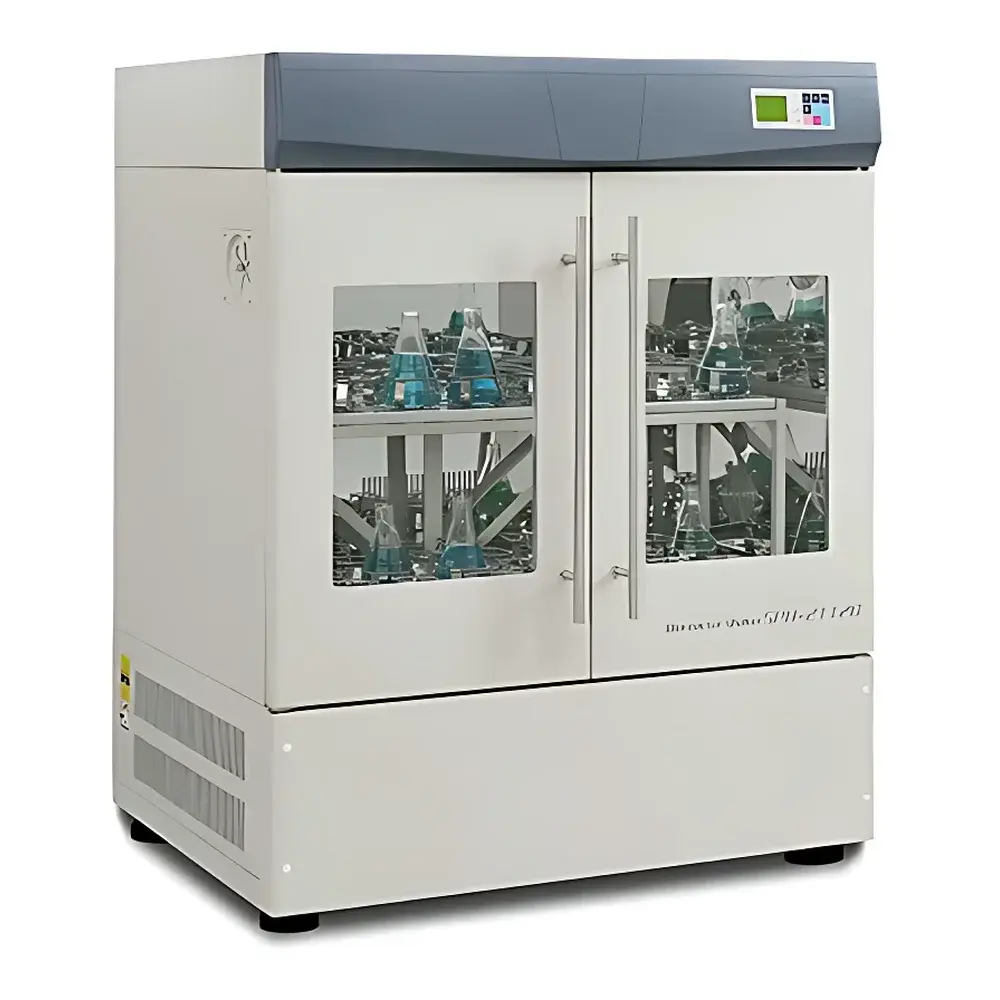
Shiping SPH-1112D / SPH-2112D Vertical Dual-Door Dual-Shelf Full-Temperature Incubated Orbital Shaker
| Brand | Shiping |
|---|---|
| Origin | Shanghai, China |
| Model | SPH-1112D / SPH-2112D |
| Temperature Range | 4 °C to 60 °C (SPH-2112D: 6 °C to 60 °C) |
| Oscillation Frequency | 50–300 rpm |
| Oscillation Amplitude | Φ35 mm (SPH-1112D) / Φ50 mm (SPH-2112D) |
| Timer Range | 0–500 h |
| Shelf Quantity | 2 |
| Power Consumption | 1100 W / 1340 W |
| Refrigerant | CFC-Free R134a |
| Control System | PID microprocessor with LCD dual-display |
| Safety Certifications | Over-temperature/over-speed alarm, independent thermal cutoff, door-open shutdown, leakage & overcurrent protection |
| Compliance | Designed for GLP-compliant labs |
Overview
The Shiping SPH-1112D and SPH-2112D are vertically oriented, dual-door, dual-shelf incubated orbital shakers engineered for high-capacity, temperature-controlled cell culture, microbial growth, protein expression, and biochemical assay workflows. These instruments operate on the principle of orbital shaking—generating a circular motion (Φ35 mm or Φ50 mm amplitude) at precisely regulated frequencies (50–300 rpm) within a thermally stabilized chamber. Unlike benchtop units, their vertical architecture maximizes floor space efficiency while accommodating up to 164 × 100 mL flasks (or 36 × 1000 mL vessels) across two independently accessible stainless-steel shelves. The chamber maintains uniformity (±1 °C) and stability (±0.1 °C control accuracy) across the full operating range of 4 °C to 60 °C (SPH-2112D: 6 °C to 60 °C), enabled by a balanced single-axis drive system, high-efficiency R134a refrigeration, and 800 W resistive heating. This design supports both ambient-cooled and sub-ambient applications—including low-temperature induction of recombinant proteins and cold-adapted enzyme assays—without condensation or thermal stratification.
Key Features
- Vertical dual-door configuration with reinforced cold-rolled steel frame and electrostatic powder-coated exterior; interior chamber constructed from mirror-finish imported stainless steel (AISI 304) for corrosion resistance and ease of decontamination.
- Dual-shelf layout (920 × 520 mm per shelf) enables parallel processing of heterogeneous sample sets—e.g., simultaneous E. coli expression at 37 °C and Pichia pastoris induction at 25 °C—without cross-contamination risk.
- PID-controlled microprocessor with environmental scanning logic continuously monitors chamber temperature, motor load, and ambient humidity (20–90% RH, 5–25 °C ambient), dynamically adjusting compressor duty cycle and heater output to maintain setpoint fidelity.
- LCD backlit dual-display interface shows real-time and set values for temperature, speed, elapsed time, and remaining timer duration; supports eight-segment programmable ramp-hold profiles for complex kinetic studies (e.g., gradual temperature shift during fed-batch fermentation).
- 250 W brushless AC induction motor with variable-frequency drive ensures constant torque across the full 50–300 rpm range, eliminating carbon brush wear and enabling smooth acceleration/deceleration to protect shear-sensitive cultures.
- Integrated safety architecture includes independent mechanical over-temperature cutoff, door-interlocked motor shutdown, ground-fault circuit interruption (GFCI), and dual-channel over-current protection—certified to IEC 61010-1:2010 for laboratory equipment safety.
Sample Compatibility & Compliance
These shakers accommodate standard microbiological and molecular biology vessels—including Erlenmeyer flasks (100–1000 mL), test tubes, deep-well plates, and custom bioreactor bags—via interchangeable universal clamps or platform adapters. The Φ50 mm amplitude option (SPH-2112D) enhances oxygen transfer in high-density cultures, while the Φ35 mm variant (SPH-1112D) provides gentler agitation suitable for mammalian suspension cells or fragile aggregates. All models comply with ISO 13485 design controls for medical device manufacturing environments and meet electromagnetic compatibility (EMC) requirements per EN 61326-1. Optional UV germicidal lamps (254 nm) and sterile air inlet ports support aseptic workflows under ISO Class 5 laminar flow conditions. For regulated quality systems, firmware supports optional 21 CFR Part 11-compliant electronic signatures and audit trails when paired with validated data acquisition software.
Software & Data Management
While standalone operation requires no PC, the shaker’s RS-485 serial interface enables integration into centralized lab management systems (LIMS) or SCADA networks via Modbus RTU protocol. Optional Shiping LabLink™ software (v3.2+) provides remote monitoring, real-time graphing of temperature/speed profiles, automated report generation (PDF/CSV), and secure user-level access control (admin/operator/guest). All parameter changes, alarm events, and power-loss recovery actions are timestamped and stored locally for ≥12 months—meeting GLP documentation standards for method validation and equipment qualification (IQ/OQ/PQ). Data encryption (AES-128) and TLS 1.2 handshake ensure secure transmission when connected to enterprise IT infrastructure.
Applications
- Microbial fermentation: E. coli, Bacillus subtilis, and yeast cultivations under controlled dissolved oxygen (DO)-correlated agitation profiles.
- Recombinant protein production: Induction-phase optimization using temperature-gradient programming (e.g., 30 °C → 18 °C over 4 h) to improve soluble yield.
- Molecular diagnostics: Hybridization kinetics, ELISA plate washing, and nucleic acid extraction buffer equilibration.
- Biopharmaceutical process development: Scale-down modeling of 50–200 L bioreactors using vessel-specific kLa correlation curves derived from oscillation frequency and amplitude calibration.
- Environmental microbiology: BOD incubation, soil slurry respiration assays, and antibiotic susceptibility testing under standardized CLSI M07-A10 conditions.
FAQ
What is the difference between SPH-1112D and SPH-2112D?
The SPH-2112D features a wider oscillation amplitude (Φ50 mm vs. Φ35 mm), enhanced cooling capacity for stable sub-ambient operation down to 6 °C, and a higher net weight (456 kg) reflecting upgraded structural bracing for extended 24/7 operation.
Can this shaker be validated for GMP use?
Yes—when equipped with optional calibration certificates (NIST-traceable temperature and speed sensors), IQ/OQ documentation templates, and LabLink™ software with 21 CFR Part 11 mode enabled, it satisfies Annex 11 and EU GMP Chapter 4 requirements.
Is humidity control available?
Humidity sensing is supported as an add-on module (0–95% RH, ±3% accuracy); active humidification requires external steam generator integration via the optional air-inlet port.
Does the unit support external CO₂ monitoring or control?
No native CO₂ capability is built in; however, third-party gas analyzers can be interfaced via analog 4–20 mA input terminals for alarm-triggered shutdown if thresholds are exceeded.
What maintenance is required for long-term reliability?
Annual verification of temperature uniformity (per ISO 17025), compressor oil level check, and drive belt tension inspection—no scheduled motor servicing due to brushless design.




