
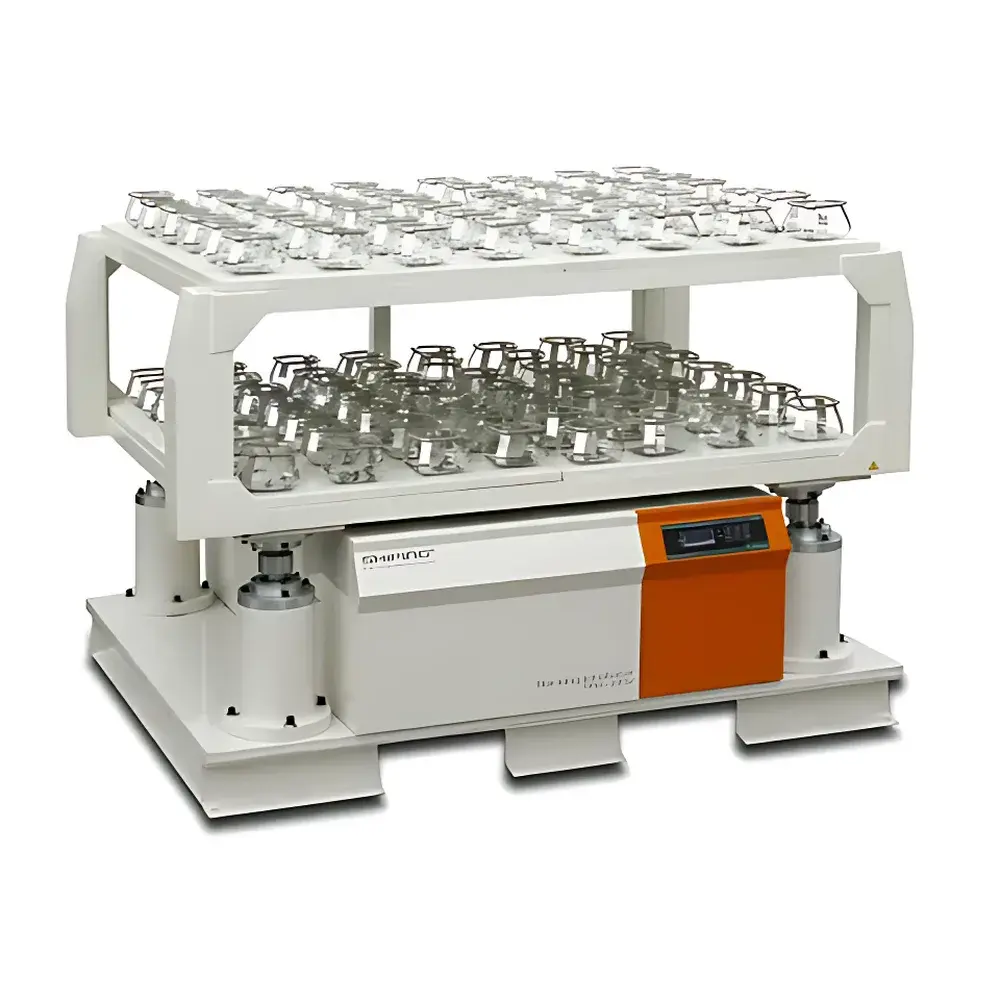
Shiping SPH-3312 Reciprocal Dual-Deck Orbital Shaker
| Brand | Shiping |
|---|---|
| Origin | Shanghai, China |
| Model | SPH-3312 |
| Timing Range | 0–500 h |
| Oscillation Frequency | 50–250 rpm |
| Frequency Accuracy | ±1 rpm |
| Orbit Diameter | Φ25 mm |
| Deck Quantity | 2 |
| Deck Dimensions | 840 × 620 mm (per deck) |
| Net Weight | 250 kg |
| Power Supply | AC 200–240 V, 50–60 Hz |
| Motor | 250 W variable-frequency motor |
| Total Power Consumption | 280 W |
| Enclosure Material | High-strength cold-rolled steel, cast iron frame, structural steel reinforcements |
| Cooling Method | Natural convection |
| Control System | PID microprocessor with LCD display |
| Programmability | 8-segment user-defined programs |
| Safety Features | Over-speed audio-visual alarm, independent leakage/overcurrent protection, over-temperature cutoff, motor thermal shutdown, soft-start circuitry, power-fail resume function |
| Compliance | Designed for GLP-compliant laboratories |
Overview
The Shiping SPH-3312 Reciprocal Dual-Deck Orbital Shaker is an engineered platform for reproducible, long-duration agitation of biological and chemical samples under ambient temperature conditions. It operates on the principle of controlled reciprocal orbital motion—where a balanced eccentric drive system imparts a smooth, sinusoidal horizontal displacement to the shaker decks—minimizing vertical acceleration and mechanical stress on cultures and reagents. Unlike rotary or vortex shakers, this design ensures uniform mixing across large-volume vessels while maintaining low shear profiles critical for sensitive cell suspensions, microbial cultures, and immunoassay plates. The dual-deck architecture enables parallel processing of heterogeneous sample sets—such as comparative fermentation trials or multi-condition enzyme kinetics—without cross-contamination or inter-deck interference. Its robust cast-iron chassis, precision-machined chromium-alloy drive components, and imported sealed ball bearings collectively ensure >20,000 hours of continuous operational stability, meeting the durability expectations of core facility and GMP-aligned QC labs.
Key Features
- Reciprocal orbital motion with Φ25 mm orbit diameter—optimized for homogeneous suspension of viscous media and high-density cultures.
- Dual independently mounted decks (840 × 620 mm each), each supporting up to 108 × 250 mL flasks or 48 × 1000 mL bottles—enabling scalable throughput without compromising mechanical balance.
- PID-controlled microprocessor system with LCD interface and eight-segment programmable timing; retains last-used parameters including speed, duration, and program sequence after power interruption.
- Soft-start circuitry eliminates torque shock at initiation, preventing splashing and meniscus disruption in narrow-necked vessels—critical for sterile handling and low-volume assays.
- 250 W high-torque, maintenance-free variable-frequency motor delivers stable output across the full 50–250 rpm range, with frequency resolution of ±1 rpm verified per ISO 17025 traceable calibration protocols.
- Integrated safety architecture: independent over-speed audible/visual alarm, dual-channel over-current and earth-leakage detection, motor overheat cutoff, and automatic thermal shutdown if ambient enclosure temperature exceeds safe thresholds.
- Electrostatically applied corrosion-resistant polyester coating over cold-rolled steel and reinforced cast-iron frame—compliant with ISO 9227 salt-spray resistance standards (>500 h).
Sample Compatibility & Compliance
The SPH-3312 accommodates standard laboratory glassware and plastic vessels—including Erlenmeyer flasks (250–1000 mL), culture bottles, deep-well microplates, and custom bioreactor sleeves—via interchangeable clamp systems (sold separately). Its natural convection cooling design ensures no forced-air interference with temperature-sensitive reactions, making it suitable for applications where external thermostatic control is provided by incubator enclosures or environmental chambers. The unit complies with IEC 61010-1:2010 for electrical safety in laboratory equipment and incorporates design elements aligned with FDA 21 CFR Part 11 data integrity principles—specifically parameter memory retention, audit-trail-capable operation logging (when integrated with optional RS-485/Modbus data acquisition), and non-volatile configuration storage. It is routinely deployed in facilities operating under GLP, ISO/IEC 17025, and ISO 13485 quality management frameworks.
Software & Data Management
While the SPH-3312 operates as a standalone instrument with embedded firmware, its RS-485 serial interface supports integration into centralized lab automation networks via Modbus RTU protocol. When connected to compatible SCADA or LIMS platforms, real-time monitoring of setpoint vs. actual rpm, elapsed time, and fault status codes becomes possible. The eight-segment programmable controller allows users to define cascaded sequences—for example: 60 min at 120 rpm → 30 min pause → 180 min at 200 rpm—with each segment storing independent timer, speed, and repeat-cycle values. All operational logs—including start/stop timestamps, emergency stop events, and parameter changes—are retained in non-volatile memory for post-run review and audit readiness.
Applications
- Bacterial and yeast fermentation studies requiring extended agitation cycles (up to 500 h) under controlled ambient conditions.
- Antibody-antigen binding assays, ELISA plate washing steps, and hybridization protocols where consistent lateral motion prevents pellet resuspension artifacts.
- Enzyme activity profiling across multiple substrate concentrations using parallel deck loading to eliminate inter-run variability.
- Tissue dissociation and primary cell isolation workflows where gentle reciprocal motion preserves membrane integrity better than rotary shaking.
- Environmental microbiology—e.g., BOD testing, nutrient broth enrichment, and biodegradation assays—where regulatory methods (e.g., ASTM D5210, ISO 10707) specify orbital agitation parameters.
- Pharmaceutical excipient solubility screening and formulation stability testing under static ambient air conditions.
FAQ
Does the SPH-3312 support temperature control?
No—it is a non-thermostatic shaker designed for use in temperature-regulated rooms or within externally controlled incubators. Ambient operation only.
Can both decks operate at different speeds simultaneously?
No—the dual decks are mechanically coupled and run at identical rpm; independent speed control requires two separate units.
What is the maximum load capacity per deck?
Each deck supports up to 25 kg uniformly distributed load, verified per EN 61000-6-3 EMC emission limits under full-load conditions.
Is calibration documentation included?
A factory-issued performance verification report (including rpm linearity, timing accuracy, and safety cutoff validation) is supplied; ISO/IEC 17025-accredited calibration services are available upon request.
What maintenance is required?
The brushless motor and sealed bearings are maintenance-free; annual inspection of clamp fasteners, belt tension (if applicable), and electrical grounding continuity is recommended per manufacturer guidelines.






