
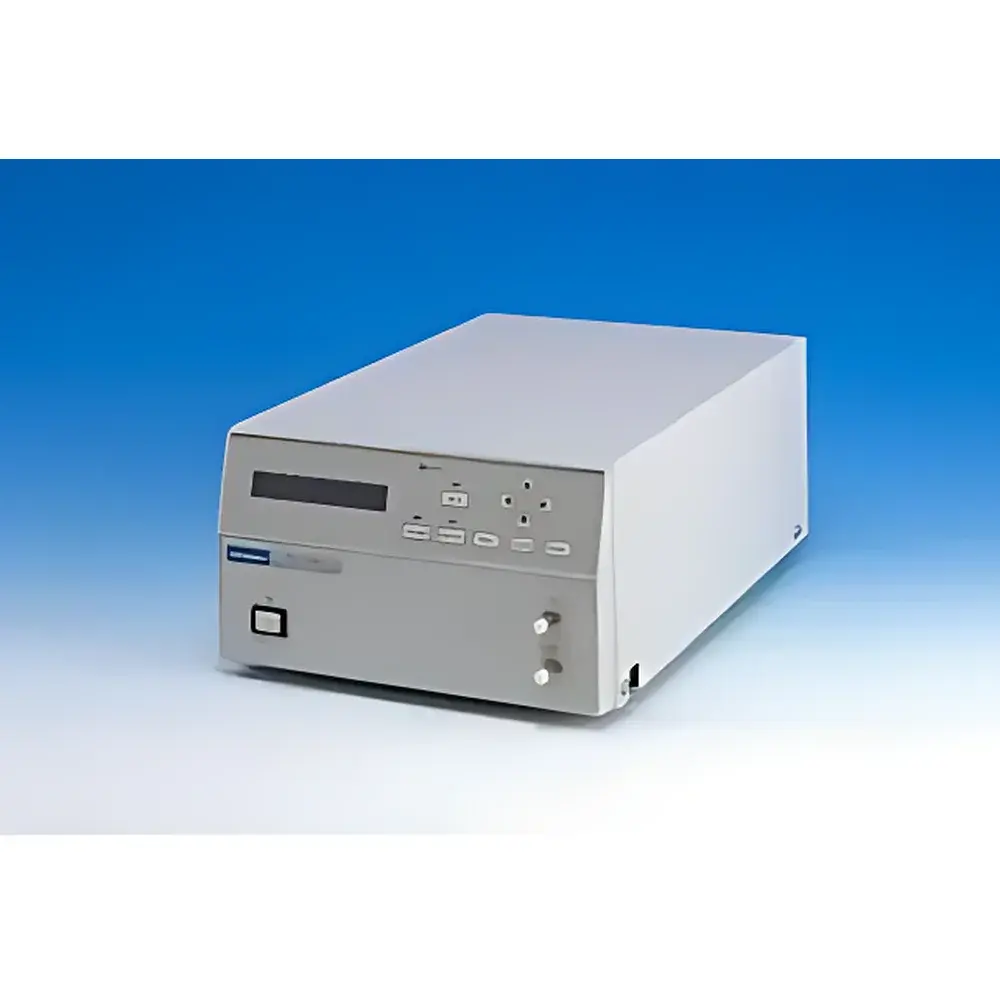
Shodex RI-201H Refractive Index Detector
| Brand | Shodex |
|---|---|
| Origin | Japan |
| Model | RI-201H |
| Detection Principle | Differential Refractive Index (dRI) |
| Compatible Systems | HPLC & GPC Platforms |
| Detector Type | Universal Bulk Property Detector |
| Temperature Control | Built-in Thermostatic Cell Housing |
| Output Signal | Analog Voltage (0–1 V) & Digital RS-232 Interface |
| Noise Level | ≤ 2.5 × 10⁻⁹ RIU (RMS, 1 sec time constant) |
| Drift | ≤ 2 × 10⁻⁷ RIU/h (at 40 °C, stabilized) |
| Flow Cell Volume | 8 µL |
| Maximum Flow Rate | 10 mL/min |
| Solvent Compatibility | All HPLC-grade solvents except strong halogenated organics (e.g., chloroform, carbon tetrachloride) |
| Compliance | CE Marked, RoHS Compliant, Designed per IEC 61010-1 for Laboratory Equipment Safety |
Overview
The Shodex RI-201H Refractive Index Detector is a precision-engineered universal detector designed for integration with high-performance liquid chromatography (HPLC) and gel permeation chromatography (GPC) systems. Operating on the differential refractive index (dRI) principle, it measures minute changes in the refractive index between a sample stream and a reference solvent stream—enabling quantitative detection of analytes lacking chromophores or electrochemical activity. Unlike UV-Vis or fluorescence detectors, the RI-201H responds to bulk physical property changes, making it indispensable for carbohydrate analysis, polymer molecular weight distribution profiling, natural product characterization, and excipient quantification in pharmaceutical formulations. Its optical architecture employs a dual-beam, temperature-stabilized flow cell with matched sapphire windows and a solid-state photodiode array, ensuring long-term baseline stability and high signal reproducibility across diverse mobile phases.
Key Features
- Wide refractive index measurement range (1.00–1.75 RIU) with sub-nanorefractive-unit resolution, optimized for both aqueous and organic solvent systems.
- Automatic optical gain compensation via integrated photometric feedback loop—dynamically corrects for signal attenuation caused by flow cell fouling, bubble formation, or solvent viscosity shifts.
- Microprocessor-controlled auto-zero function with <10-second stabilization time; supports manual or scheduled zeroing routines without interrupting chromatographic runs.
- Digital drift compensation algorithm continuously monitors and adjusts baseline offset in real time, reducing post-run baseline correction requirements.
- One-touch reference cell rinse protocol executed via front-panel keypad—eliminates manual solvent switching and minimizes cross-contamination risk during method development.
- Hermetically sealed optical chamber with desiccant-integrated housing prevents internal condensation and protects photodiodes and beam splitters from humidity-induced degradation—critical for unattended overnight operation.
- Native RS-232 interface enables bidirectional communication with major HPLC data systems (e.g., Waters Empower, Agilent OpenLab, Shimadzu LabSolutions) for synchronized method loading, status polling, and alarm logging.
Sample Compatibility & Compliance
The RI-201H accommodates standard 1/16″ stainless steel or PEEK capillary connections and supports flow rates up to 10 mL/min—compatible with analytical, semi-preparative, and GPC columns ranging from 4.6 mm to 20 mm i.d. It is validated for use with common HPLC solvents including water, acetonitrile, THF, DMF, and chlorinated solvents (with caution advised for prolonged exposure to chloroform). The detector conforms to IEC 61010-1:2010 for electrical safety in laboratory equipment and carries CE marking under the EU Machinery Directive. While not intrinsically compliant with FDA 21 CFR Part 11, its digital output and audit-ready event logging (via compatible CDS software) support GLP/GMP-aligned workflows when deployed in validated environments. Routine performance verification follows ASTM D5296 (for GPC) and USP guidelines for detector suitability testing.
Software & Data Management
The RI-201H operates as a plug-and-play peripheral within established chromatography data systems (CDS). Its analog output (0–1 V, full-scale corresponding to ±5 × 10⁻⁶ RIU) integrates seamlessly with analog input modules, while the RS-232 port transmits real-time detector status (temperature, zero status, error flags), calibrated RIU values, and diagnostic logs. Firmware supports user-defined zero thresholds and configurable alarm triggers (e.g., temperature deviation > ±0.5 °C, signal noise exceeding 5 × 10⁻⁹ RIU RMS). When paired with Shodex’s optional RI Manager software (v3.2+), users gain access to automated calibration curve generation using sucrose or polystyrene standards, batch report templating, and export to CSV, PDF, or CDF formats compliant with LIMS ingestion protocols.
Applications
- Gel Permeation Chromatography (GPC/SEC): Quantitative determination of polymer molar mass distributions (Mn, Mw, Đ) for synthetic polymers, biopolymers, and dendrimers.
- Carbohydrate Analysis: Detection of mono-/di-/oligosaccharides in food, fermentation broths, and glycoprotein digests—especially where UV transparency limits alternative detection.
- Pharmaceutical Excipient Profiling: Assay of polyethylene glycols (PEGs), polysorbates, and hydroxypropyl methylcellulose (HPMC) in drug product formulations.
- Natural Product Isolation: Monitoring neutral fractions in column chromatography eluates without derivatization.
- Quality Control of Solvent Blends: Verification of composition homogeneity in mixed mobile phases prior to system priming.
FAQ
Is the RI-201H compatible with UHPLC systems operating above 1000 bar?
No—the RI-201H is rated for maximum inlet pressure of 0.5 MPa (5 bar); it must be installed post-column with appropriate backpressure regulation for UHPLC applications.
Does the detector require helium sparging for optimal noise performance?
Helium degassing of solvents is recommended but not mandatory; the built-in temperature stabilization and low-noise optical design achieve specification-grade performance with standard vacuum-degassed solvents.
Can the RI-201H be used with gradient elution methods?
Yes—though dRI detectors exhibit inherent gradient sensitivity, the auto-zero and drift compensation functions mitigate baseline disturbances, enabling robust gradient-compatible operation when paired with low-gradient-index solvents (e.g., water/methanol).






