
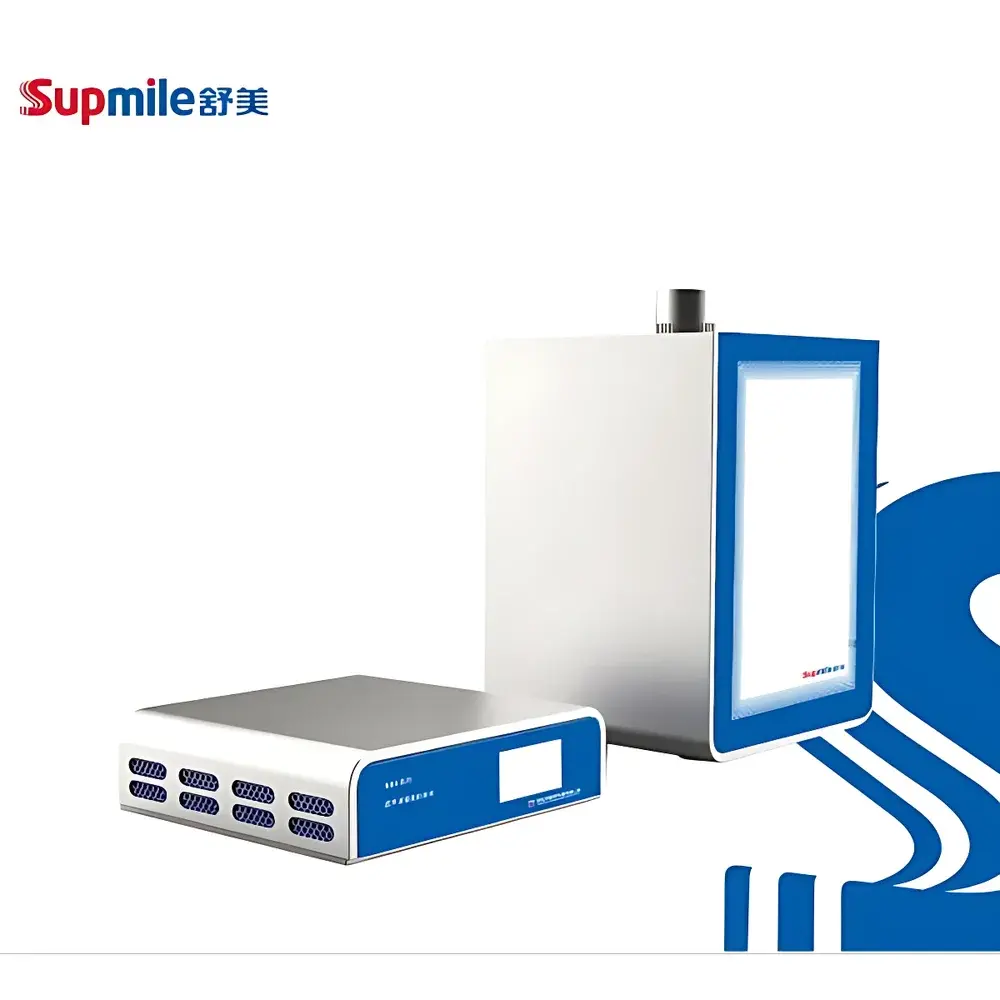
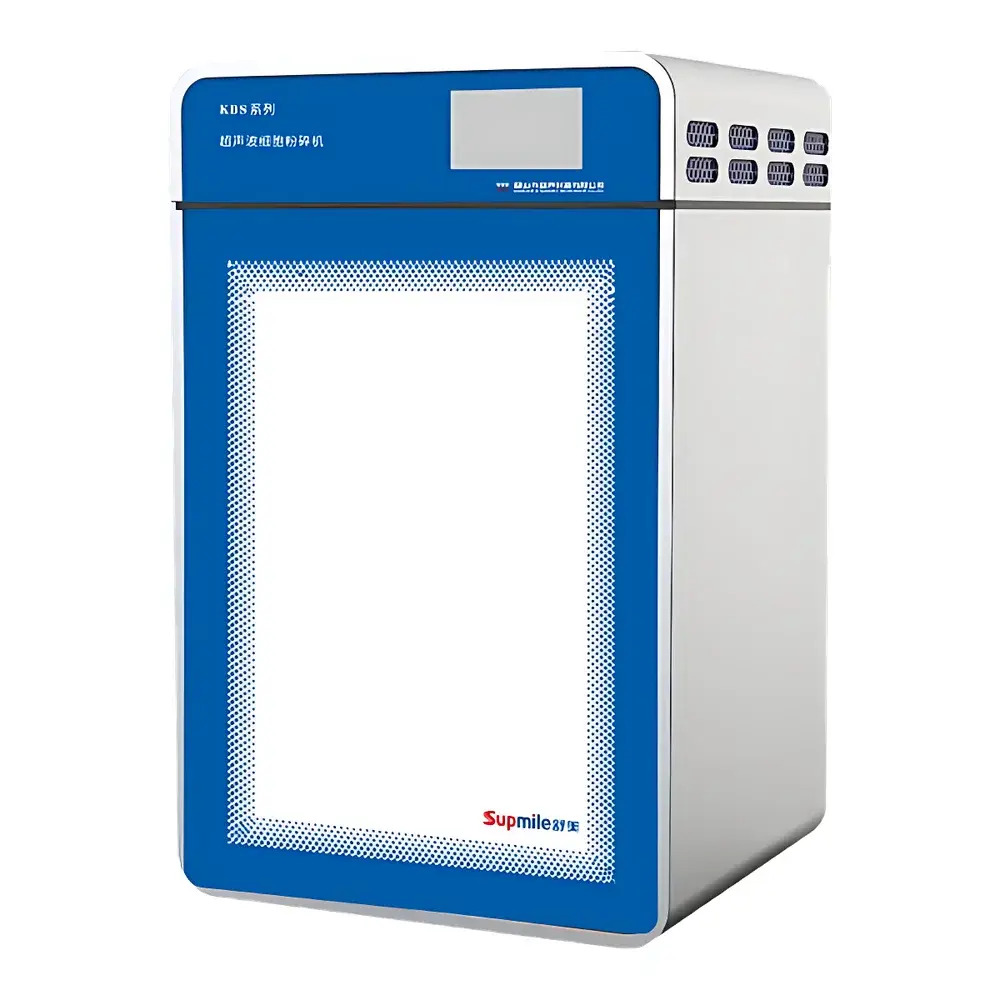
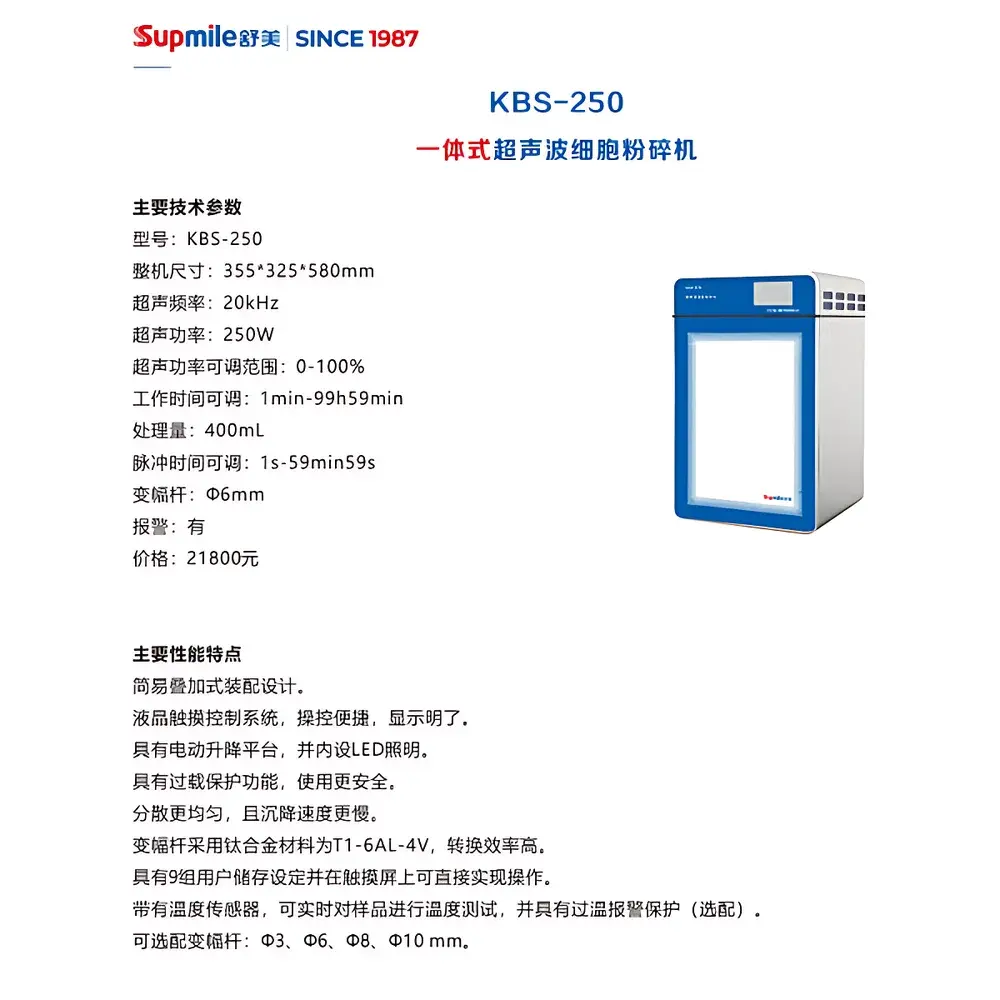
Shumei KBS-250 Integrated Ultrasonic Cell Disruptor
| Brand | Shumei |
|---|---|
| Origin | Jiangsu, China |
| Manufacturer Type | Direct Manufacturer |
| Instrument Category | Domestic |
| Model | KBS-250 |
| Quotation | ¥21,800 |
| Instrument Type | Ultrasonic Cell Disruptor |
| Ultrasonic Frequency | 20 kHz |
| Ultrasonic Power | 250 W |
| Power Adjustment Range | 0–100% |
| Time Setting Range | 1 min – 99 h 59 min |
| Pulse Duration Adjustment | 1 s – 59 min 59 s |
| Sample Volume Capacity | 400 mL |
| Horn Diameter Options | Φ3, Φ6 (standard), Φ8, Φ10 mm |
| Horn Material | Ti-6Al-4V Titanium Alloy |
| Safety Features | Overload Protection, Overtemperature Alarm (optional), LED Illumination, Motorized Vertical Stage |
| Control Interface | LCD Touchscreen |
| Memory Presets | 9 User-Defined Programs |
| Dimensions (W×D×H) | 355 × 325 × 580 mm |
| Temperature Monitoring | Real-time Sensor with Threshold Alert (optional) |
Overview
The Shumei KBS-250 Integrated Ultrasonic Cell Disruptor is a benchtop sonication system engineered for reproducible and scalable cell lysis, nanoparticle dispersion, emulsification, and tissue homogenization in life science laboratories. It operates on the principle of high-intensity ultrasonic cavitation—where rapid pressure fluctuations induced by 20 kHz acoustic energy generate transient microbubbles in liquid media; their collapse produces localized shear forces, microstreaming, and shockwaves sufficient to disrupt cellular membranes and subcellular structures without significant thermal denaturation when operated under controlled duty cycles. Designed as an all-in-one unit, the KBS-250 integrates transducer, generator, motorized vertical positioning stage, and touchscreen controller into a single compact chassis—eliminating external cables, alignment complexity, and inter-unit compatibility constraints common in modular systems.
Key Features
- Integrated motorized vertical stage with fine-resolution height adjustment (±0.1 mm), enabling precise horn immersion depth control and repeatable probe-to-sample geometry across experiments.
- High-efficiency Ti-6Al-4V titanium alloy horn (standard Φ6 mm) with superior acoustic impedance matching and corrosion resistance—optimized for long-term stability under continuous or pulsed operation.
- Full-range ultrasonic power output (0–250 W) with digital regulation and real-time feedback, supporting both continuous and programmable pulse modes (1 s–59 min 59 s on/off intervals) to minimize sample heating and preserve labile biomolecules.
- Intuitive 7-inch capacitive LCD touchscreen interface with multilingual support (English default), graphical time/power profile preview, and nine non-volatile user-programmable memory slots for method recall and SOP compliance.
- Dual-safety architecture: hardware-based overload detection (current/voltage monitoring) coupled with optional real-time temperature sensing (PT100 probe) and configurable overtemperature cutoff (e.g., >45 °C) to meet GLP-relevant thermal management requirements.
- Integrated LED illumination beneath the sample chamber enhances visual monitoring of suspension homogeneity, foam formation, or phase separation during processing.
Sample Compatibility & Compliance
The KBS-250 accommodates aqueous and organic solvent-based suspensions up to 400 mL volume in standard cylindrical vessels (e.g., 50–500 mL beakers or jacketed reactors). Its variable horn diameter options (Φ3, Φ6, Φ8, Φ10 mm) allow optimization for viscosity, particle size distribution, and throughput: smaller tips deliver higher energy density for viscous lysates or small-volume nucleic acid extraction; larger tips improve bulk mixing efficiency in protein solubilization or nanomaterial synthesis. The system complies with IEC 61000-6-3 (EMC emission limits) and IEC 61000-6-2 (immunity standards). While not certified for ISO 13485 or FDA 21 CFR Part 11 out-of-the-box, its audit-trail-capable parameter logging (via optional USB export) supports internal validation protocols aligned with GMP/GLP documentation practices.
Software & Data Management
No proprietary PC software is required for basic operation—the KBS-250 functions autonomously via its embedded controller. However, time-stamped operational logs—including start/stop timestamps, applied power %, total sonication duration, pulse cycle configuration, and (if equipped) temperature readings—are stored internally and exportable via USB flash drive in CSV format. This enables traceability for method verification, equipment qualification (IQ/OQ), and deviation investigations. Users may integrate exported data into LIMS or ELN platforms using standard parsing scripts. Firmware updates are delivered via USB and include version-controlled release notes referencing changes to timing accuracy, safety thresholds, or UI responsiveness.
Applications
- Microbial cell disruption (E. coli, yeast, Bacillus spp.) for recombinant protein recovery and inclusion body solubilization.
- Chromatin shearing in ChIP-seq workflows—achieving fragment sizes between 200–600 bp with optimized pulse parameters.
- Nanoparticle deagglomeration and uniform dispersion in polymer matrices or colloidal suspensions for DLS or TEM sample prep.
- Tissue homogenization of liver, brain, or tumor biopsies in RIPA or QIAzol lysis buffers prior to RNA/DNA isolation.
- Preparation of liposomes and nanoemulsions where controlled cavitation avoids surfactant degradation observed with high-shear rotor-stators.
FAQ
What is the maximum recommended sample volume for consistent cavitation efficiency?
For optimal energy transfer and minimal standing-wave interference, the KBS-250 is validated for volumes between 10–400 mL in standard glass or stainless-steel containers. Volumes below 10 mL require Φ3 mm horn and reduced power settings to avoid excessive localized heating.
Is the temperature sensor included as standard equipment?
No—the PT100 temperature probe and associated alarm logic are optional accessories. When installed, it provides real-time monitoring with user-defined upper threshold (default 45 °C) and automatic shutdown upon breach.
Can the KBS-250 be integrated into automated liquid handling workflows?
While lacking native RS-232 or Ethernet ports, the device supports TTL-level external trigger input (0–5 V) for synchronized start/stop commands from PLCs or robotic arms—enabling semi-automated batch processing in QC labs.
How often does the titanium horn require recalibration or maintenance?
Ti-6Al-4V horns do not require periodic calibration; however, visual inspection for pitting or tip erosion is recommended after every 200 hours of cumulative operation. Replacement is advised if tip diameter deviation exceeds ±0.05 mm or if cavitation efficiency drops significantly despite cleaning.
Does the system support validation documentation for regulated environments?
Yes—upon request, Shumei provides Factory Acceptance Test (FAT) reports, electrical safety certificates (IEC 61010-1), and a configurable electronic log template compliant with ALCOA+ principles for internal IQ/OQ execution.
Related Products



