
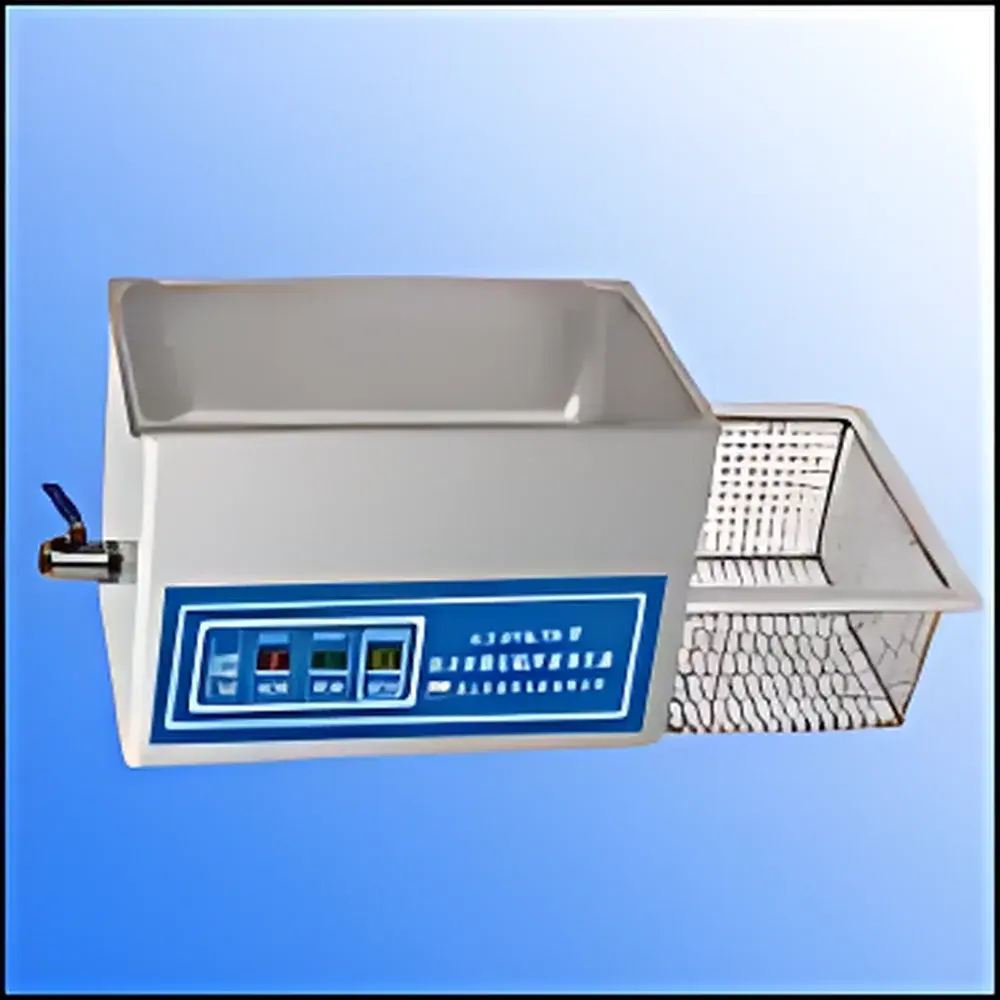
Shumei KQ-100B Benchtop Ultrasonic Cleaner
| Brand | Shumei |
|---|---|
| Origin | Jiangsu, China |
| Model | KQ-100B |
| Tank Capacity | 4 L |
| External Dimensions (L×W×H) | 320×174×260 mm |
| Inner Tank Dimensions (L×W×H) | 300×150×100 mm |
| Ultrasonic Frequency | 40 kHz |
| Total Ultrasonic Power | 100 W |
| Heating Power | 800 W |
| Temperature Range | 0–80 °C |
| Timer Range | 1–20 min |
Overview
The Shumei KQ-100B Benchtop Ultrasonic Cleaner is an integrated, compact cleaning system engineered for precision and reliability in laboratory, academic, and light industrial environments. It operates on the principle of high-frequency ultrasonic cavitation—generating microscopic implosions in liquid media at 40 kHz—to effectively remove particulate contaminants, organic residues, and surface-adhered films from delicate components, glassware, instrumentation parts, and biological samples. Unlike modular systems requiring external generators or water baths, the KQ-100B features a fully integrated transducer assembly directly bonded to the stainless steel tank bottom, ensuring optimal energy transfer, consistent acoustic field distribution, and long-term mechanical stability. Its 4-liter capacity and ergonomic footprint (320 × 174 × 260 mm) make it suitable for benchtop deployment in QC labs, university teaching facilities, R&D cleanrooms, and small-scale manufacturing support areas where space efficiency and operational simplicity are critical.
Key Features
- Integrated Ultrasonic Generator: Eliminates signal loss and impedance mismatch by embedding the 40 kHz piezoelectric transducers directly into the tank structure—no external cables or coupling gels required.
- Stainless Steel Construction: Both inner tank (300 × 150 × 100 mm) and outer housing fabricated from high-grade 304 stainless steel for corrosion resistance, thermal stability, and compliance with ISO 14644-1 Class 8 cleanroom-compatible surface requirements.
- Programmable Digital Timer: Adjustable ultrasonic activation from 1 to 20 minutes with automatic shutdown—enabling repeatable process standardization across sample batches.
- Heated Cleaning Capability: Independent 800 W heating element with PID-controlled temperature regulation (0–80 °C), supporting enhanced solubilization of waxes, greases, and biofilms without compromising thermal integrity of heat-sensitive substrates.
- Standard Accessories Included: Removable stainless steel wire mesh basket (included) for secure sample positioning and protection; integrated drain valve for rapid, spill-free solution exchange; no sound-dampening lid provided—intended for use in controlled ambient noise environments per ANSI S1.13-2020 guidelines.
Sample Compatibility & Compliance
The KQ-100B accommodates a broad range of sample types—including optical lenses, microfluidic chips, surgical instruments, printed circuit boards, ceramic filters, and biological tissue culture vessels—without mechanical abrasion or solvent dependency. Its 40 kHz frequency delivers balanced cavitation intensity: sufficient for particle dislodgement yet gentle enough to avoid pitting or erosion of soft metals (e.g., aluminum alloys) and coated surfaces. While not certified to IEC 61000-6-3 for EMC emissions or EN 61000-6-2 for immunity, the unit meets general-purpose electrical safety standards applicable to Class I laboratory equipment under GB 4793.1–2007 (equivalent to IEC 61010-1). For GLP/GMP-aligned workflows, users may document timer settings, bath temperature, and cycle duration as part of SOP-defined cleaning validation protocols.
Software & Data Management
The KQ-100B is a standalone analog-digital hybrid instrument with no embedded firmware, network interface, or data logging capability. All operational parameters—including time, temperature, and power activation—are set via front-panel membrane switches and displayed on a dual-segment LED indicator. This design prioritizes electromagnetic compatibility (EMC), mechanical robustness, and regulatory traceability: no software validation (e.g., FDA 21 CFR Part 11) is required, simplifying qualification in regulated environments where audit trails are maintained manually or via external LIMS integration. Users performing routine cleaning validation may record settings using standardized log sheets compliant with ISO/IEC 17025 clause 7.7 (result reporting).
Applications
- Pre-analytical preparation of HPLC vials, GC injectors, and spectrophotometer cuvettes
- Removal of flux residues from PCB assemblies prior to AOI inspection
- Deagglomeration of nanoparticle suspensions for DLS or TEM sample prep
- Cell lysis optimization in microbiology and molecular biology workflows
- Cleaning of precision optics, watch components, and dental prosthetics
- Supporting ASTM D2240 (Shore A hardness) and ISO 4618 (coating thickness) sample conditioning steps
FAQ
Is the KQ-100B suitable for cleaning delicate MEMS devices?
Yes—its 40 kHz frequency and adjustable 1–20 min cycle allow fine-tuned exposure to minimize mechanical stress while achieving effective contaminant removal. Use low-temperature aqueous solutions and verify compatibility with device packaging materials.
Does the unit include a degassing function?
While not explicitly labeled “degas mode,” the 40 kHz ultrasonic field inherently promotes dissolved gas nucleation and removal during initial operation—typically within the first 2–5 minutes before initiating the main cleaning cycle.
Can the heating and ultrasonics operate simultaneously?
Yes. The system supports concurrent heating and ultrasonic activation, enabling thermally assisted cleaning protocols critical for removing hydrophobic residues.
What maintenance is required for long-term reliability?
Routine cleaning of the tank interior with mild detergent, periodic inspection of the drain valve seal, and verification of transducer adhesion integrity every 6 months—especially after prolonged operation above 60 °C.
Is calibration documentation available?
No factory calibration certificate is supplied; however, users may perform functional verification using ASTM E1721-16 (standard practice for verifying ultrasonic cleaner performance) with aluminum foil erosion testing or thermometric response checks.



