
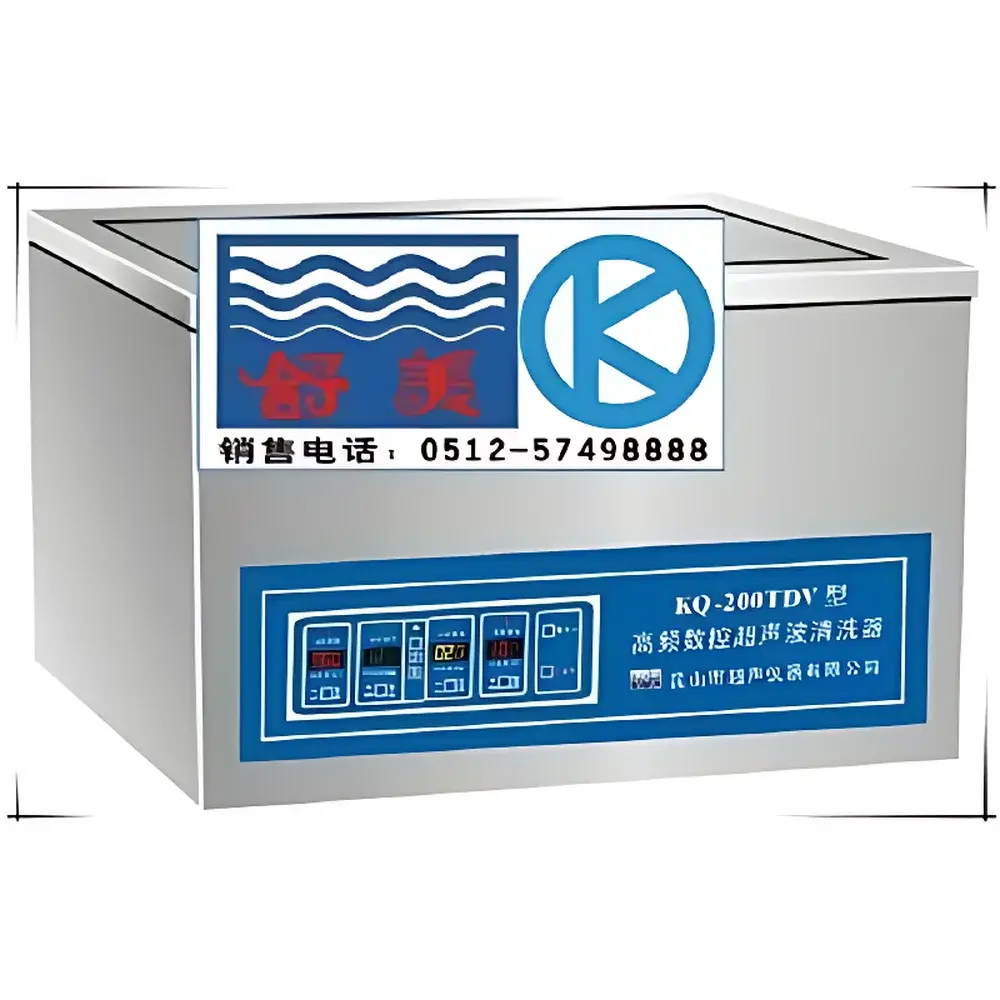
Shumei KQ-200TDV Desktop High-Frequency Digital Ultrasonic Cleaner
| Brand | Shumei |
|---|---|
| Origin | Jiangsu, China |
| Manufacturer Type | Direct Manufacturer |
| Country of Origin | China |
| Model | KQ-200TDV |
| Dimensions (W×D×H) | 410 × 350 × 380 mm |
| Inner Tank Dimensions | 300 × 150 × 180 mm |
| Capacity | 8 L |
| Ultrasonic Frequency | 80 kHz |
| Ultrasonic Power Output | 200 W |
| Power Adjustment Range | 40–100 % |
| Fill Level Range | 1–140 mm |
| Heating Power | 600 W |
| Temperature Control Range | 10–80 °C |
| Timer Range | 1–480 min |
| Cumulative Operating Time Counter | 999999 h |
| Heating Element | Immersed Stainless Steel |
| Tank Material | 304 Stainless Steel |
| Lid | Acoustic-Dampening Stainless Steel Cover with Vapor Recovery System |
| Basket Material | Polypropylene |
| Water Inlet/Drain | Electrically Actuated Solenoid Valves |
| Protection Features | Overvoltage/Overcurrent Indication, Low-Liquid-Level Lockout, Dry-Run Prevention, Real-Time Temperature & Level Monitoring |
Overview
The Shumei KQ-200TDV is a desktop-grade, high-frequency digital ultrasonic cleaner engineered for precision laboratory and light industrial applications requiring stringent control over cleaning efficacy, thermal stability, and process repeatability. Unlike conventional low- to mid-frequency (20–40 kHz) ultrasonic systems—whose cavitation dynamics favor macro-scale particle removal—the KQ-200TDV operates at a fixed 80 kHz frequency, generating finer, more densely distributed cavitation bubbles. This higher-frequency regime enhances microscale contaminant removal from complex geometries, delicate substrates (e.g., optical lenses, MEMS components, semiconductor wafers), and porous surfaces without inducing surface erosion or acoustic streaming-induced sample displacement. The unit integrates a fully sealed stainless steel tank (304 grade), electronically controlled fill/drain valves, and an integrated vapor recovery lid designed to minimize solvent evaporation and reduce ambient volatile organic compound (VOC) exposure—critical for labs operating under OSHA or ISO 14001 environmental compliance frameworks.
Key Features
- High-resolution digital interface displaying real-time and setpoint values for ultrasonic power (40–100 %), temperature (10–80 °C), fill level (1–140 mm), elapsed time (1–480 min), and cumulative operational hours (up to 999,999 h)
- Dual-sensor liquid-level monitoring system with dry-run prevention and automatic shutdown upon low-fluid detection
- Microprocessor-controlled heating circuit with ±1 °C thermal stability and PID-based regulation for uniform bath temperature distribution
- Acoustically optimized stainless steel lid incorporating condensate return channels to recover evaporated cleaning solvents—reducing consumable loss and improving lab safety
- Electromechanically actuated water inlet and drain valves enabling programmable fill cycles and automated bath replacement
- Integrated overvoltage and overcurrent protection with visual LED indicators; fault logging accessible via front-panel display
- Tank constructed from seamless 304 stainless steel with radiused corners to prevent residue accumulation and facilitate cleaning validation per ISO 13485 or FDA 21 CFR Part 820 requirements
Sample Compatibility & Compliance
The KQ-200TDV supports aqueous, alcohol-based, and mild alkaline cleaning solutions compatible with common laboratory materials including glassware, quartz cuvettes, metal calibration standards, ceramic filters, and polymer-based microfluidic chips. Its 80 kHz operation minimizes risk of pitting on soft metals (e.g., aluminum, copper alloys) and avoids delamination in multilayered substrates. The unit complies with IEC 61000-6-3 (EMC emission limits) and IEC 61000-6-2 (immunity to electrostatic discharge and conducted disturbances). While not certified for sterile processing per ISO 17664 or EN 13060, its consistent cavitation intensity and traceable parameter logging support GxP-aligned cleaning validation protocols when paired with documented SOPs and periodic performance qualification (PQ) testing.
Software & Data Management
All operational parameters—including temperature setpoint, ultrasonic power level, fill height, timer duration, and real-time bath temperature—are stored in non-volatile memory and retained after power cycling. The embedded microcontroller logs cumulative runtime and displays last-used settings on startup—supporting audit-ready documentation for GLP environments. No external PC connection or proprietary software is required; however, the unit’s repeatable parameter recall enables integration into automated lab workflows via optional RS-232 or TTL-level digital I/O interfaces (available as OEM add-on). All displayed values meet NIST-traceable accuracy specifications for temperature (±1.0 °C) and time (±0.5 s/min), satisfying internal quality system requirements for instrument calibration records.
Applications
- Pre-analytical sample preparation: removal of organic residues from HPLC vials, GC autosampler needles, and ICP-MS nebulizer components
- Surface decontamination of electron microscopy grids and TEM specimen holders prior to coating
- Cell lysis and homogenization in low-volume biological samples (e.g., tissue lysates, bacterial pellets) where mechanical shear must be minimized
- De-gassing of viscous solvents (e.g., silicone oils, glycerol-water mixtures) prior to microfluidic device filling
- Removal of photoresist residues and flux contaminants from PCB prototypes and SMT stencils
- Supporting ASTM D2621 (ultrasonic cleaning verification) and ISO 11553-1 (laser product safety—cleaning of optical elements) test procedures
FAQ
What is the maximum allowable solvent temperature during ultrasonic operation?
The system maintains safe thermal operation up to 80 °C; however, for flammable solvents (e.g., acetone, isopropanol), operation above 45 °C is not recommended without additional ventilation or explosion-proof certification.
Can the unit operate without heating enabled?
Yes—temperature control is fully independent of ultrasonic activation. Users may run cold ultrasonic cycles (e.g., for heat-sensitive biomolecules) with heater disabled.
Is the plastic basket chemically resistant to common lab solvents?
The standard polypropylene basket exhibits compatibility with water, ethanol, isopropanol, and dilute NaOH/KOH solutions; it is not resistant to chlorinated solvents (e.g., chloroform) or strong oxidizers (e.g., concentrated HNO₃).
How is ultrasonic power calibrated and verified?
Power output is factory-calibrated using calorimetric measurement per ASTM E1739 and verified annually via thermal rise rate testing in standardized water load conditions.
Does the unit support remote start/stop or data export?
Base configuration includes local keypad control only; RS-232 communication module and custom firmware for SCADA integration are available upon request for OEM deployment.



