
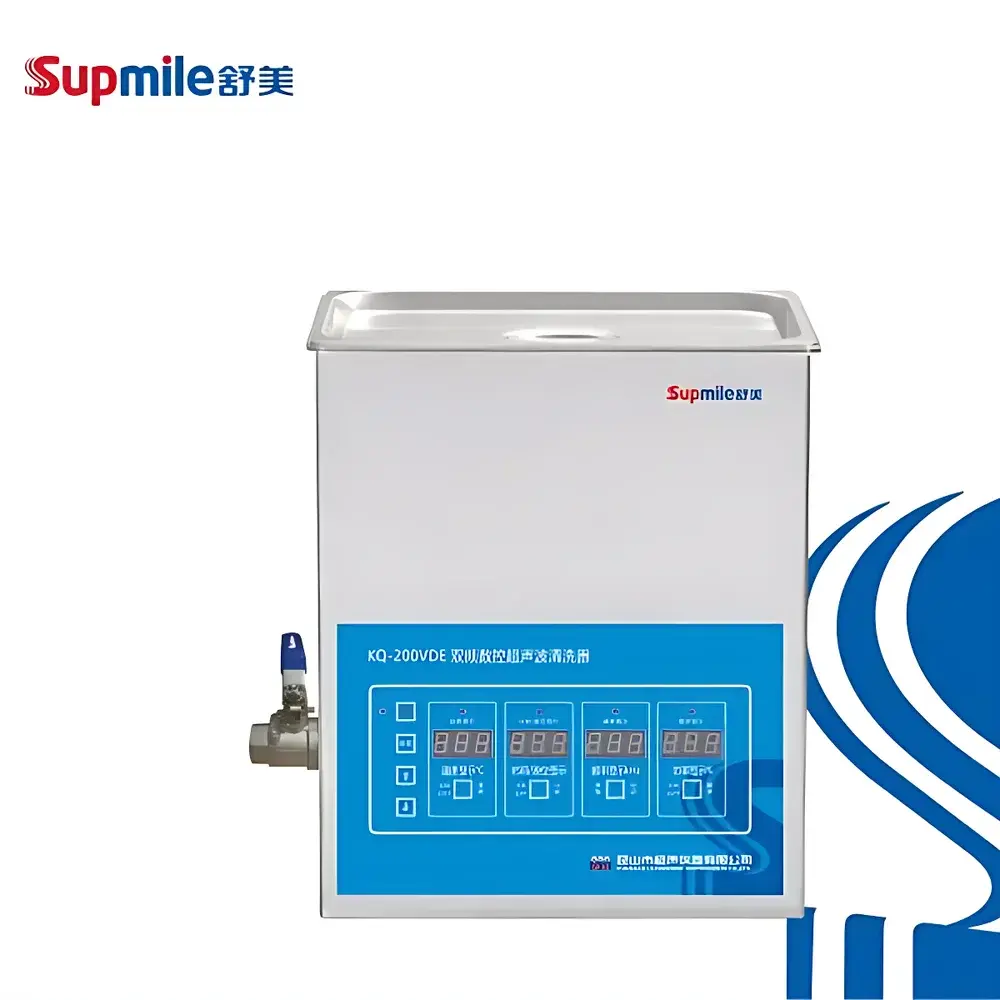
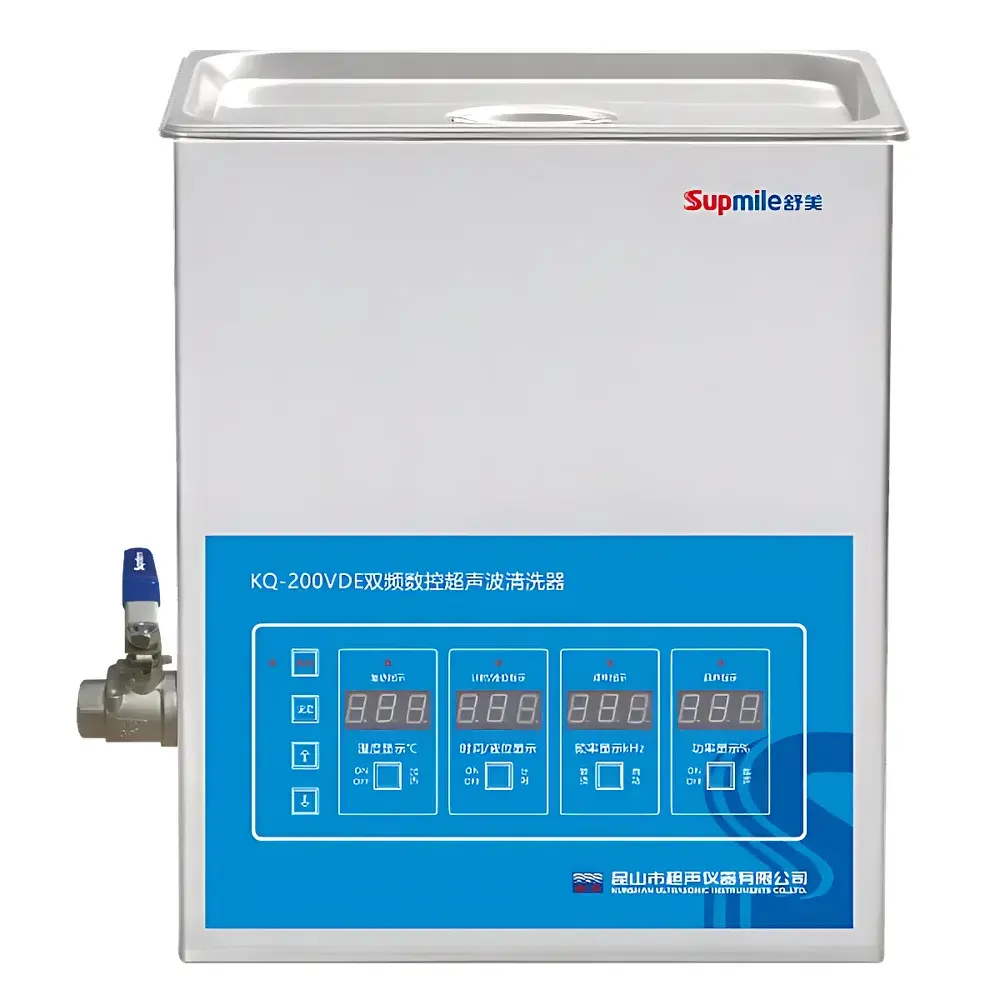
Shumei KQ-200VDE Dual-Frequency Digital Ultrasonic Cleaner
| Brand | Shumei |
|---|---|
| Origin | Jiangsu, China |
| Manufacturer Type | Direct Manufacturer |
| Product Category | Domestic |
| Model | KQ-200VDE |
| Instrument Type | General-Purpose |
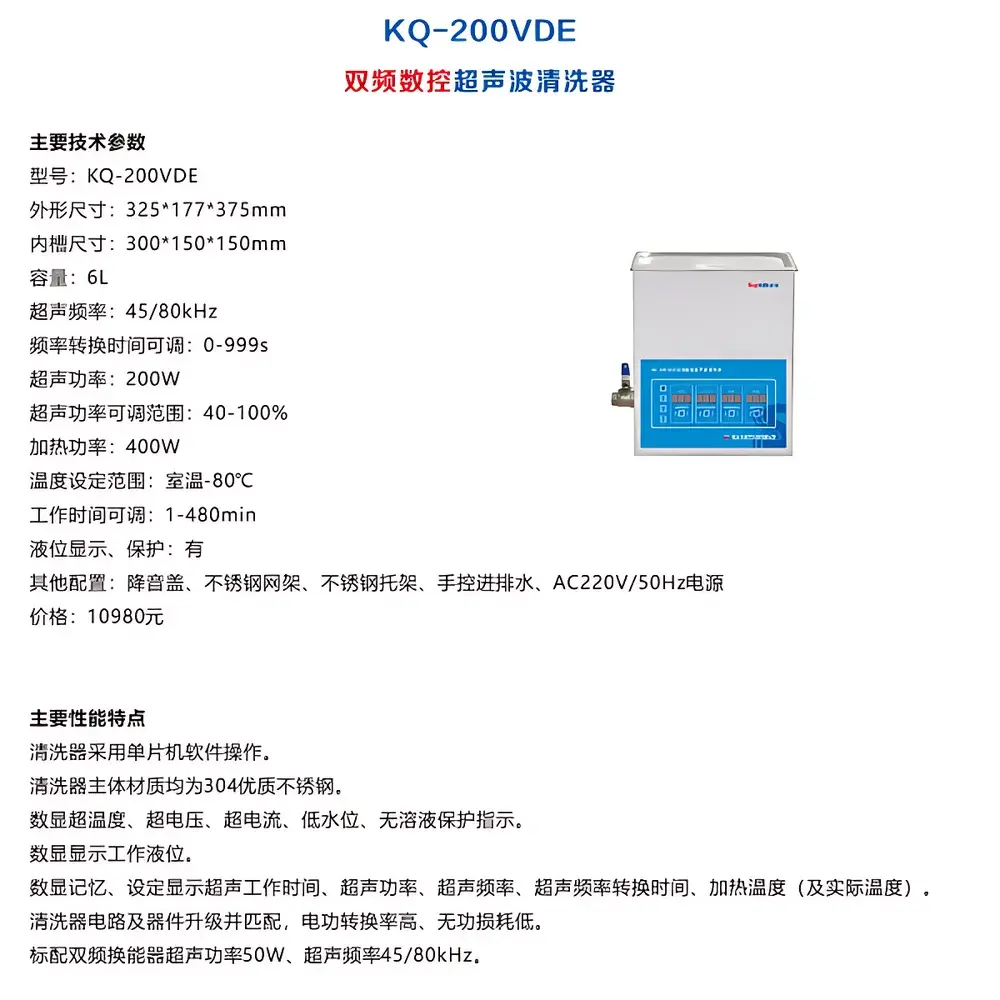
| Tank Capacity | 6 L |
| Ultrasonic Frequencies | 45 kHz / 80 kHz |
| Ultrasonic Power Output | 200 W |
| Power Adjustment Range | 40–100% |
| Heating Temperature Range | Ambient to 80 °C |
| Timer Range | 1–480 min |
| Sound-Dampening Lid | Yes |
| Manual Fill/Drain | Yes |
Overview
The Shumei KQ-200VDE Dual-Frequency Digital Ultrasonic Cleaner is an engineered solution for precision cleaning of delicate laboratory components, optical elements, analytical instrumentation parts, and small-volume sample containers. It operates on the principle of cavitation-induced acoustic energy transfer in liquid media—generated simultaneously at two discrete ultrasonic frequencies (45 kHz and 80 kHz)—to address a broader spectrum of contaminant particle sizes and adhesion strengths. The lower frequency (45 kHz) delivers higher-energy cavitation bubbles suitable for robust particulate removal from machined metal surfaces or glassware with dried residues; the higher frequency (80 kHz) produces finer, more densely distributed cavitation events ideal for gentle yet effective cleaning of microfluidic channels, semiconductor wafers, and coated optics without surface erosion. Designed for routine QC/QA laboratories, R&D facilities, and maintenance workshops, the KQ-200VDE integrates digital process control with industrial-grade 304 stainless steel construction, ensuring long-term stability under repeated thermal and mechanical cycling.
Key Features
- Dual-frequency ultrasonic generation (45 kHz and 80 kHz), independently selectable or alternated via programmable frequency-switching intervals (0–999 s)
- Digital microcontroller-based operation with real-time display of ultrasonic power (%), operating frequency, temperature setpoint and actual bath temperature, elapsed time, and liquid level status
- Adjustable ultrasonic power output (40–100% of 200 W nominal), enabling optimization for sensitive substrates or high-load cleaning cycles
- Integrated heating system (400 W) with precise temperature control from ambient to 80 °C, supporting aqueous and mild solvent-based cleaning protocols
- Programmable timer (1–480 minutes) with automatic shutdown and audible end-of-cycle alert
- Comprehensive safety protection suite: low-level liquid detection, overtemperature cutoff, overcurrent monitoring, overvoltage regulation, and dry-run prevention
- Sound-dampening lid included as standard equipment to reduce operational noise and minimize solvent evaporation
- Stainless steel tank (300 × 150 × 150 mm internal dimensions) and accessories—including mesh basket and support rack—constructed from AISI 304 stainless steel for corrosion resistance and cleanroom compatibility
Sample Compatibility & Compliance
The KQ-200VDE accommodates a wide range of laboratory items including HPLC vials, pipette tips, filter housings, cuvettes, microscope slides, electrode assemblies, and small-volume reaction vessels. Its dual-frequency architecture enhances compatibility across material classes: metals (stainless steel, aluminum, titanium), ceramics, borosilicate glass, and select polymers (e.g., PTFE, polypropylene) when used within recommended temperature and exposure limits. While not certified for ISO 13485 or FDA 21 CFR Part 11 compliance out-of-the-box, the device supports GLP/GMP-aligned workflows through its repeatable parameter logging (via manual recording), stable thermal and acoustic performance, and traceable operational settings. Users may integrate it into validated cleaning processes per ASTM D4712 (Standard Guide for Selection of Cleaning Agents) or ISO 15883-1 (washer-disinfectors), provided ancillary validation documentation (e.g., thermocouple mapping, particle count verification) is performed per institutional SOPs.
Software & Data Management
The KQ-200VDE operates via embedded firmware with no external PC dependency. All operational parameters—including frequency selection, power level, temperature setpoint, timer duration, and frequency-switching interval—are stored in non-volatile memory and recalled upon power-up. The LED display provides continuous feedback on real-time bath temperature, active frequency mode, and remaining cycle time. Although the unit lacks USB/Ethernet connectivity or exportable data logs, its deterministic digital interface ensures high inter-run reproducibility—a critical requirement for method transfer between laboratories or during equipment qualification (IQ/OQ). For regulated environments, users may document parameter inputs and outcomes manually or via external environmental monitoring systems synchronized to cycle initiation.
Applications
- Cleaning of chromatography columns, injector ports, and detector flow cells prior to system suitability testing
- Removal of organic residue and biofilm from reusable cell culture flasks and bioreactor components
- Preparation of calibration standards by eliminating adsorbed contaminants from volumetric glassware
- Surface decontamination of electron microscopy grids and TEM specimen holders
- Post-fabrication cleaning of MEMS devices and precision-machined metrology fixtures
- Routine maintenance of pH electrodes, conductivity probes, and dissolved oxygen sensors
FAQ
Is the KQ-200VDE suitable for use with flammable solvents?
No. This unit is designed exclusively for aqueous solutions and water-miscible, non-flammable cleaning agents. Use with volatile organic solvents (e.g., acetone, ethanol above 30% v/v, chlorinated hydrocarbons) is prohibited due to lack of explosion-proof certification and absence of vapor containment features.
Can the ultrasonic frequency be operated simultaneously at both 45 kHz and 80 kHz?
No. The dual-frequency capability refers to sequential or alternating operation—not concurrent emission. Users select one frequency at a time or define a timed switching pattern between them.
What is the maximum allowable fill volume for optimal cavitation efficiency?
For consistent performance, the tank should be filled between 3 L and 6 L. Operating below 3 L risks transducer overheating and inconsistent energy distribution; overfilling beyond the marked level compromises cavitation intensity and may trigger low-level alarms.
Does the unit include a degassing function?
No dedicated degas mode is provided. However, initiating ultrasonic operation at reduced power (40–60%) for 5–10 minutes prior to full-power cleaning achieves effective dissolved gas removal in most aqueous baths.
Is calibration or annual verification required?
While no factory calibration certificate is supplied, users are advised to verify temperature accuracy annually using a NIST-traceable thermometer and confirm timer fidelity with a calibrated stopwatch as part of routine equipment maintenance per ISO/IEC 17025 or internal QA protocols.



