
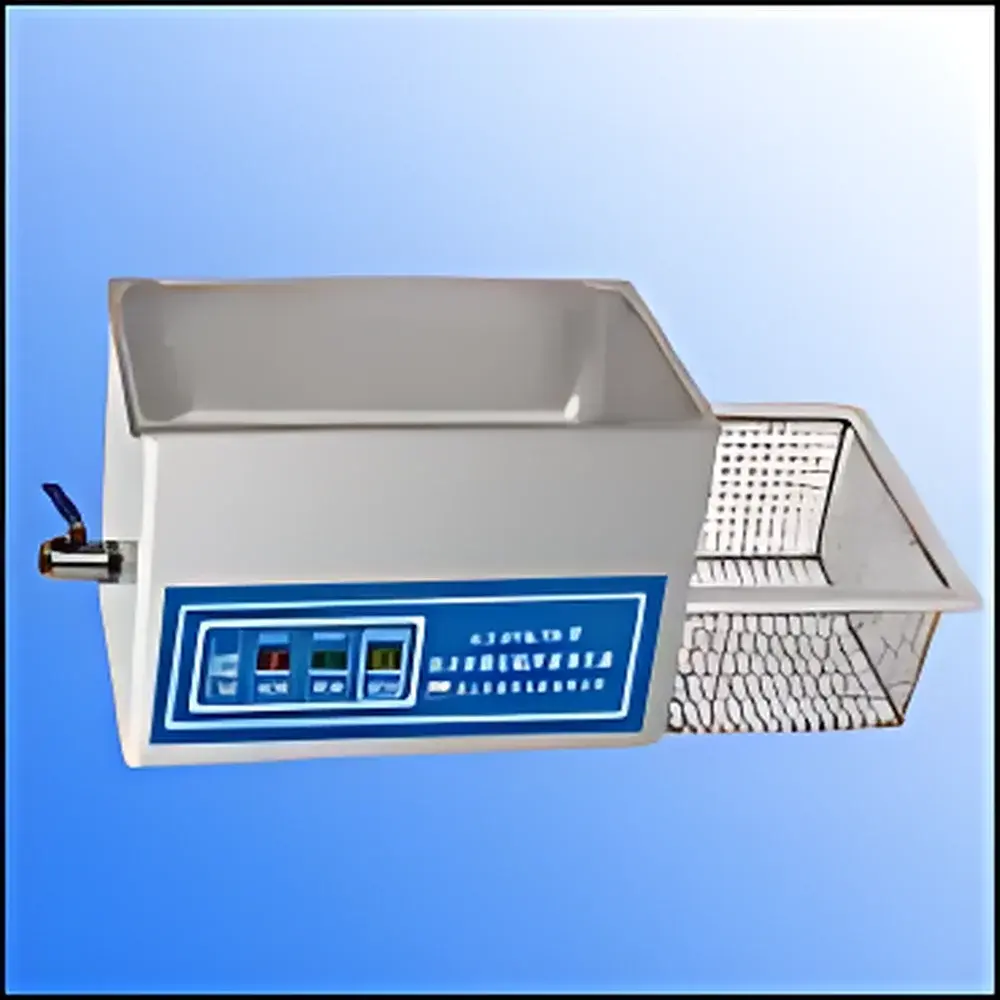
Shumei KQ-250DE Desktop Digital Ultrasonic Cleaner
| Brand | Shumei |
|---|---|
| Origin | Jiangsu, China |
| Model | KQ-250DE |
| Ultrasonic Frequency | 40 kHz |
| Ultrasonic Power | 250 W |
| Power Adjustment Range | 40–100 % |
| Heating Power | 600 W |
| Temperature Control Range | 20–80 °C |
| Timer Range | 1–480 min |
| Tank Capacity | 10 L |
| Internal Tank Dimensions | 300 × 240 × 150 mm |
| Overall Dimensions | 320 × 264 × 340 mm |
| Material | Stainless Steel (304) Tank & Housing |
| Digital Display | Yes |
| Drain Valve | Yes |
| Lid with Sound-Dampening | Yes |
| Stainless Steel Mesh Basket | Yes |
| Protection Features | Low-water, over-temperature, over-voltage, over-current |
| Cumulative Operating Time Counter | Up to 999,999 hours |
Overview
The Shumei KQ-250DE is a precision-engineered desktop digital ultrasonic cleaner designed for routine and critical cleaning tasks in analytical laboratories, quality control environments, and R&D facilities. It operates on the principle of high-frequency ultrasonic cavitation—generating microscopic vacuum bubbles in aqueous or solvent-based cleaning solutions that implode with localized energy, dislodging particulate contaminants, organic residues, and biofilms from complex geometries without mechanical abrasion. With a nominal frequency of 40 kHz and an adjustable ultrasonic output of 250 W (40–100% linear control), the unit delivers consistent energy distribution across its 10-liter stainless steel tank (300 × 240 × 150 mm internal dimensions). The integrated 600 W heating system enables temperature-controlled cleaning between 20 °C and 80 °C—critical for optimizing detergent efficacy, reducing surface tension, and accelerating contaminant solubilization. Its robust 304 stainless steel construction—including welded mesh basket and sound-dampening lid—ensures long-term corrosion resistance and operator safety in regulated environments.
Key Features
- Digital microprocessor control with real-time display of set and actual ultrasonic power, heating temperature, elapsed time, and cumulative operating hours (up to 999,999 h)
- Programmable timer (1–480 minutes) with auto-shutdown and audible alert
- Adjustable ultrasonic intensity (40–100%) to match sample sensitivity and contamination load
- Integrated thermal protection circuitry with over-temperature, over-voltage, and over-current monitoring
- Low-level liquid detection with automatic shutdown to prevent transducer damage
- Stainless steel (304) tank and housing—electropolished interior for enhanced cleanability and compliance with ISO 15195 and CLSI EP29-A standards
- Sound-dampening lid reduces ambient noise to ≤55 dB(A) at 1 m—meeting OSHA workplace exposure guidelines
- Drain valve for rapid, spill-free solution exchange; compatible with waste containment protocols
- Single-chip firmware architecture ensures deterministic response, repeatability, and firmware stability over extended service life
Sample Compatibility & Compliance
The KQ-250DE accommodates a broad range of laboratory components including glassware (vials, cuvettes, pipettes), metal parts (surgical instruments, calibration standards), ceramic substrates, and polymer-based microfluidic devices. Its uniform acoustic field—validated per ASTM E1731-21 (Standard Practice for Verification of Ultrasonic Cleaning Equipment)—supports cleaning validation for ISO 13485-certified medical device manufacturing and USP particulate matter testing preparation. The unit meets IEC 61010-1:2010 safety requirements for laboratory electrical equipment and complies with RoHS 2011/65/EU directives. While not FDA 21 CFR Part 11–certified out-of-the-box, its deterministic operation, non-volatile parameter memory, and audit-ready cumulative hour counter facilitate integration into GLP/GMP workflows when paired with documented SOPs and periodic verification procedures.
Software & Data Management
The KQ-250DE utilizes embedded firmware—not external PC software—to manage all operational parameters. All settings—including power level, temperature setpoint, timer duration, and date of manufacture—are stored in non-volatile memory and retained after power cycling. The cumulative hour counter serves as a maintenance tracking tool for scheduled transducer inspection and preventive servicing. For regulated users, the device supports traceable calibration via external thermocouple verification (per ISO/IEC 17025) and acoustic output mapping using calibrated hydrophones (per IEC 62127-1). No proprietary drivers or cloud connectivity are required, minimizing cybersecurity risk and ensuring compatibility with air-gapped lab networks.
Applications
- Pre-analytical preparation of HPLC, GC, and ICP-MS sample vials and autosampler components
- Cleaning of optical lenses, interferometer mirrors, and photomask substrates prior to metrology
- Removal of flux residues and solder paste from PCB assemblies in electronics QA labs
- Decontamination of reusable surgical tools and dental handpieces under ISO 15883-1
- Supporting ASTM D3417 (thermal analysis sample prep) and ASTM D2156 (soot residue removal)
- Surface activation of polymers and metals prior to coating or adhesion testing
- Disaggregation of nanoparticle agglomerates in suspension-based formulation development
FAQ
What is the recommended cleaning solution for general laboratory use?
Aqueous alkaline detergents (e.g., Alconox® or Liquinox®) at 1–2% concentration are optimal for most inorganic and organic residues. Avoid chlorinated solvents unless explicitly validated for compatibility with 304 stainless steel and sealed transducer housings.
Can the KQ-250DE be used for sterilization?
No. Ultrasonic cleaning removes bioburden but does not achieve sterility. It is a prerequisite step before autoclaving, ethylene oxide, or hydrogen peroxide plasma sterilization per ISO 17664.
How often should the tank solution be changed?
Solution replacement is task-dependent. For high-throughput QC labs, change daily or after every 8–10 cleaning cycles. Monitor pH and conductivity; discard if turbidity increases or surfactant depletion is observed.
Is calibration required, and how frequently?
Temperature calibration using a NIST-traceable thermometer is recommended quarterly. Acoustic output verification (via hydrophone or calorimetric method) is advised annually or after 1,000 operating hours.
Does the unit support external data logging?
No native RS-232 or USB interface is provided. Parameter logging requires manual entry into LIMS or ELN systems based on front-panel display readings.



