
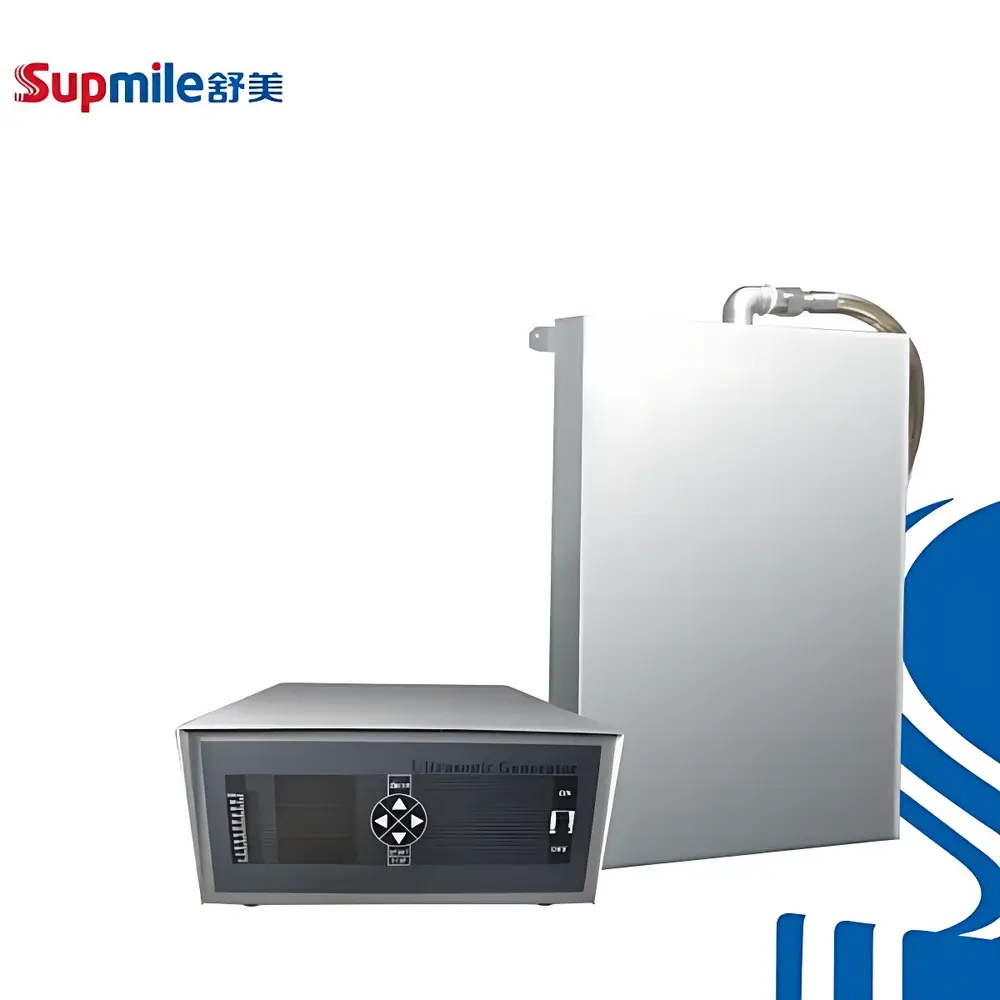
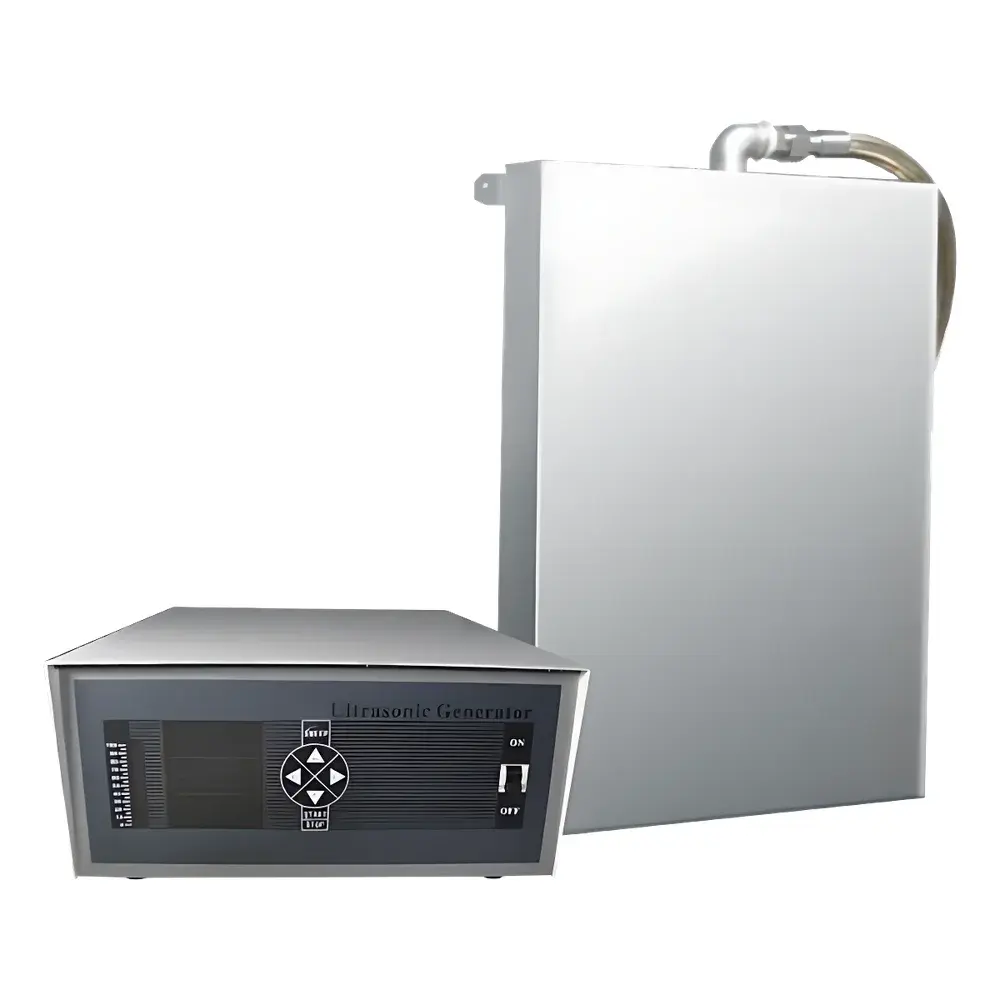
Shumei KQ-3000ZB Immersion Ultrasonic Transducer Plate
| Brand | Shumei |
|---|---|
| Origin | Jiangsu, China |
| Manufacturer Type | Direct Manufacturer |
| Product Category | Domestic |
| Model | KQ-3000ZB |
| Instrument Type | General-Purpose Ultrasonic Cleaner |
| Ultrasonic Frequency | 28 kHz or 40 kHz |
| Ultrasonic Power Output | 3000 W |
| Power Adjustment Range | 0–100% |
| Temperature Control Range | 0–40 °C |
| Timer Range | 0–9999 s |
| Generator Dimensions | 370 × 290 × 130 mm |
| Transducer Plate Dimensions | 1200 × 450 × 100 mm |
| Construction Material | Full 316L Stainless Steel |
| Protection Features | Over-Temperature & Over-Current Protection |
| Display | Triple Digital LCD (Frequency, Current, Elapsed Time) |
| Communication Interface | Standard Remote Control Port |
Overview
The Shumei KQ-3000ZB Immersion Ultrasonic Transducer Plate is an industrial-grade, modular ultrasonic energy delivery system engineered for integration into custom cleaning tanks, passivation baths, solvent degreasing lines, and inline sterilization modules. Unlike benchtop ultrasonic cleaners, this transducer plate is designed for permanent or semi-permanent installation—mounted directly to the bottom or side wall of stainless steel process vessels. It operates on the principle of piezoelectric resonance: high-frequency alternating current drives ceramic transducers bonded to a titanium alloy radiating surface, generating intense cavitation fields in the coupled liquid medium. The dual-frequency capability (28 kHz for aggressive particle removal in heavy-duty applications; 40 kHz for finer, gentler cleaning of delicate optics or microfluidic components) enables process optimization across diverse material classes and contamination profiles.
Key Features
- Full 316L stainless steel construction—resistant to nitric acid, citric acid, alkaline detergents, and organic solvents used in ISO 13485-compliant medical device cleaning validation protocols.
- High-Q piezoelectric transducers with titanium alloy radiating surface ensure consistent acoustic output and extended service life under continuous operation.
- Digital generator with real-time frequency tracking and auto-sweep functionality maintains optimal resonance despite load variation, temperature drift, or fluid level changes—critical for reproducible cleaning validation per ASTM F2793 and ISO 15883-5.
- Triple-parameter digital display shows operating frequency (kHz), real-time RMS current draw (A), and elapsed time (s)—enabling traceable parameter logging during IQ/OQ/PQ qualification.
- Programmable power modulation (0–100%) allows precise energy dosing—essential for avoiding substrate erosion in semiconductor wafer cleaning or preventing delamination in coated optical assemblies.
- Integrated thermal monitoring circuit continuously samples heatsink temperature and throttles output if threshold exceeds 75 °C, ensuring compliance with IEC 61000-6-4 electromagnetic compatibility requirements.
- Standard remote control interface supports dry-contact start/stop and analog 0–10 V signal input for PLC synchronization in automated manufacturing cells.
Sample Compatibility & Compliance
The KQ-3000ZB is validated for use with aqueous alkaline cleaners, deionized water, ethanol, isopropanol, and low-viscosity fluorinated solvents. Its immersion configuration eliminates air gaps and ensures uniform energy distribution across large-volume tanks (up to 300 L capacity). The unit meets CE marking requirements for industrial equipment (2014/30/EU EMC Directive, 2014/35/EU LVD Directive) and conforms to UL 61010-1 safety standards for laboratory and industrial electrical equipment. When deployed in regulated environments—including pharmaceutical cleanrooms (ISO 14644-1 Class 7), medical device reprocessing facilities (AAMI ST79), or GLP-compliant analytical labs—the system supports audit-ready documentation through optional RS-485 Modbus RTU integration for SCADA data capture and 21 CFR Part 11–compliant electronic records when paired with validated software platforms.
Software & Data Management
While the KQ-3000ZB operates as a standalone hardware module, its standard remote port enables seamless integration with LabVIEW, MATLAB, or custom MES systems via TTL-level triggers. Optional RS-485 communication provides read/write access to all operational parameters—including setpoints, real-time status flags, fault codes, and cumulative runtime hours. Logged data can be exported in CSV format for inclusion in cleaning validation reports aligned with FDA Guidance for Industry: Reprocessing Medical Devices in Health Care Settings (2022) and EU MDR Annex I General Safety and Performance Requirements (GSPR 10.2).
Applications
- Automated batch cleaning of surgical instruments prior to steam sterilization (EN ISO 15883-1).
- In-tank ultrasonic activation of enzymatic detergents during endoscope reprocessing workflows.
- Removal of photoresist residues and metal particulates from silicon wafers in semiconductor front-end fabrication.
- Surface activation and micro-roughening of polymer substrates prior to plasma bonding or adhesive application.
- Accelerated extraction of botanical compounds in GMP-compliant phytochemical processing lines.
- Disintegration of biofilm matrices on reusable bioreactor components for cleaning verification (ATP bioluminescence assay support).
FAQ
Can the KQ-3000ZB be operated continuously for 24/7 industrial duty cycles?
Yes—the generator employs forced-air cooling with thermally monitored fans and derates output automatically above 45 °C ambient to maintain component longevity. Mean time between failures (MTBF) exceeds 25,000 hours under rated load conditions.
Is tank material compatibility documented for specific cleaning chemistries?
Material compatibility charts are available upon request, covering resistance to >30 common cleaning agents including Alconox® Tergazyme®, Citranox®, and Deconex® series formulations at temperatures up to 40 °C.
Does the system support validation documentation packages for regulated industries?
Shumei provides Factory Acceptance Test (FAT) reports, IQ/OQ templates, and calibration certificates traceable to NIST standards. On-site PQ support is available through authorized partners in North America and EMEA.
What is the recommended minimum fluid depth for effective cavitation coupling?
A minimum immersion depth of 50 mm above the transducer surface is required to establish stable cavitation field formation. Optimal performance occurs at 100–150 mm depth with homogeneous fluid density and temperature distribution.
How is acoustic output verified after installation?
Users may perform field verification using calibrated hydrophones (e.g., Onda HGL-02) or aluminum foil erosion tests per ASTM E1731-17. Shumei recommends annual acoustic power calibration using calorimetric methods per ISO 13075-2.
Related Products



