
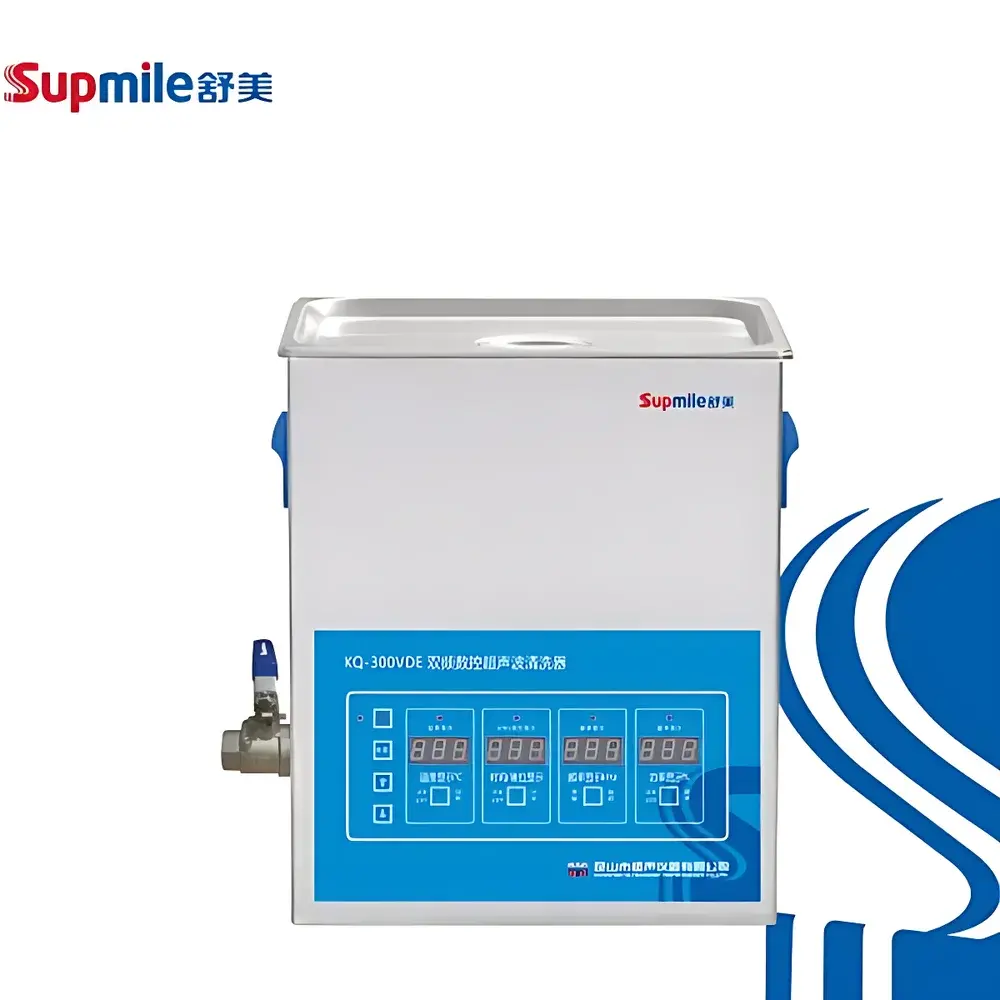
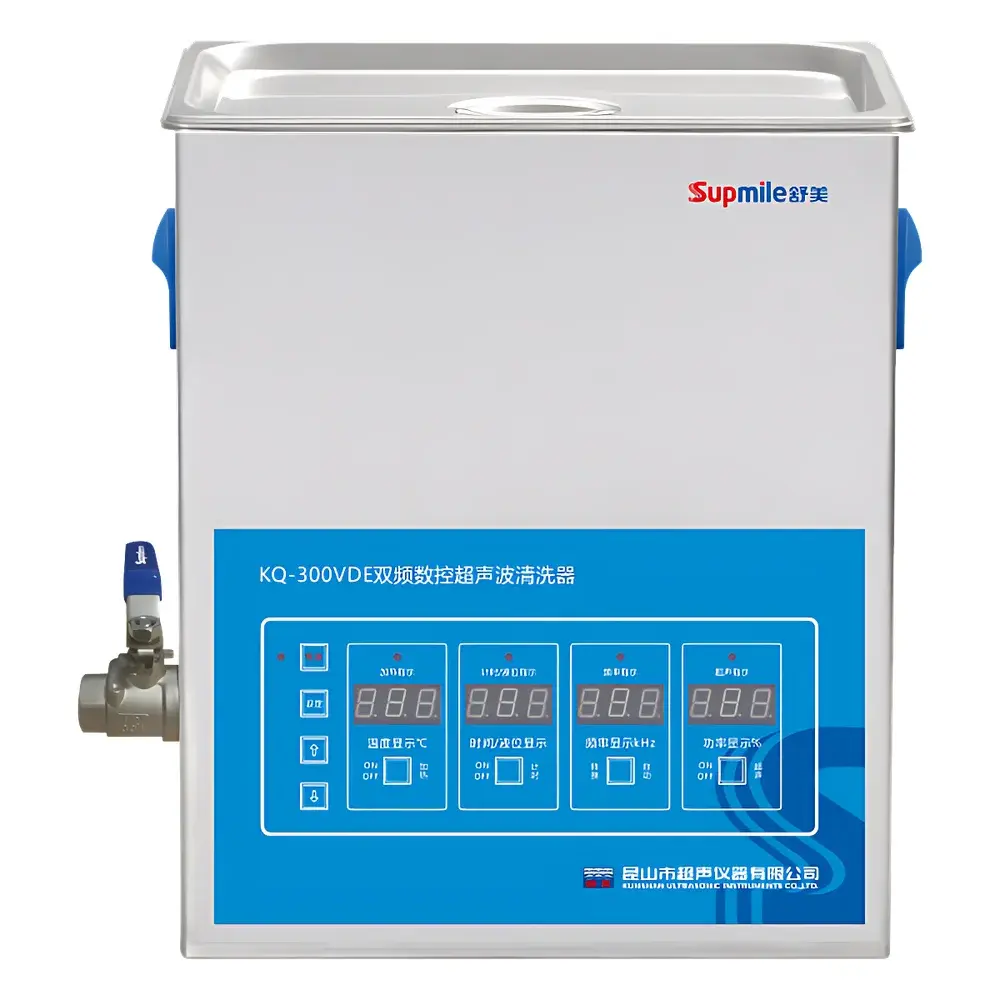
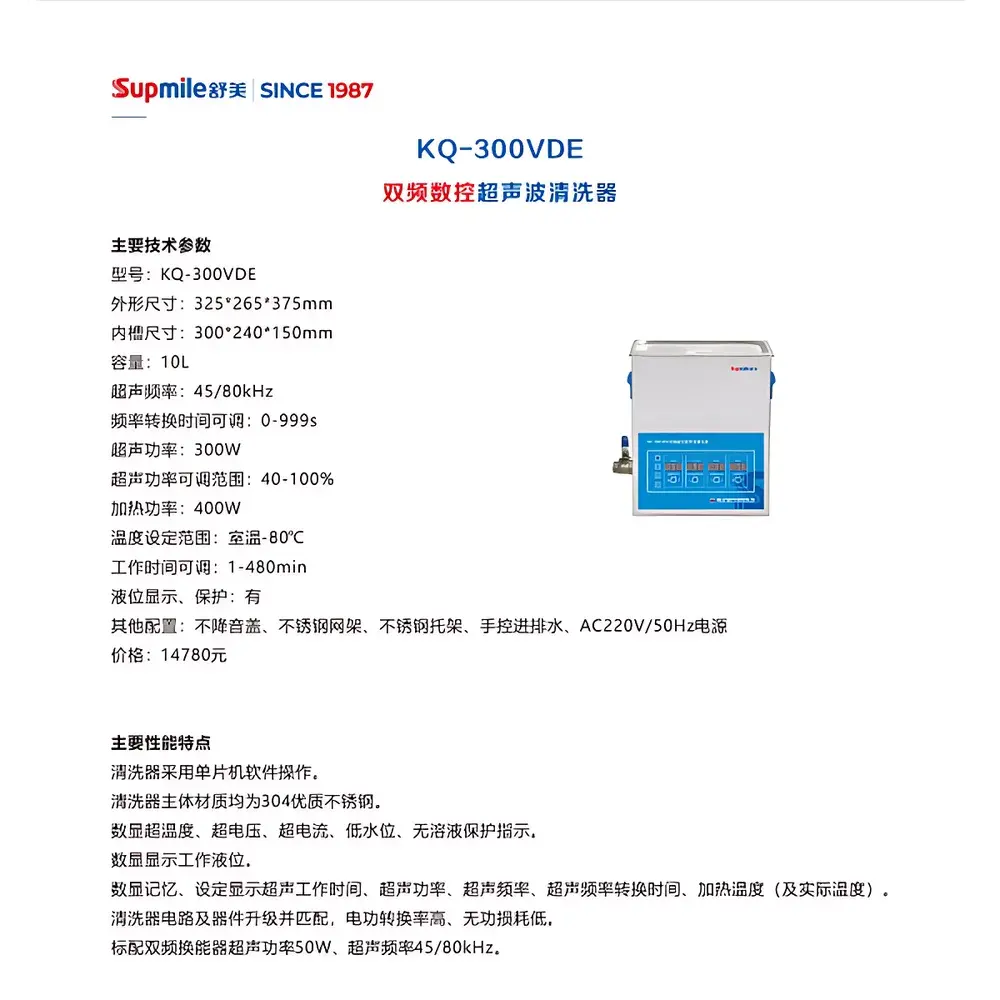
Shumei KQ-300VDE Dual-Frequency Digital Ultrasonic Cleaner
| Brand | Shumei |
|---|---|
| Origin | Jiangsu, China |
| Manufacturer Type | Direct Manufacturer |
| Equipment Type | General-Purpose Ultrasonic Cleaner |
| Tank Capacity | 10 L |
| Ultrasonic Frequencies | 45 kHz / 80 kHz |
| Total Ultrasonic Power Output | 300 W |
| Power Adjustment Range | 40–100% |
| Heating Power | 400 W |
| Temperature Control Range | Ambient to 80 °C |
| Timer Range | 1–480 min |
| Frequency Switching Interval | 0–999 s |
| Tank Dimensions (L×W×H) | 300 × 240 × 150 mm |
| External Dimensions (L×W×H) | 325 × 265 × 375 mm |
| Construction Material | 304 Stainless Steel |
| Safety Features | Low-level liquid detection, over-temperature, over-voltage and over-current protection |
| Display | Digital LED with real-time parameter monitoring |
| Standard Accessories | Stainless steel mesh basket, stainless steel rack, manual fill/drain |
| Power Supply | AC 220 V / 50 Hz |
| Noise Reduction Lid | Not included |
Overview
The Shumei KQ-300VDE Dual-Frequency Digital Ultrasonic Cleaner is an engineered laboratory cleaning system designed for reproducible, non-destructive removal of particulate, organic, and ionic contaminants from precision components, glassware, surgical instruments, and analytical sample preparation vessels. It operates on the principle of acoustic cavitation—where high-frequency sound waves generate transient microbubbles in a liquid medium that collapse violently upon reaching resonance, producing localized shockwaves and microstreaming effects sufficient to dislodge adherent residues without mechanical abrasion. Its dual-frequency capability (45 kHz and 80 kHz) enables application-specific optimization: lower frequency delivers higher cavitation intensity for robust particulate removal from macro-surface geometries, while the higher frequency provides finer, more uniform energy distribution suitable for delicate substrates or sub-micron contaminant detachment.
Key Features
- Dual-frequency ultrasonic generation (45 kHz / 80 kHz) with programmable switching intervals (0–999 s), allowing sequential or alternating operation to maximize cleaning efficacy across heterogeneous sample loads.
- Digitally controlled power output (300 W total, adjustable from 40% to 100%) ensures precise energy delivery matched to solvent compatibility and substrate sensitivity.
- Integrated heating system (400 W, ambient to 80 °C) enhances solvation kinetics and accelerates contaminant dissolution—particularly effective with aqueous alkaline or mild organic solutions.
- Microprocessor-based control panel with LED display continuously monitors and displays real-time parameters: actual and set temperature, elapsed and programmed time, applied power level, active frequency, and frequency-switching countdown.
- Comprehensive safety architecture includes automatic shutdown triggered by low liquid level detection, over-temperature, over-voltage, and over-current conditions—fully compliant with IEC 61010-1 requirements for laboratory electrical equipment.
- 304 stainless steel tank and housing provide corrosion resistance, structural integrity, and long-term compatibility with common cleaning chemistries including aqueous detergents, ethanol, isopropanol, and low-concentration alkaline solutions.
Sample Compatibility & Compliance
The KQ-300VDE accommodates standard laboratory glassware (e.g., volumetric flasks, pipettes, crucibles), metal tools (tweezers, forceps, scalpel handles), ceramic substrates, and polymer components with surface features down to ~100 µm. Its 10 L capacity supports batch processing of up to 12 standard 50 mL centrifuge tubes or four 100 mm Petri dishes simultaneously. While not certified for sterilization per ISO 17664 or EN 285, it meets functional requirements for pre-sterilization cleaning as defined in AAMI ST79 and USP Analytical Instrument Qualification. The unit’s digital logging capability (via optional RS232/USB interface) supports GLP-compliant documentation when integrated into validated cleaning protocols.
Software & Data Management
The built-in firmware supports full parameter recall and retention across power cycles, enabling repeatable method execution without reconfiguration. Time-stamped operational logs—including start/stop timestamps, temperature profiles, and power settings—are accessible via serial export for audit trail generation. When connected to external lab information management systems (LIMS), the device can feed cleaning cycle metadata into electronic batch records. All configuration changes are subject to operator authentication (via physical key switch or password-enabled menu lock), satisfying basic requirements for data integrity under FDA 21 CFR Part 11 Annex 11 when deployed in regulated QC environments.
Applications
- Pre-analytical cleaning of HPLC vials, GC autosampler syringes, and ICP-MS sample introduction components to eliminate memory effects and baseline drift.
- Removal of polishing compounds and oxide layers from optical lenses, semiconductor wafers, and MEMS devices prior to metrology or coating processes.
- Routine decontamination of reusable surgical and dental instruments in research animal facilities and core histology labs.
- Extraction support for solid-phase microextraction (SPME) fiber conditioning and tissue homogenate clarification prior to LC-MS analysis.
- Surface activation of polymeric microfluidic chips before plasma bonding or antibody immobilization steps.
FAQ
Is the KQ-300VDE suitable for cleaning delicate MEMS devices or microfluidic chips?
Yes—when operated at 80 kHz with reduced power (40–60%) and short durations (≤5 min), it achieves effective contaminant removal without inducing mechanical stress or feature erosion.
Can the unit be integrated into an automated lab workflow?
It supports TTL-triggered start/stop via optional I/O module and offers RS232/USB communication for remote command execution and status polling.
Does the heater maintain ±1 °C stability across the full 10 L volume?
Temperature uniformity is ±2.5 °C within the central 70% of the tank volume under static conditions; optimal consistency requires use of a circulating water bath or internal stirrer accessory.
What cleaning solutions are compatible with the 304 stainless steel tank?
Aqueous alkaline detergents (pH 9–11), ethanol, isopropanol, acetone, and diluted citric or phosphoric acid solutions are routinely used; avoid halogenated solvents and strong oxidizers (e.g., nitric acid >10%).
Is validation documentation available for IQ/OQ/PQ protocols?
Shumei provides factory calibration certificates and a configurable URS template; site-specific qualification must be performed per ISO/IEC 17025 guidelines using third-party thermocouples and power meters.



