
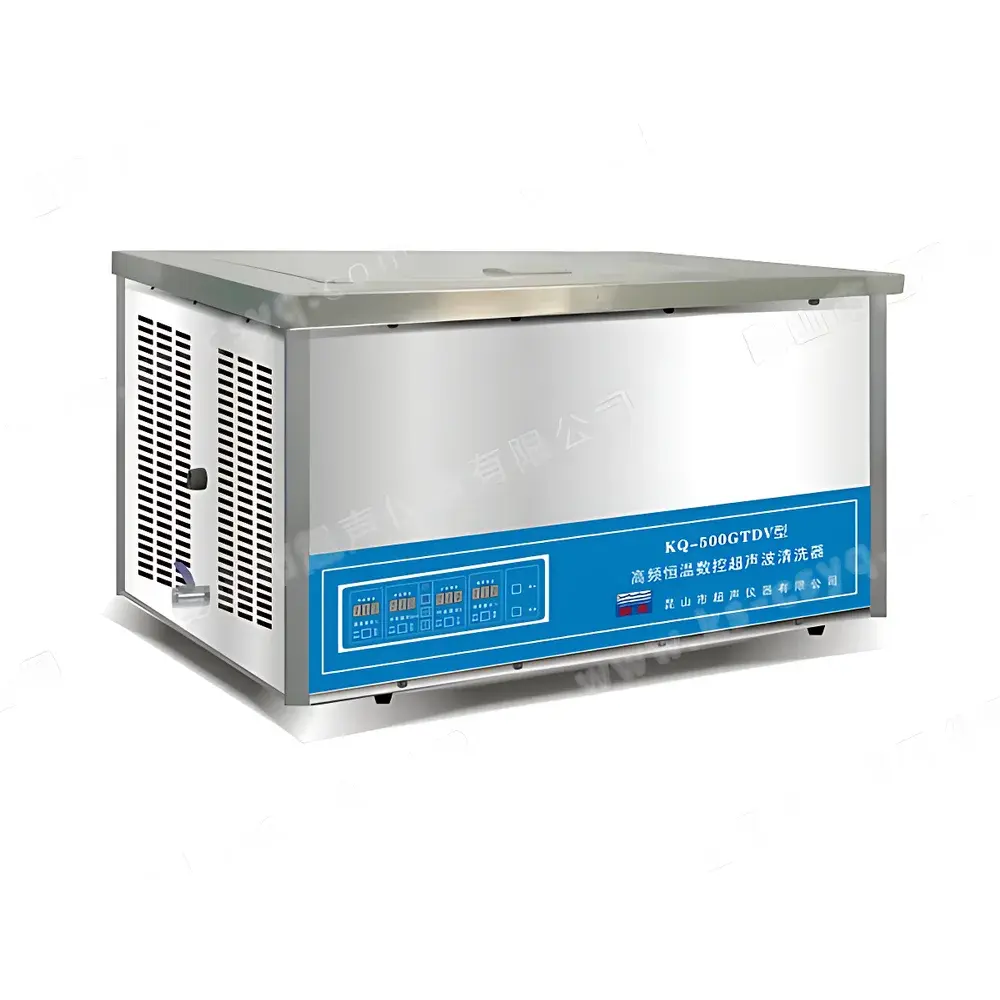
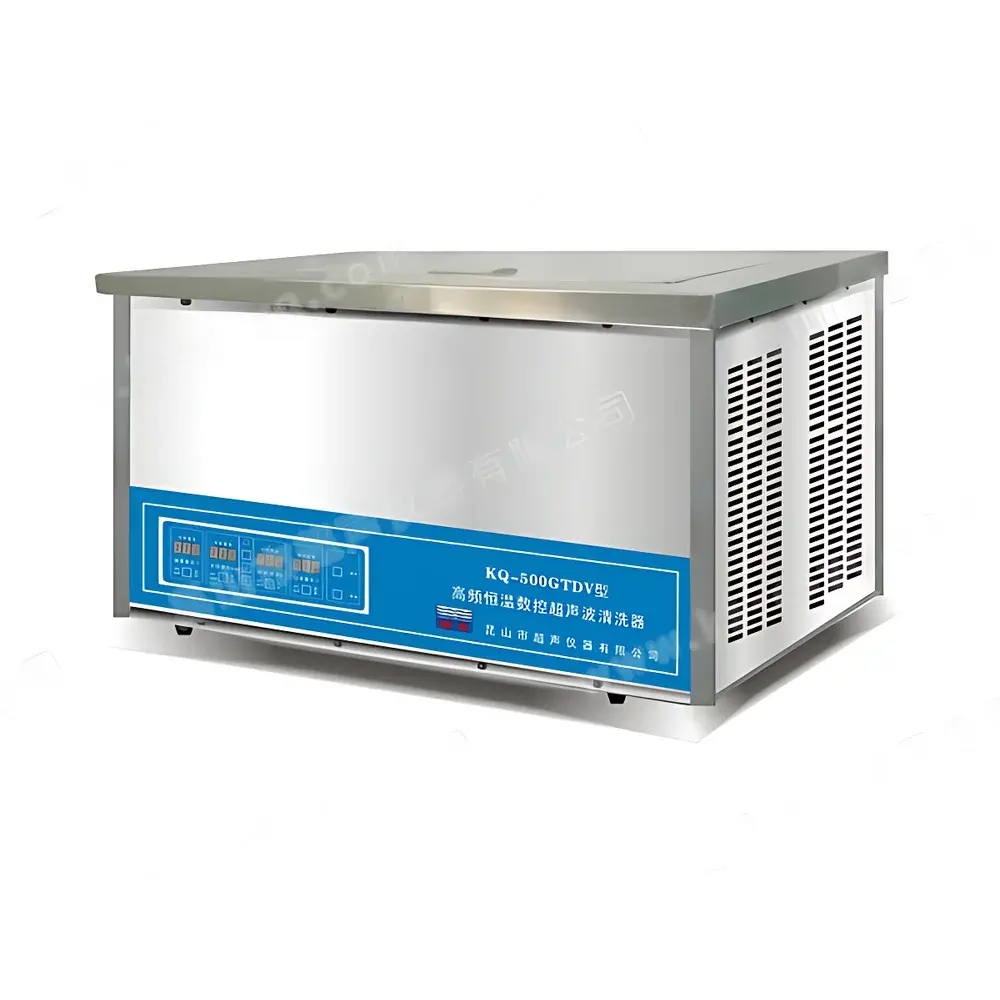
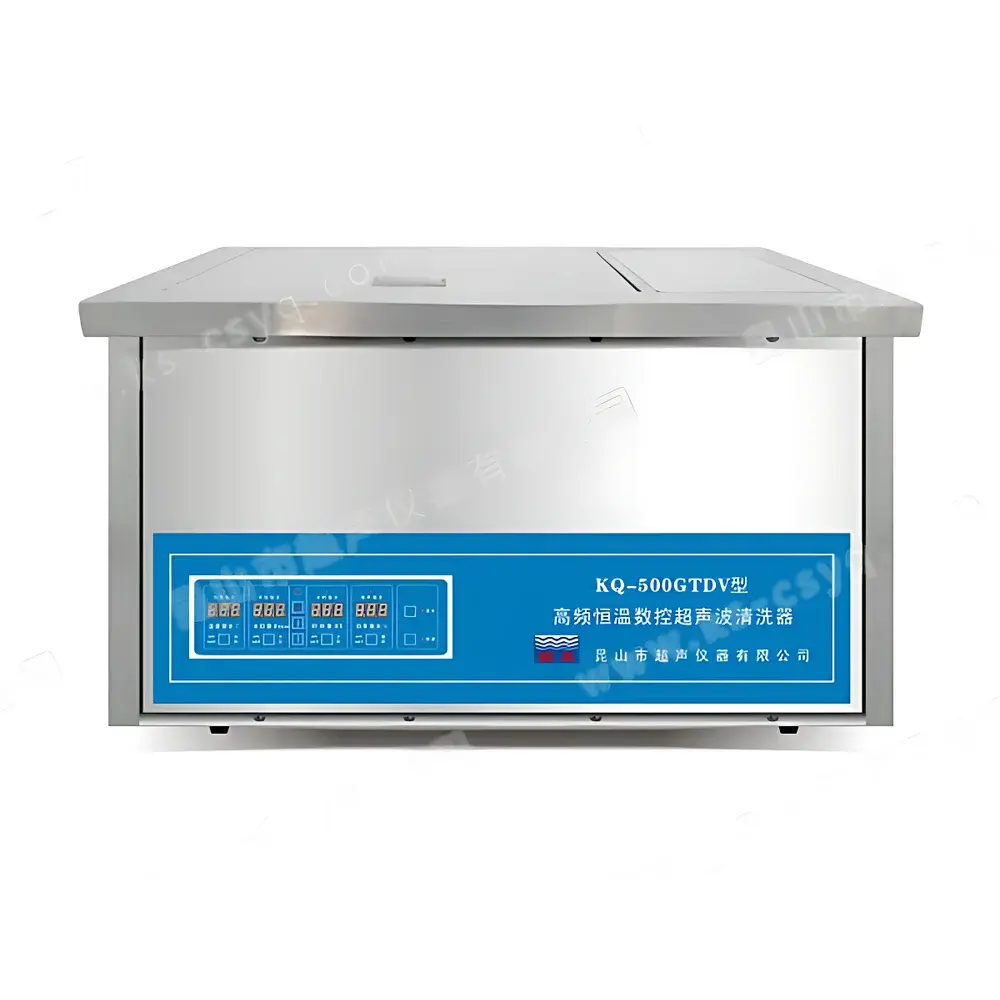
Shumei KQ-500GTDV High-Frequency Programmable Temperature-Controlled Ultrasonic Cleaner
| Brand | Shumei |
|---|---|
| Origin | Jiangsu, China |
| Manufacturer Type | Direct Manufacturer |
| Instrument Type | General-Purpose Ultrasonic Cleaner |
| Capacity | 27 L |
| Ultrasonic Frequency | 80 kHz |
| Ultrasonic Power Output | 500 W (Adjustable 40–100%) |
| Heating Range | 0–80 °C |
| Timer Range | 1–480 min |
| Sound-Dampening Lid | Yes |
| Electrically Controlled Fill/Drain | Yes |
| Tank Dimensions (L×W×H) | 500 × 300 × 180 mm |
| Overall Dimensions (L×W×H) | 910 × 490 × 540 mm |
| Heating Power | 1000 W |
| Cooling Power | 350 W |
| Water Level Detection Range | 80–130 mm |
| Transducer Configuration | High-frequency piezoelectric transducers (50 W each, 80 kHz) |
| Protection Features | Over-temperature, over-voltage, over-current, and low-water-level monitoring |
| Control System | Microprocessor-based digital interface with parameter memory and real-time display |
Overview
The Shumei KQ-500GTDV is a high-frequency, digitally programmable ultrasonic cleaner engineered for precision cleaning of delicate laboratory components, optical elements, microfluidic devices, semiconductor wafers, and analytical instrumentation parts. It operates on the principle of cavitation-induced acoustic energy transfer—where high-frequency (80 kHz) ultrasonic waves generate controlled microbubble implosion in aqueous or solvent-based cleaning media, effectively dislodging sub-micron particulate contamination, organic residues, and biofilm without mechanical abrasion. Its integrated temperature control system maintains stable bath conditions across the full 0–80 °C range, enabling thermally enhanced cleaning protocols critical for removing viscous contaminants or accelerating detergent action. Designed for continuous-duty laboratory environments, the unit features a robust 304 stainless steel tank and chassis, IP65-rated electronics, and fail-safe protection logic compliant with IEC 61010-1 safety standards for laboratory electrical equipment.
Key Features
- Microprocessor-controlled digital interface with real-time display and non-volatile memory for time, power, temperature, and water level settings
- Adjustable ultrasonic output (40–100% of 500 W nominal), enabling optimization for sensitive substrates or heavily soiled samples
- Programmable timer (1–480 minutes) with auto-shutdown and audible end-of-cycle alert
- Active thermal regulation via 1000 W heating element and optional 350 W cooling module for precise isothermal operation
- Electrically actuated fill-and-drain system with level-sensing feedback for repeatable bath volume control
- Integrated sound-dampening lid with stainless steel construction to reduce ambient noise (<55 dB(A) at 1 m) and minimize evaporative loss
- Comprehensive safety architecture: over-temperature cutoff, over-current trip, over-voltage detection, and low-water-level interlock
- Self-tuning automatic frequency sweep to maintain resonance stability under varying load and fluid conditions
Sample Compatibility & Compliance
The KQ-500GTDV accommodates a broad range of sample geometries and material classes—including glassware (vials, cuvettes, pipette tips), metal components (syringe needles, filters, surgical instruments), ceramic substrates, and polymer-based microdevices—without risk of surface pitting or delamination when operated within recommended parameters. Its 27 L capacity and 500 × 300 × 180 mm tank allow batch processing of multiple items simultaneously while preserving uniform energy distribution. The unit complies with ISO 13485 design controls for medical device cleaning validation support and meets key requirements for GLP-compliant laboratories per OECD Principles of Good Laboratory Practice. While not certified for sterile processing per ISO 17664, it supports validated cleaning steps aligned with ASTM F3252-20 (Standard Guide for Validation of Cleaning Processes for Reusable Medical Devices) when integrated into documented SOPs.
Software & Data Management
The embedded controller records cumulative operational hours and stores up to 10 user-defined cleaning programs with timestamped execution logs. All parameter changes—including setpoints, actual measured values, and alarm events—are retained in internal memory for audit readiness. Though no external PC connectivity is built-in, data export is achievable via optional RS-485 or USB-to-serial adapter modules (sold separately), facilitating integration into centralized lab information management systems (LIMS) or electronic lab notebooks (ELN). The interface supports 21 CFR Part 11–compatible audit trail generation when paired with validated third-party software platforms, fulfilling documentation requirements for regulated QC/QA environments.
Applications
- Cleaning of HPLC and GC autosampler vials, columns, and injector components prior to analysis
- Preparation of TEM/SEM specimens requiring particle-free surfaces
- Removal of photoresist residue and etch byproducts from photomasks and wafer carriers
- Routine decontamination of reusable pipette tips, centrifuge rotors, and electrophoresis apparatus
- Supporting ASTM D2621 and ISO 10545-14 test methods for ceramic tile cleanliness verification
- Pharmaceutical component cleaning in accordance with USP and EP 2.6.27 guidelines
FAQ
What is the maximum allowable operating temperature for aqueous solutions?
The unit is rated for continuous operation at up to 80 °C with water-based cleaning solutions; use above 60 °C requires confirmation of solvent compatibility and vapor pressure limits.
Can the ultrasonic frequency be changed to other values such as 40 kHz or 135 kHz?
No—the KQ-500GTDV is factory-configured for fixed 80 kHz operation using matched high-frequency transducers; frequency switching is not supported.
Is the cooling function standard or optional?
The 350 W cooling module is included as standard equipment to enable rapid cooldown and precise temperature hold during extended cycles.
Does the unit support remote monitoring or network integration?
Not natively; however, analog/digital I/O expansion options are available through authorized Shumei technical partners for custom SCADA or BMS integration.
How often should the transducers be recalibrated or serviced?
Transducers do not require periodic recalibration; routine visual inspection and impedance testing every 12 months are recommended per manufacturer maintenance guidelines.



