
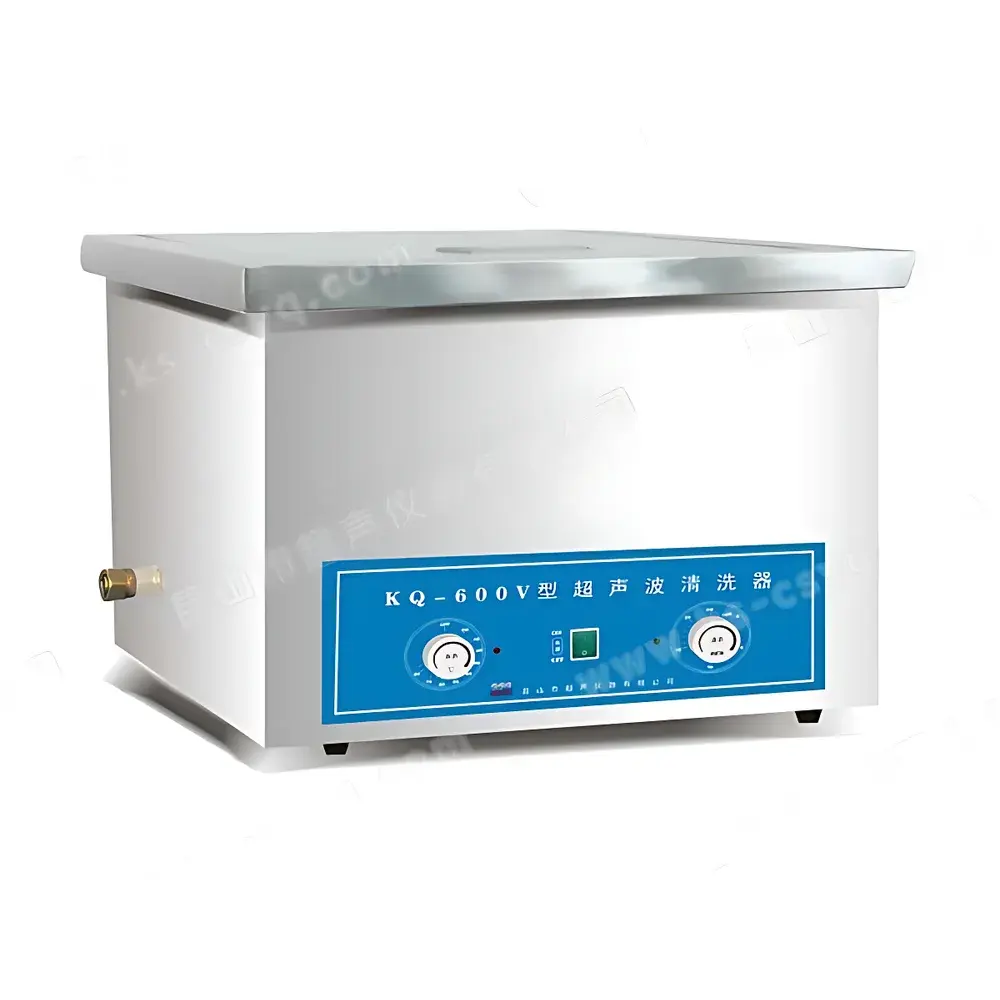
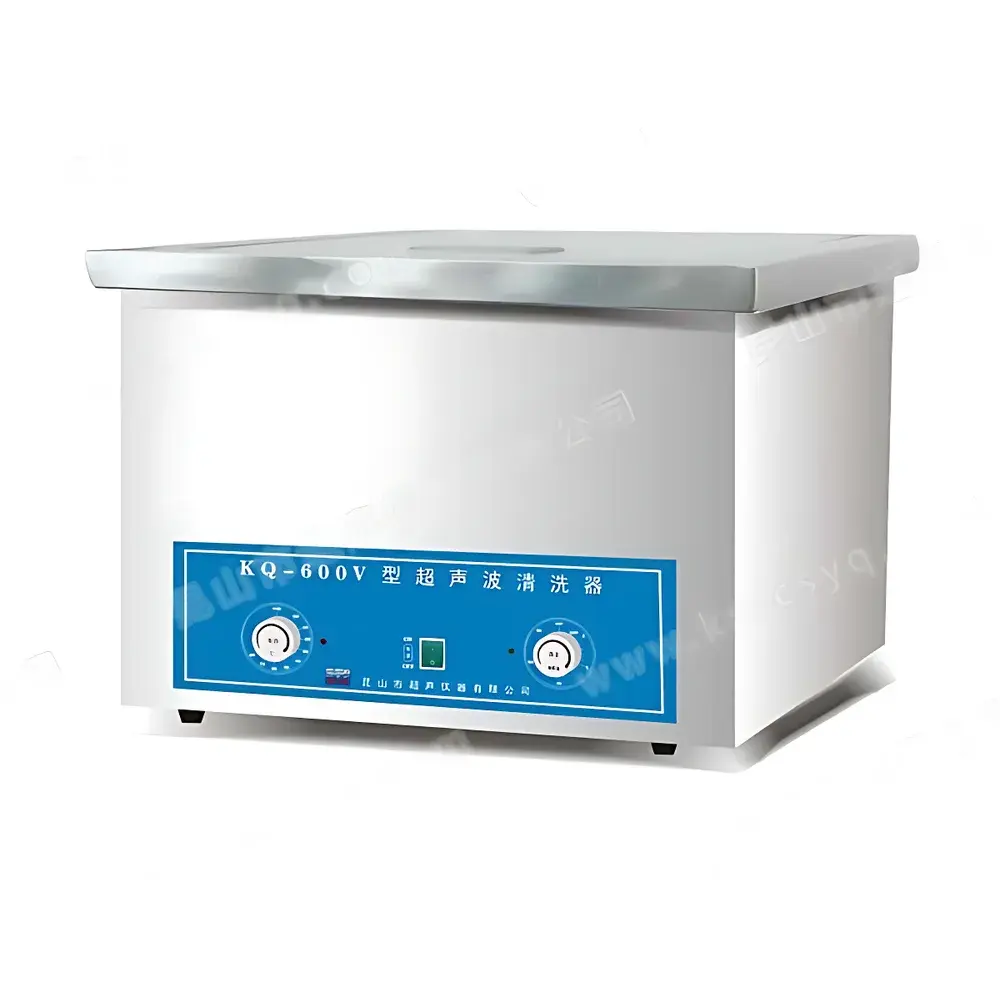
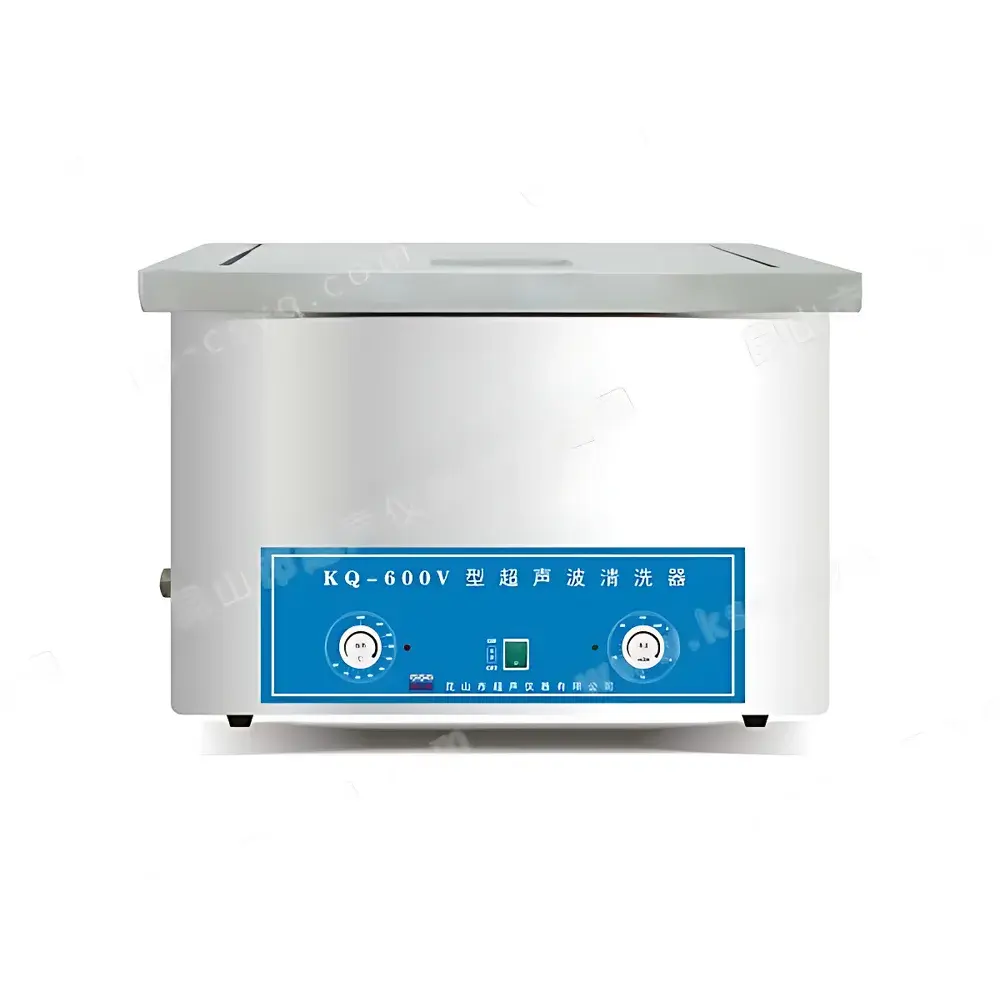
SHUMEI KQ-600V Benchtop Ultrasonic Cleaner
| Brand | SHUMEI |
|---|---|
| Origin | Jiangsu, China |
| Manufacturer Type | Direct Manufacturer |
| Equipment Category | Domestic |
| Model | KQ-600V |
| Instrument Type | General-Purpose |
| Tank Capacity | 27 L |
| Ultrasonic Frequency | 40 kHz |
| Ultrasonic Power Output | 600 W |
| Power Adjustment | Not Adjustable |
| Temperature Control Range | 0–80 °C |
| Timer Range | 1–20 min |
| Sound-Dampening Lid | Included |
| Manual Fill/Drain | Yes |
| Heating Power | 1000 W |
| Input Voltage/Frequency | 220 V / 50 Hz |
| Tank Internal Dimensions | 500 × 300 × 180 mm |
| External Dimensions | 610 × 410 × 385 mm |
| Construction Material | 304 Stainless Steel |
| Heating Method | PTC Surface-Mount Heater |
| Auto-Frequency Sweeping | Enabled |
| Transducer Configuration | Standard 50 W per element, 40 kHz |
Overview
The SHUMEI KQ-600V is a general-purpose benchtop ultrasonic cleaner engineered for consistent, reproducible cleaning performance in academic laboratories, quality control environments, and small-scale manufacturing support labs. It operates on the principle of ultrasonic cavitation—where high-frequency mechanical vibrations (40 kHz) generate microscopic vacuum bubbles in aqueous or mild solvent-based cleaning solutions; upon collapse, these bubbles release localized energy sufficient to dislodge particulate contaminants, organic residues, and loosely adhered biofilms from submerged surfaces. Designed with a 27-liter stainless steel tank (500 × 300 × 180 mm internal), the unit delivers uniform acoustic energy distribution across standard sample carriers including glassware, metal parts, printed circuit boards, optical components, and dental or surgical instruments. Its fixed-frequency 40 kHz transducer array—comprising multiple 50 W elements—ensures stable output without frequency drift during extended operation, while integrated auto-sweeping circuitry minimizes standing wave formation and hot-spot accumulation.
Key Features
- Robust 304 stainless steel tank and housing for corrosion resistance, thermal stability, and long-term structural integrity in humid lab environments
- PTC surface-mount heating system (1000 W) enabling precise temperature regulation from ambient up to 80 °C—critical for enhancing detergent efficacy and reducing surface tension
- Dedicated mechanical timer with 1–20 minute adjustable intervals, supporting repeatable process validation under standardized cleaning protocols
- Integrated sound-dampening lid to reduce operational noise (measured at ≤55 dB(A) at 1 m distance) and minimize solvent evaporation during heated cycles
- Manual fill-and-drain valves compatible with standard laboratory plumbing infrastructure; no external pump or pressure source required
- Auto-frequency sweeping function mitigates node/antinode localization, improving cleaning uniformity across complex geometries and multi-part loads
- Electrical architecture compliant with IEC 61000-6-3 (EMC emission limits) and IEC 61000-6-2 (immunity to electrostatic discharge and fast transients)
Sample Compatibility & Compliance
The KQ-600V accommodates a broad range of laboratory substrates—including borosilicate glass, anodized aluminum, titanium alloys, ceramic substrates, and polymer-based fixtures—without risk of surface pitting or etching when operated within recommended parameters (e.g., non-aggressive aqueous detergents, ≤80 °C, ≤20 min). Its construction meets ISO 9001-certified manufacturing practices, and its electrical safety design conforms to GB 4793.1–2007 (equivalent to IEC 61010-1:2010) for laboratory equipment. While not certified for sterile processing per ISO 13485 or FDA 21 CFR Part 820, the unit supports GLP-aligned documentation workflows when paired with external logbooks or electronic batch records. It is routinely deployed in pre-analytical sample preparation steps compliant with ASTM D2603 (ultrasonic cleaning of test specimens) and USP (cleaning validation guidance for analytical instrumentation).
Software & Data Management
The KQ-600V utilizes a fully embedded microcontroller-based control system with no external software dependency. All operational parameters—including time, temperature setpoint, and sweep activation—are configured via front-panel rotary dials and tactile push buttons. The absence of digital connectivity (e.g., USB, Ethernet, Bluetooth) eliminates cybersecurity concerns and ensures deterministic behavior in regulated environments where network isolation is mandated. For audit readiness, users may manually record cycle parameters in paper-based or validated electronic lab notebooks (ELN) aligned with 21 CFR Part 11 requirements. Optional calibration verification kits (traceable to NIST-standard thermistors and stopwatch references) are available for periodic performance checks.
Applications
- Removal of machining oils, flux residues, and particulate debris from precision-engineered components prior to metrology or coating processes
- Cleaning of HPLC vials, autosampler needles, and flow cell assemblies to prevent carryover and baseline drift
- Decontamination of reusable pipette tips, crucibles, and filtration housings in analytical chemistry workflows
- Preparation of electron microscopy grids and TEM sample holders requiring sub-micron particulate removal
- Supporting ISO 14644-1 cleanroom component cleaning protocols where particle count reduction is verified via light-scattering particle counters
- Routine maintenance of optical lenses, spectrophotometer cuvettes, and interferometric reference surfaces
FAQ
Is the ultrasonic frequency adjustable on the KQ-600V?
No. The unit operates exclusively at 40 kHz, optimized for general-purpose cleaning efficiency and transducer longevity.
Can the KQ-600V be used with flammable solvents?
No. It is designed for aqueous or water-miscible detergents only. Use of flammable or chlorinated solvents poses fire, explosion, and material compatibility hazards.
Does the unit include a filtration system for the cleaning bath?
No. Filtration is not integrated; users must replace or replenish the cleaning solution between batches per SOPs.
What is the maximum recommended load volume relative to tank capacity?
For optimal cavitation efficiency, total immersed volume—including fixtures and parts—should not exceed 70% of the 27 L tank capacity (i.e., ≤19 L liquid + load displacement).
Is the stainless steel tank electropolished or passivated?
The tank is fabricated from standard 304 stainless steel with a mechanically polished interior finish; electropolishing is available as a factory customization option.



