
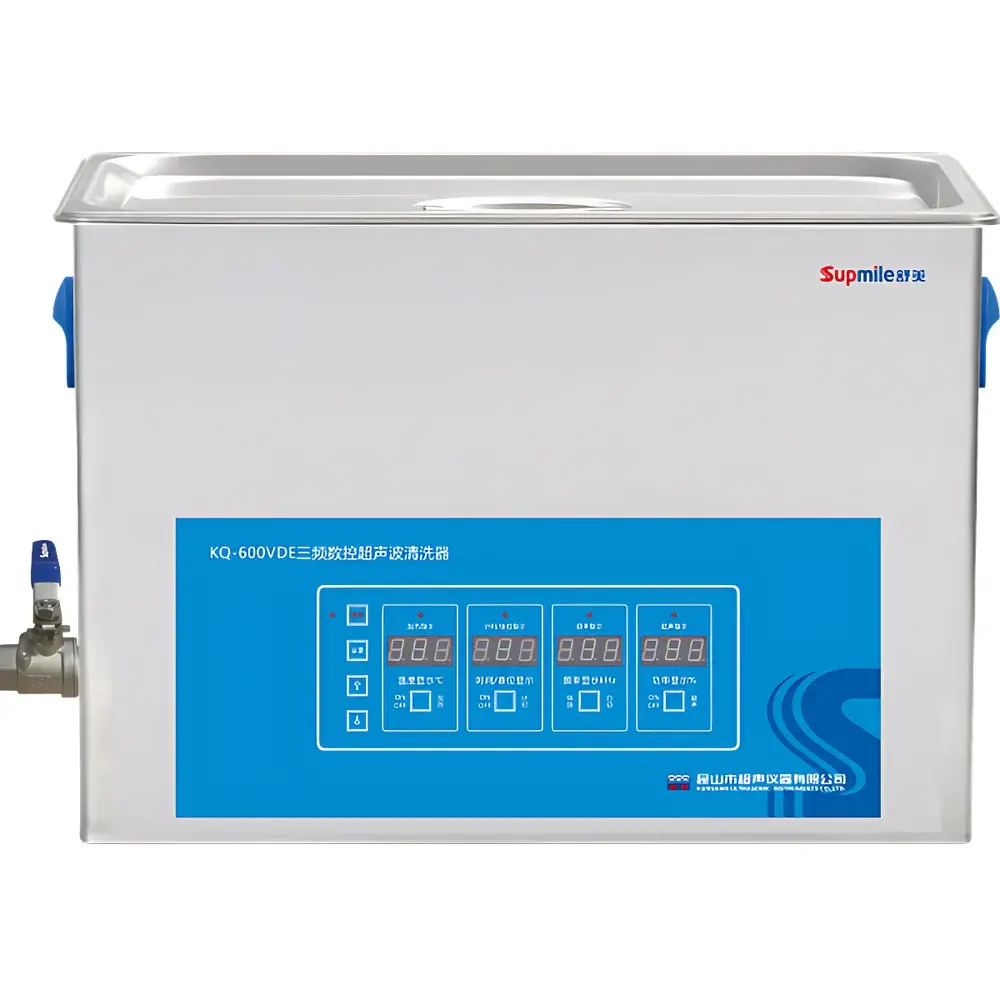
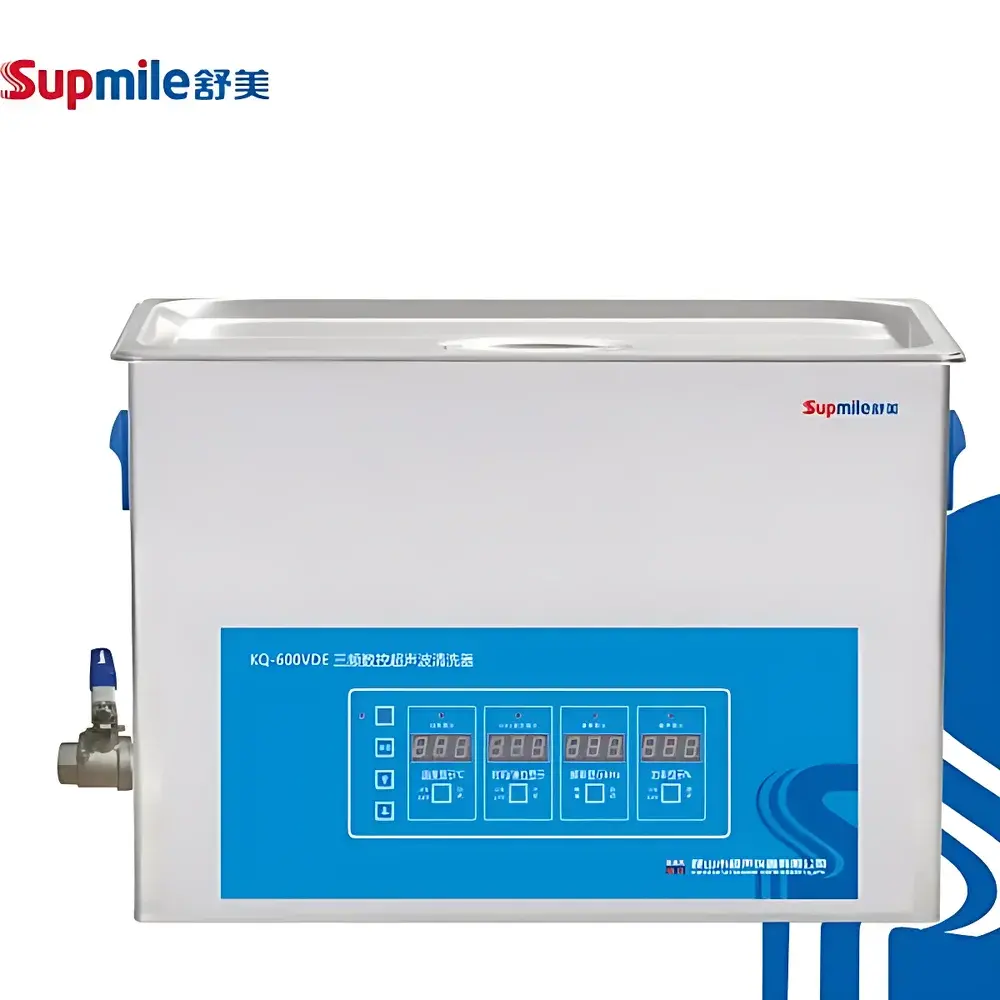
Shumei KQ-600VDE Triple-Frequency Digital Ultrasonic Cleaner
| Brand | Shumei |
|---|---|
| Origin | Jiangsu, China |
| Manufacturer Type | Direct Manufacturer |
| Product Category | Domestic |
| Model | KQ-600VDE |
| Instrument Type | General-Purpose |
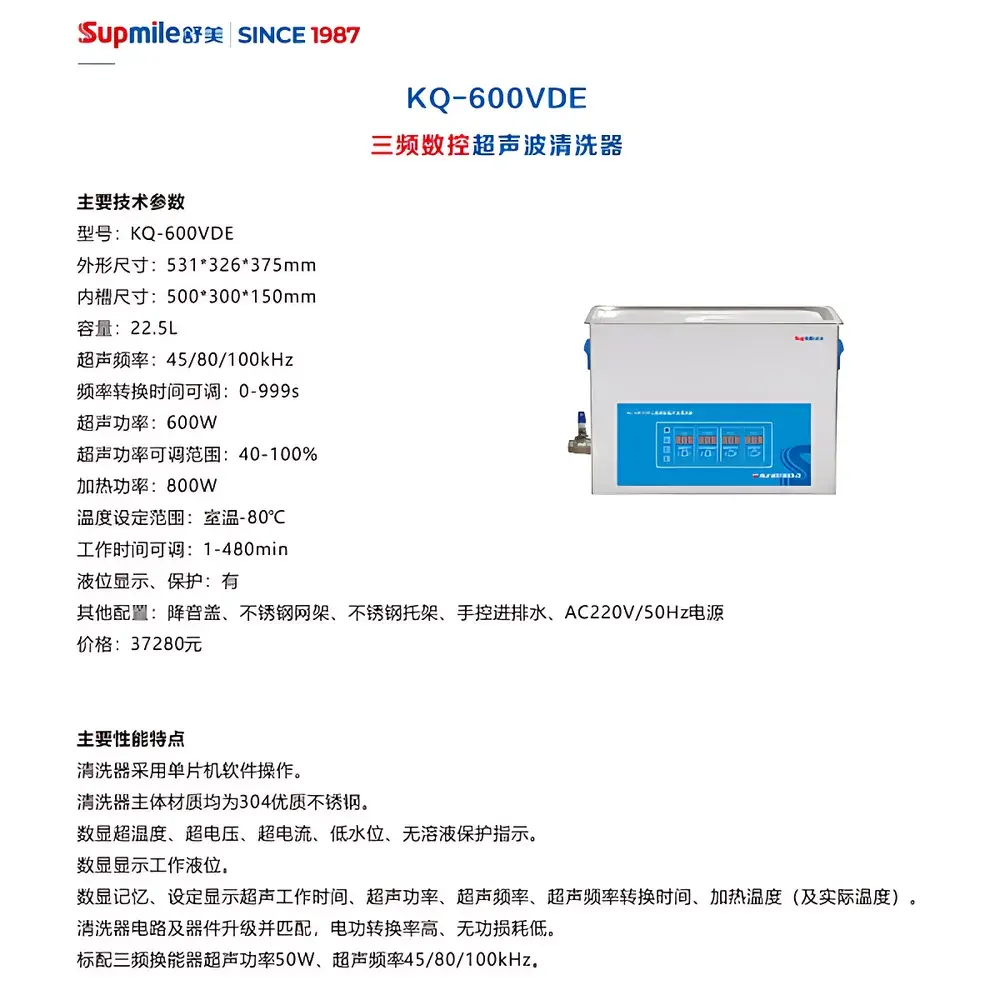
| Tank Capacity | 22.5 L |
| Ultrasonic Frequencies | 45 / 80 / 100 kHz |
| Ultrasonic Power Output | 600 W |
| Power Adjustment Range | 40–100% |
| Temperature Control Range | Ambient to 80 °C |
| Timer Range | 1–480 min |
| Sound-Dampening Lid | Yes |
| Drain/Inlet | Manual Valve Control |
| Heating Power | 800 W |
| Internal Tank Dimensions | 500 × 300 × 150 mm |
| External Dimensions | 531 × 326 × 375 mm |
| Power Supply | AC 220 V / 50 Hz |
Overview
The Shumei KQ-600VDE Triple-Frequency Digital Ultrasonic Cleaner is an engineered solution for precision cleaning of delicate laboratory components, optical elements, analytical instrumentation parts, and small-volume sample containers. It operates on the principle of acoustic cavitation—where high-frequency sound waves generate transient microbubbles in liquid media that collapse with localized energy release, effectively dislodging particulate contaminants, organic residues, and biofilms from submerged surfaces. Unlike single-frequency systems, the KQ-600VDE integrates three discrete ultrasonic frequencies (45 kHz, 80 kHz, and 100 kHz), enabling users to select or cycle between frequencies based on sample geometry, contaminant type, and substrate sensitivity. This multi-frequency capability supports optimized cleaning efficiency across diverse applications—from coarse particulate removal at lower frequencies to gentle, high-resolution cleaning of microstructures and MEMS devices at higher frequencies.
Key Features
- Triple-frequency transducer system with selectable or programmable frequency switching (45 / 80 / 100 kHz), each calibrated for consistent acoustic output and spatial uniformity within the tank.
- Digital microcontroller-based operation with real-time display of critical parameters: elapsed time, set/actual temperature, ultrasonic power level (%), selected frequency, frequency dwell time (0–999 s), and liquid level status.
- Stainless steel 304 construction throughout the tank, housing, and internal fixtures ensures long-term corrosion resistance, chemical compatibility with common solvents (e.g., isopropanol, acetone, aqueous detergents), and compliance with ISO 15195 and GLP environmental durability requirements.
- Integrated safety protections include over-temperature cutoff, low-level fluid detection, over-current monitoring, over-voltage regulation, and automatic shutdown upon lid opening or abnormal power draw.
- Adjustable ultrasonic power output (40–100% of 600 W nominal) allows fine-tuning for sensitive samples without compromising cleaning efficacy—particularly valuable for fragile glassware, coated optics, or polymer-based labware.
- Heating function (800 W) enables temperature-assisted cleaning protocols up to 80 °C, supporting enhanced solubilization of waxy, lipidic, or proteinaceous residues in accordance with ASTM D4488 and USP cleaning validation guidelines.
Sample Compatibility & Compliance
The KQ-600VDE accommodates a broad range of laboratory items including HPLC vials, pipette tips, syringe filters, cuvettes, crucibles, electrode assemblies, and semiconductor wafers (up to 150 mm diameter). Its 22.5 L capacity and 500 × 300 × 150 mm tank volume support batch processing while maintaining acoustic homogeneity. The unit complies with IEC 61000-6-3 (EMC emissions) and IEC 61000-6-2 (immunity), and its stainless steel wetted surfaces meet FDA-recommended material criteria for non-porous, cleanable surfaces per 21 CFR Part 111. While not certified for sterile processing, it serves as a validated pre-sterilization cleaning step in GMP-compliant laboratories when operated under documented SOPs with periodic performance qualification (PQ) per ISO 13485 Annex A.
Software & Data Management
The KQ-600VDE features embedded firmware with non-volatile memory for storing up to 10 user-defined cleaning programs—including frequency sequence, power ramping profiles, heating ramp rates, and dwell times. All parameter changes are logged with timestamped entries accessible via front-panel navigation. Though it lacks Ethernet or USB data export, its digital interface supports audit-ready traceability for routine QC documentation. When integrated into a validated lab environment, operators may record settings manually in electronic lab notebooks (ELNs) aligned with 21 CFR Part 11 requirements for electronic records and signatures—provided procedural controls govern versioning, access rights, and change history.
Applications
- Cleaning of chromatography columns, autosampler needles, and detector flow cells prior to calibration or maintenance.
- Removal of residual catalysts, metal oxides, or photoresist from research-grade substrates in materials science labs.
- Preparation of TEM grids and SEM stubs to minimize artifact introduction during imaging.
- Routine decontamination of reusable cell culture flasks, bioreactor sensors, and microfluidic chips in academic and industrial life science facilities.
- Supporting ASTM E1921 and ISO 11140-5 cleaning verification protocols through reproducible, parameter-controlled cycles.
FAQ
Can the KQ-600VDE be used with flammable solvents?
No. The unit is not explosion-proof and lacks solvent vapor management systems. Only aqueous solutions or low-volatility, non-flammable cleaning agents should be used.
Is frequency switching automated or manual?
Both modes are supported: users may fix a single frequency or program sequential switching with adjustable dwell time per frequency (0–999 seconds).
Does the unit include temperature calibration certification?
Factory calibration is performed; however, users must conduct periodic verification using NIST-traceable thermometers per ISO/IEC 17025 requirements for accredited labs.
What is the expected service life of the transducers under continuous operation?
With proper maintenance (e.g., avoiding dry operation, regular descaling, and adherence to duty-cycle limits), transducers typically exceed 5,000 operational hours before measurable output degradation occurs.
Can the timer be paused mid-cycle?
Yes—the digital controller supports pause/resume functionality without resetting parameters, facilitating intermittent inspection or repositioning of samples.



