
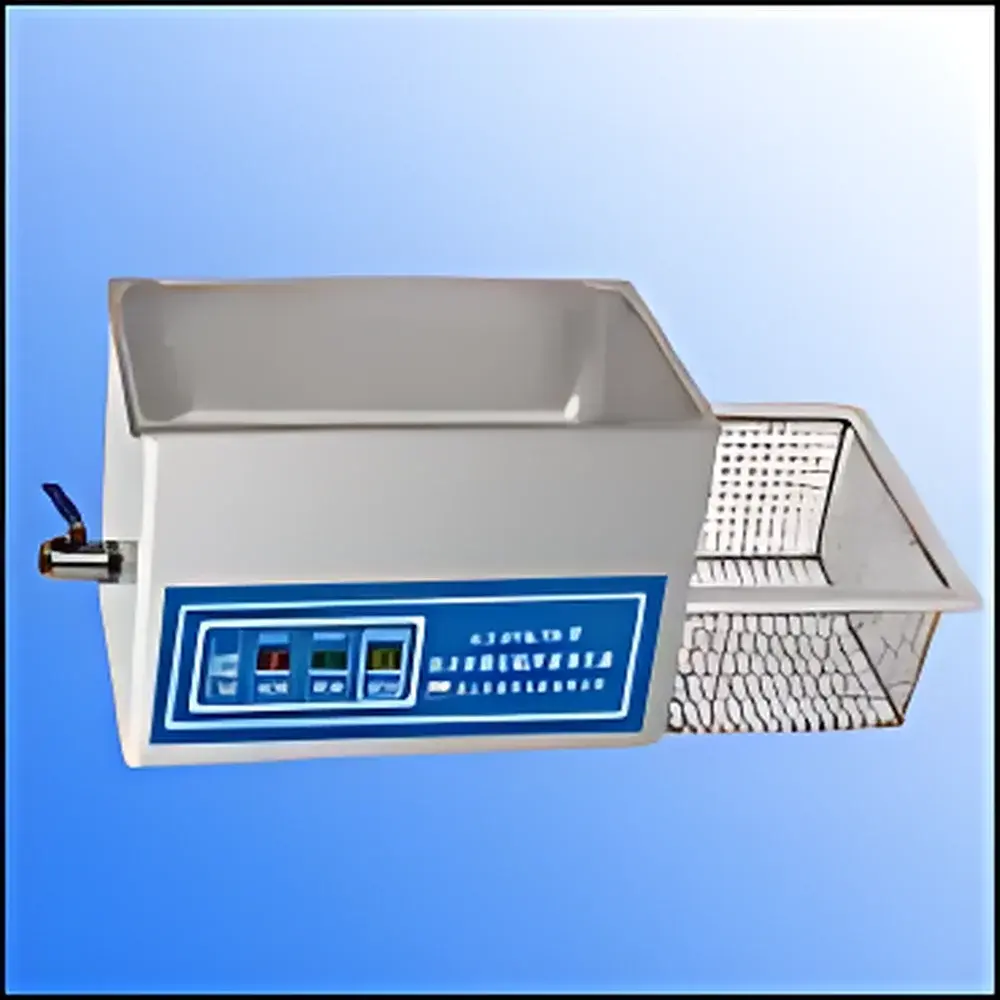
Shumei KQ2200DE Benchtop Digital Ultrasonic Cleaner
| Brand | Shumei |
|---|---|
| Origin | Jiangsu, China |
| Model | KQ2200DE |
| Tank Dimensions (L×W×H) | 230×140×100 mm |
| Capacity | 3 L |
| Ultrasonic Frequency | 40 kHz |
| Total Ultrasonic Power | 100 W |
| Power Adjustment Range | 40–99% |
| Heating Power | 600 W |
| Temperature Control Range | 20–80 °C |
| Timer Range | 1–99 min |
Overview
The Shumei KQ2200DE is a benchtop digital ultrasonic cleaner engineered for precision cleaning, degassing, and sample preparation in regulated laboratory environments. It operates on the principle of piezoelectric ultrasonic cavitation: high-frequency mechanical vibrations (40 kHz) generated by integrated transducers induce controlled microbubble formation and collapse within aqueous or compatible solvent media. This transient cavitation delivers localized energy sufficient to dislodge sub-micron particulates, organic residues, and biofilms from delicate surfaces—including optical components, microfluidic devices, chromatography vials, surgical instruments, and biological substrates—without mechanical abrasion or thermal degradation. Unlike analog units, the KQ2200DE integrates a sealed, monolithic transducer–tank architecture that ensures consistent acoustic coupling, minimal energy loss, and long-term stability across repeated duty cycles. Its compact footprint (260×160×280 mm) and 3 L capacity make it suitable for QC labs, academic research stations, and R&D cleanrooms where space efficiency and reproducible cleaning performance are critical.
Key Features
- Digital microcontroller-based control system with real-time monitoring and non-volatile memory for user-defined protocols (time, temperature, power level, and cumulative runtime)
- Adjustable ultrasonic power output (40–99%), enabling optimization for sensitive samples (e.g., fragile glassware or cell monolayers) versus robust contaminants (e.g., metal oxides or dried polymers)
- Precise thermostatic heating (20–80 °C, ±1 °C accuracy) with independent digital display of setpoint and actual bath temperature—critical for temperature-dependent processes such as enzymatic decontamination or solvent-assisted extraction
- Integrated safety interlocks: automatic shutdown upon low liquid level detection, dry-run prevention, and over-temperature/over-voltage/over-current fault indication
- Stainless steel construction: 304-grade tank interior and exterior housing (excluding legacy plastic-housed variants), resistant to corrosion from common cleaning solvents including alkaline detergents, ethanol, and isopropanol
- Acoustically damped lid and stainless steel mesh basket (argon-welded for structural integrity), minimizing noise emission (<65 dB(A)) and ensuring uniform sample suspension during sonication
- Drain valve assembly for rapid, spill-free solution exchange—essential for multi-step cleaning protocols requiring sequential solvent rinses
- Cumulative operational logging up to 999,999 hours, supporting preventive maintenance scheduling and GLP-compliant equipment lifecycle documentation
Sample Compatibility & Compliance
The KQ2200DE accommodates a broad range of sample formats: standard 15 mL and 50 mL centrifuge tubes, Petri dishes, microscope slides, HPLC autosampler vials, watch parts, printed circuit boards, and dental instruments. Its 40 kHz frequency provides optimal balance between penetration depth and cavitation intensity for general-purpose cleaning; higher frequencies (e.g., 80–130 kHz) are reserved for nano-scale particle removal in semiconductor applications. While not certified to IEC 61000-6-3 (EMC) or ISO 13485 out-of-the-box, the unit meets fundamental electrical safety requirements per GB 4793.1 (Chinese equivalent of IEC 61010-1) and is routinely deployed in laboratories adhering to ISO/IEC 17025, ASTM D2603 (ultrasonic cleaning validation), and USP (cleaning validation guidance). Users performing GMP-regulated cleaning must validate cycle parameters—including temperature uniformity mapping, ultrasonic intensity profiling (via calorimetry or aluminum foil erosion test), and residue recovery studies—prior to routine use.
Software & Data Management
The KQ2200DE operates via embedded firmware without external PC dependency. All operational parameters—including start time, duration, temperature setpoint, power level, and real-time status—are displayed on a high-contrast LCD interface with backlighting. The system logs cumulative runtime and retains last-used settings after power cycling, eliminating reconfiguration between sessions. Though it lacks USB/Ethernet connectivity or FDA 21 CFR Part 11-compliant electronic signatures, its deterministic behavior and hardware-enforced safety limits support audit-ready manual recordkeeping. For laboratories requiring full traceability, integration with LIMS or ELN systems can be achieved via optional RS-232 or TTL-level serial output (available on select firmware revisions), enabling timestamped export of cycle metadata for inclusion in electronic batch records.
Applications
- Life sciences: Removal of protein residues from electrophoresis combs, cleaning of microcentrifuge tubes prior to qPCR, and gentle disaggregation of cultured cells
- Materials science: Deburring of sintered metal parts, removal of polishing compounds from optical lenses, and preparation of TEM grids
- Pharmaceutical QA/QC: Cleaning of dissolution apparatus vessels, tablet punch dies, and filter housings in accordance with USP and EU GMP Annex 15
- Electronics manufacturing: Flux residue removal from PCB assemblies prior to AOI inspection
- Forensics & archaeology: Non-destructive cleaning of fragile artifacts, bone fragments, and tool marks without altering surface morphology
- Environmental testing: Extraction of PAHs and PCBs from soil/sediment matrices using solvent-assisted ultrasonication (EPA Method 3550C)
FAQ
What is the recommended cleaning solution for general laboratory use?
Aqueous alkaline detergent solutions (pH 9–11) at 40–60 °C provide optimal results for organic and particulate contamination. Avoid halogenated solvents unless confirmed compatible with stainless steel and transducer materials.
Can the KQ2200DE be used for sterilization?
No. Ultrasonic cleaning removes bioburden but does not achieve sterility assurance levels (SAL ≤ 10⁻⁶). It is a precleaning step preceding autoclaving, ethylene oxide, or hydrogen peroxide plasma sterilization.
How often should the tank solution be replaced?
Replace after each use when processing heavily soiled items; for light-duty applications, refresh every 8–10 hours of cumulative operation or when visible turbidity or foam stability declines.
Is calibration required for routine operation?
While no formal calibration is mandated, periodic verification of temperature accuracy (using a NIST-traceable thermometer) and timer fidelity (±1 second over 60 minutes) is recommended for GLP/GMP compliance.
Does the unit support continuous operation?
Yes—thermal management and duty-cycle design allow uninterrupted operation up to 99 minutes per cycle, with automatic cooldown intervals enforced by firmware if internal temperatures exceed safe thresholds.



