
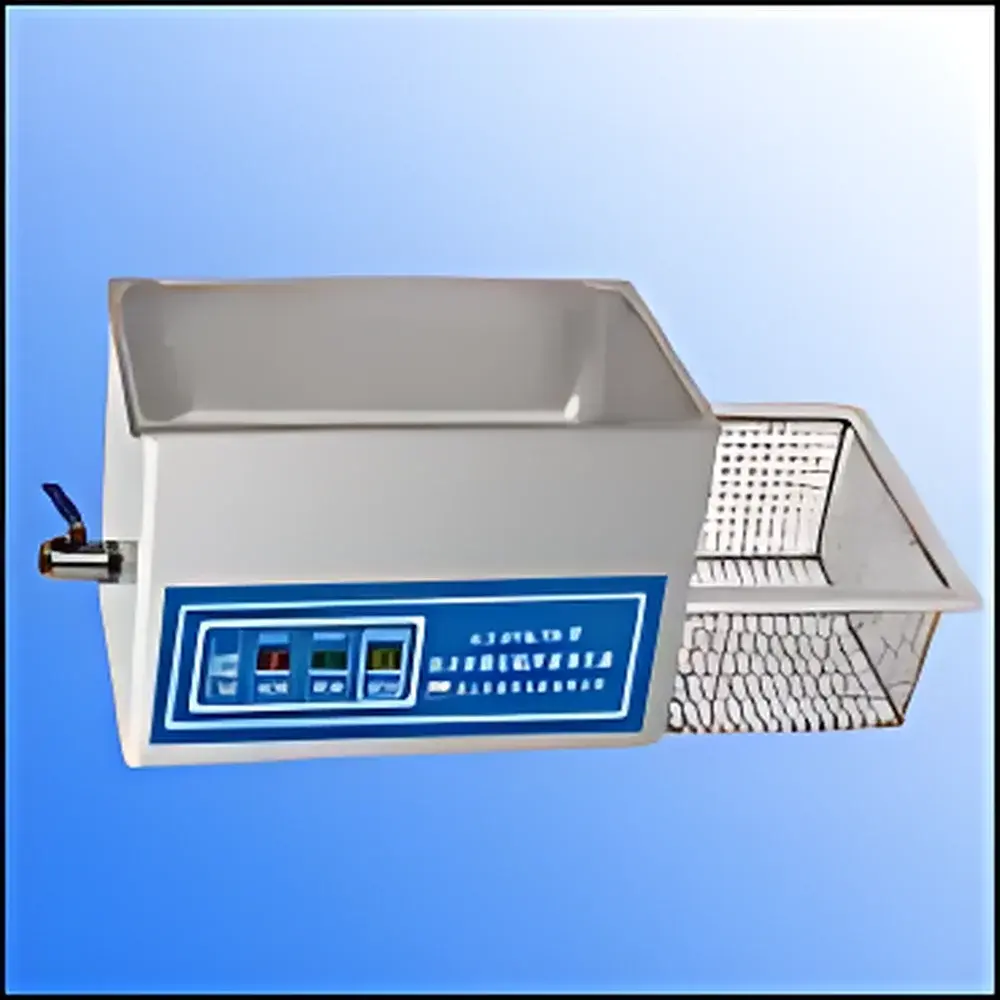
Shumei KQ3200DE Benchtop Digital Ultrasonic Cleaner
| Brand | Shumei |
|---|---|
| Model | KQ3200DE |
| Tank Capacity | 6 L |
| Ultrasonic Frequency | 40 kHz |
| Total Ultrasonic Power | 150 W |
| Power Adjustment Range | 40–100% |
| Heating Power | 600 W |
| Temperature Control Range | 20–80 °C |
| Timer Range | 1–480 min |
| Tank Internal Dimensions | 300 × 150 × 150 mm (L×W×H) |
| Overall Dimensions | 320 × 174 × 340 mm (L×W×H) |
Overview
The Shumei KQ3200DE is a benchtop digital ultrasonic cleaner engineered for precision cleaning, degassing, and sample preparation in regulated laboratory environments. It operates on the principle of high-frequency acoustic cavitation—generating microscopic implosions in liquid media via piezoelectric transducers bonded directly to the stainless steel tank wall. At a nominal frequency of 40 kHz, the system delivers consistent energy distribution across the entire 6-liter tank volume, enabling effective removal of particulate contaminants, organic residues, and adsorbed gases from delicate instrumentation parts, optical components, microfluidic devices, and biological samples. Its integrated transducer architecture eliminates coupling losses associated with external bath systems, ensuring stable output and long-term reproducibility. Designed for continuous operation in academic, industrial QC, and R&D laboratories, the KQ3200DE complies with fundamental electrical safety standards (IEC 61010-1) and supports routine validation protocols through traceable operational logging.
Key Features
- Digital microprocessor control with real-time display of ultrasonic power (%), heating temperature (°C), elapsed time (min), and cumulative operating hours (up to 999,999 h)
- Adjustable ultrasonic intensity (40–100% of 150 W total output) for optimized cleaning across diverse sample types and soiling levels
- Precise thermostatic control (20–80 °C) powered by a 600 W immersion heater with ±1 °C stability, supporting temperature-sensitive applications such as enzymatic cleaning or solvent-based extraction
- Comprehensive safety architecture: automatic shutdown triggered by low liquid level detection, over-temperature, over-voltage, and over-current conditions
- Corrosion-resistant 304 stainless steel tank and housing (except select compact models), fabricated using TIG-welded mesh basket for uniform suspension and mechanical durability
- Acoustically damped lid reduces ambient noise emission and minimizes solvent evaporation during extended cycles
- Integrated drain valve enables rapid, spill-free solution exchange—critical for multi-step cleaning protocols requiring sequential solvents
Sample Compatibility & Compliance
The KQ3200DE accommodates a broad range of substrates including glassware (vials, cuvettes, pipette tips), metal components (surgical instruments, calibration standards), ceramic filters, semiconductor wafers, and biological specimens (tissue sections, cell culture inserts). Its 300 × 150 × 150 mm internal tank geometry ensures adequate immersion depth and lateral clearance for standard labware. While not certified to ISO 13485 or FDA 21 CFR Part 11 out-of-the-box, the device’s deterministic timer, non-volatile parameter memory, and cumulative runtime logging support GLP/GMP-aligned documentation practices. Users may implement IQ/OQ protocols per ASTM D2603 (Standard Test Method for Sonic Shear Stability of Lubricating Oils) or USP particulate matter testing workflows when paired with validated cleaning agents and rinse procedures.
Software & Data Management
Operation is governed by embedded firmware running on an industrial-grade single-chip microcontroller. All user-defined parameters—including start time, power level, temperature setpoint, and duration—are retained in non-volatile memory following power interruption. The front-panel LCD displays both setpoints and real-time values simultaneously, eliminating ambiguity during method execution. Cumulative runtime tracking serves dual purposes: predictive maintenance scheduling and warranty compliance verification (“three guarantees” alignment per Chinese GB/T 2829–2002 framework). Though no PC interface or remote software is included, the unit’s deterministic behavior and repeatable thermal/sonic profiles facilitate integration into automated lab workflows via external PLC-triggered dry-contact inputs (optional relay module required).
Applications
- Pre-analytical cleaning of HPLC injection valves, GC liners, and ICP-MS nebulizers to prevent carryover and spectral interference
- Removal of polishing compounds and oxide layers from optical lenses and laser optics prior to interferometric inspection
- Cell lysis and homogenization support for proteomics sample prep, particularly in conjunction with detergent-based buffers
- Degassing of mobile phases and calibration standards to eliminate bubble formation in flow-based detection systems
- Extraction of active pharmaceutical ingredients (APIs) from botanical matrices using ethanol or isopropanol under controlled thermal-sonic conditions
- Routine decontamination of reusable PPE components (e.g., face shields, goggle frames) in biosafety Level 2 facilities
FAQ
What is the maximum recommended operating temperature for aqueous solutions?
The unit is rated for continuous operation up to 80 °C; however, for aqueous cleaning, we recommend ≤60 °C to minimize boiling-induced cavitation instability and tank stress.
Can this cleaner be used with flammable solvents?
No. The KQ3200DE lacks explosion-proof certification and internal spark suppression. Only water-miscible, non-flammable solvents (e.g., isopropyl alcohol below 12% v/v in water) should be used under strict ventilation and supervision.
Is the stainless steel tank electropolished?
The tank surface finish is mechanically polished 304 stainless steel (Ra ≤ 0.8 µm), suitable for general lab use but not classified as electropolished per ASTM A967.
Does the unit include a calibration certificate?
Factory calibration of temperature and timer functions is performed pre-shipment; however, a NIST-traceable certificate requires third-party verification and is not supplied standard.
How often should the transducers be serviced?
Under normal usage (≤8 h/day), transducer integrity remains stable for ≥5 years; visual inspection for delamination or corrosion at the tank-transducer interface is advised annually.



