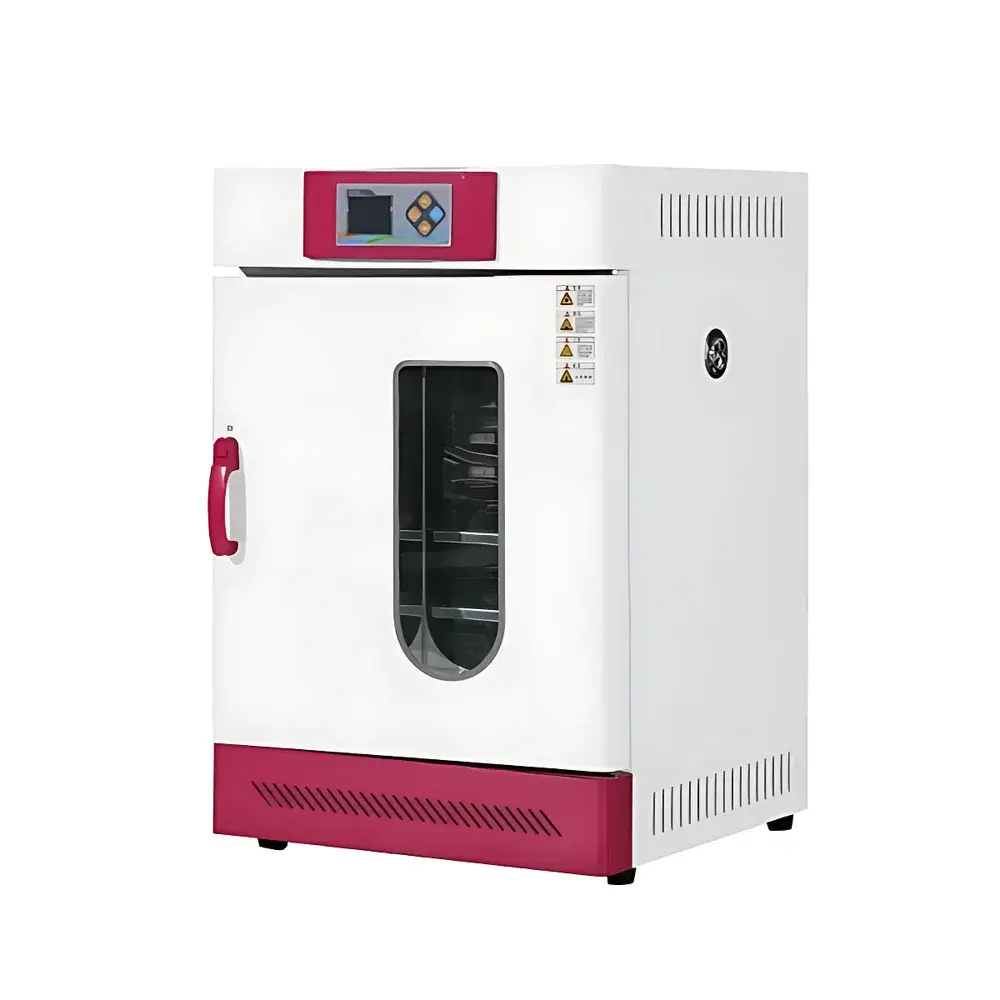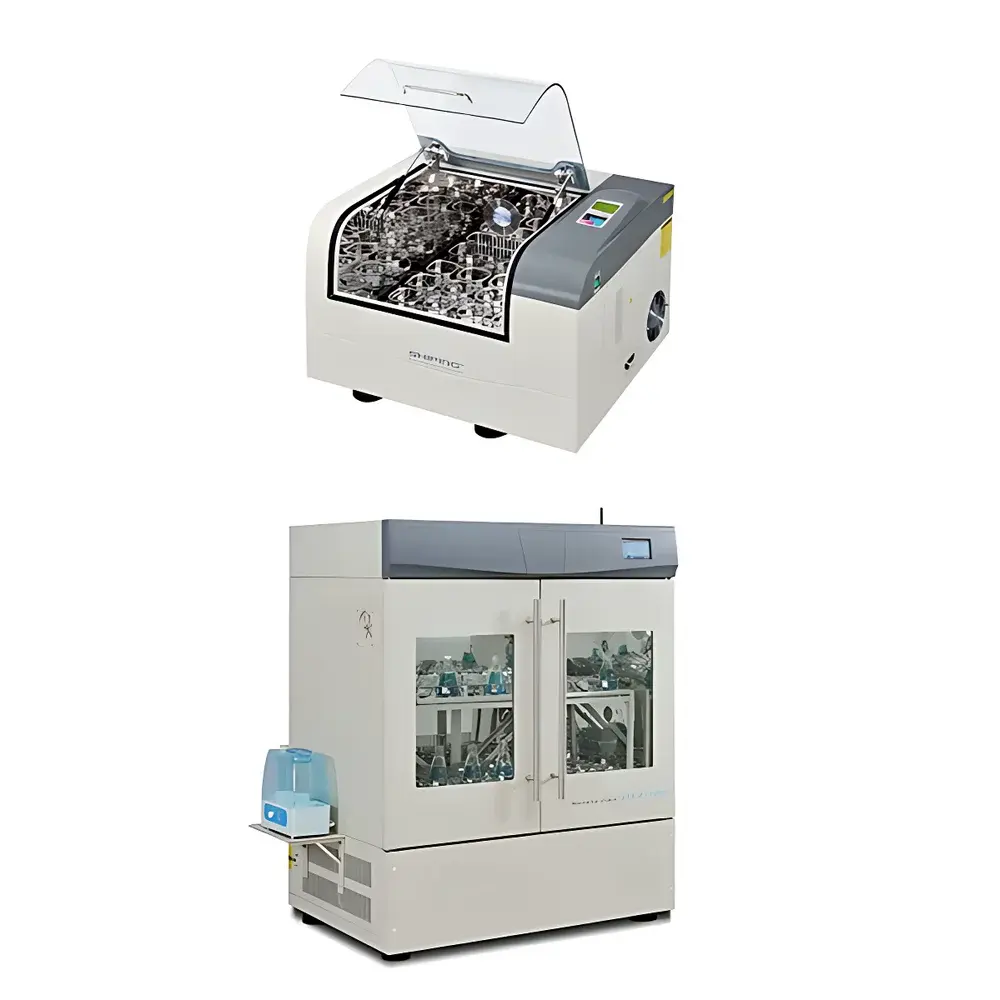
Shuoping ZPH-200B Advanced Programmable Orbital/Reciprocating Incubator Shaker
| Brand | Truelab (Chu Bai) |
|---|---|
| Origin | Shanghai, China |
| Model | ZPH-200B |
| Timer Range | 0–999.99 min |
| Oscillation Speed | 50–300 rpm |
| Orbit Diameter | Φ25 mm |
| Temperature Range | 4–60 °C |
| Temperature Uniformity | ±0.5 °C |
| Temp. Accuracy | ±0.1 °C |
| Control System | PID microprocessor with true-color touchscreen interface |
| Oscillation Mode | Selectable orbital or reciprocating motion |
| Drive Mechanism | Single-axis balanced drive (Chinese patent) |
| Chamber Material | Mirror-finish imported stainless steel |
| Power Supply | AC 200–240 V, 50–60 Hz |
| Cooling System | CFC-free R134a refrigerant |
| Heating Power | 400 W |
| Cooling Power | 118 W |
| Total Power Consumption | 580 W |
| Chamber Volume | 80 L |
| Shelf Dimensions | 420 × 400 mm |
| Net Weight | 100 kg |
| Compliance | Designed for GLP-compliant labs |
Overview
The Shuoping ZPH-200B Advanced Programmable Orbital/Reciprocating Incubator Shaker is an engineered platform for precise, temperature-controlled sample agitation in life science and bioprocessing laboratories. Based on the Couette flow principle for uniform mixing and thermal conduction via forced-air circulation, the ZPH-200B integrates incubation and oscillation in a single compact benchtop unit. Its microprocessor-driven PID temperature control ensures stable thermal environments across the full 4–60 °C range—critical for sensitive applications such as microbial growth kinetics, enzyme activity assays, hybridization protocols, and cell suspension culture. The device supports both orbital and reciprocating motion modes, enabling method flexibility without hardware modification. Designed for reproducibility and operational continuity, it features slow-start acceleration, real-time dual-display of setpoint vs. actual temperature, and programmable eight-segment time-speed-temperature profiles—each segment configurable up to 999.99 minutes.
Key Features
- True-color capacitive touchscreen interface with intuitive icon-based navigation and multilingual support (English default)
- PID-controlled thermal management with ±0.1 °C accuracy and ±0.5 °C chamber uniformity (measured at 5 reference points per ICH Q5C)
- Selectably switchable oscillation mode: orbital (standard) or reciprocating—optimized for heterogeneous suspensions or low-volume microplate formats
- Single-axis balanced drive mechanism (patented in China) minimizes vibration transmission to adjacent equipment and extends motor service life
- Integrated safety architecture: independent overtemperature cut-off, over-speed alarm with audible/visual alert, door-open stop function, and Class I leakage current protection per IEC 61010-1
- Programmable eight-step curve with memory retention for power interruption recovery, parameter recall, and automatic clock-synchronized timestamping
- CFC-free R134a refrigeration system compliant with Montreal Protocol Annex A Group II requirements and EU F-Gas Regulation (EU) No 517/2014
Sample Compatibility & Compliance
The ZPH-200B accommodates standard laboratory vessels on its 420 × 400 mm stainless-steel platform—including Erlenmeyer flasks (up to 1000 mL), test tube racks, microtiter plates (96-/384-well), centrifuge tube holders, and custom spring platforms. Load distribution is optimized for rotational balance up to 256 × 50 mL flasks or 16 × 250 mL flasks (per manufacturer loading table). All internal surfaces are electropolished AISI 316L stainless steel, meeting USP extractables criteria for pharmaceutical process equipment. The system meets essential requirements of EN 61010-1:2010 for electrical safety and EN 61326-1:2013 for electromagnetic compatibility. While not pre-certified for ISO 13485 or GMP manufacturing, its architecture—including non-volatile parameter storage, audit-trail-capable event logging (when paired with Truelab’s optional LabLink™ v4.2 software), and hardware-enforced access controls—supports qualification under FDA 21 CFR Part 11 Annex 11 and EU GMP Annex 11 frameworks.
Software & Data Management
The ZPH-200B operates autonomously via embedded firmware but interfaces seamlessly with Truelab LabLink™ PC software (Windows 10/11, x64) for advanced protocol management and compliance documentation. LabLink™ enables remote programming of multi-stage temperature-speed-time sequences, live graphical monitoring of chamber conditions, and export of CSV- or PDF-formatted reports with digital signatures. All logged events—including setpoint changes, alarm triggers, door openings, and power cycles—are time-stamped with millisecond resolution and stored with immutable metadata (user ID, IP address, session hash). When deployed in networked lab environments (up to 20 units per subnet), LabLink™ supports centralized calibration tracking, electronic batch records (EBR), and integration with LIMS via RESTful API. Optional 21 CFR Part 11 validation packages include IQ/OQ documentation, electronic signature workflows, and role-based permission templates aligned with ALCOA+ principles.
Applications
The ZPH-200B serves as a core agitator in regulated and research-grade workflows across multiple disciplines. In microbiology, it maintains consistent aeration and nutrient dispersion during aerobic bacterial cultivation (e.g., E. coli BL21(DE3) expression studies). In molecular biology, its precise temperature ramping supports stringent DNA hybridization (e.g., Southern/Northern blotting) and antibody-antigen binding kinetics. Pharmaceutical QC labs utilize its stability for dissolution testing of solid oral dosage forms per USP , while biomanufacturing groups apply it to seed train expansion and media optimization under controlled shear stress. Additional validated use cases include yeast two-hybrid screening, immunoassay plate washing pre-incubation, environmental microbiology enrichment (e.g., ISO 6222:2021), and food safety pathogen recovery (AOAC 999.05).
FAQ
Does the ZPH-200B support validation documentation for GxP environments?
Yes—Truelab provides IQ/OQ protocols, calibration certificates traceable to NIST standards, and a 21 CFR Part 11 readiness package including electronic signature configuration guides and audit trail verification procedures.
Can the oscillation mode be changed during an active run?
No—mode selection (orbital/reciprocating) must be configured prior to initiating a program. This design prevents mechanical resonance risks and ensures thermal equilibrium integrity.
Is external humidity control available?
Humidity is not actively regulated in the ZPH-200B. For humidity-sensitive protocols, Truelab recommends pairing with standalone humidification chambers or selecting the ZPH-2013R model with optional external humidifier integration.
What maintenance intervals are recommended for long-term reliability?
Annual verification of temperature uniformity (per ASTM E2234), semiannual inspection of refrigerant pressure and condensate drain integrity, and quarterly cleaning of air intake filters using isopropyl alcohol wipes.
How does the slow-start feature benefit cell culture applications?
Gradual acceleration (0–300 rpm in ≤15 s) minimizes shear-induced apoptosis in suspension-adapted mammalian cells and preserves fragile protein complexes during early-stage expression.