
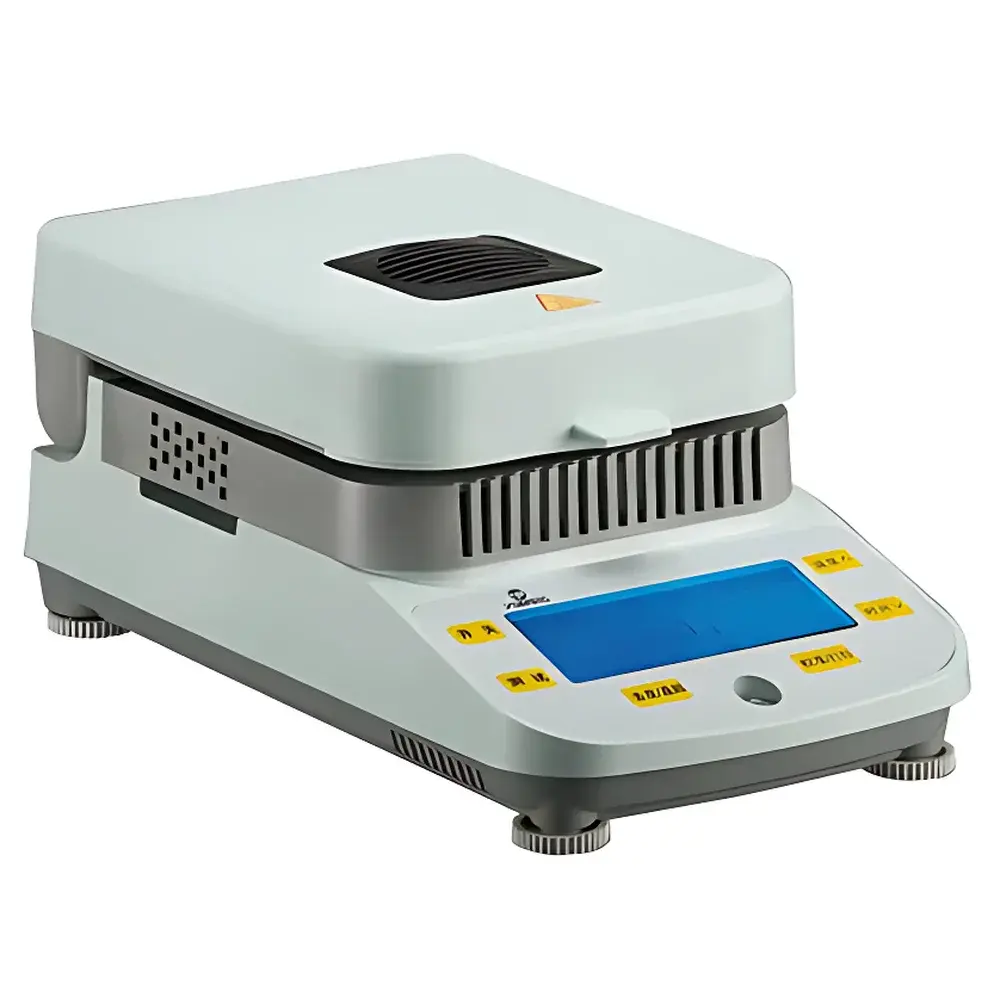
SHYP DSH-50-5 Halogen Moisture Analyzer
| Brand | SHYP |
|---|---|
| Origin | Shanghai, China |
| Model | DSH-50-5 |
| Heating Source | Halogen Lamp |
| Maximum Capacity | 50 g |
| Readability | 5 mg |
| Repeatability (3 g sample) | ±0.3% |
| Minimum Sample Mass | 0.5 g |
| Recommended Sample Mass | 3–10 g |
| Heating Duration | 1–99 min (adjustable in 10-s increments) |
| Temperature Range | 50–180 °C (1 °C step) |
| Display | Moisture %, Solid %, Weight, Time, Temperature |
| Pan Diameter | 100 mm |
| Dimensions (L×W×H) | 285 × 160 × 150 mm |
| Net Weight | 3.0 kg |
| Communication Interface | RS-232C |
Overview
The SHYP DSH-50-5 Halogen Moisture Analyzer is a precision thermal gravimetric instrument engineered for rapid, reliable quantification of moisture content in solid and semi-solid materials via halogen lamp-assisted drying. Unlike traditional oven-drying methods governed by ASTM E1447 or ISO 712, this analyzer applies controlled radiant heating—optimized for uniform energy distribution and minimal thermal lag—to accelerate moisture evaporation while preserving sample integrity. The core measurement principle follows the loss-on-drying (LOD) method: initial mass is recorded, followed by real-time mass monitoring during programmed heating; moisture content (%) is calculated as the relative mass loss versus initial weight. Designed for routine QC/QA environments, the DSH-50-5 delivers consistent results across diverse matrices including pharmaceutical excipients, cereal grains, polymer pellets, mineral ores, paper pulp, and herbal extracts—without requiring solvent extraction or Karl Fischer titration.
Key Features
- Halogen heating system with precise temperature control (50–180 °C in 1 °C increments), enabling rapid thermal response and improved reproducibility compared to conventional infrared or convection ovens.
- High-resolution backlit dot-matrix LCD display optimized for low-ambient lighting conditions—critical for laboratory environments with variable illumination or fume hood integration.
- Thermally isolated high-precision load cell (5 mg readability, ±0.3% repeatability on 3 g samples) minimizes drift from thermal expansion and ensures stable weighing performance throughout dynamic drying cycles.
- Intuitive membrane keypad interface supports direct parameter entry, real-time status feedback, and immediate endpoint confirmation—reducing operator training time and procedural variability.
- Auto-tare functionality enables sequential multi-sample analysis without manual zeroing; zero-point drift compensation further enhances long-term measurement fidelity.
- RS-232C serial interface compliant with standard laboratory peripheral protocols—enabling seamless data export to LIMS, Excel, or validated print systems (e.g., thermal label printers or dot-matrix report printers).
Sample Compatibility & Compliance
The DSH-50-5 accommodates heterogeneous particulates, powders, granules, and thin films within its 100 mm diameter stainless-steel weighing pan. Its 0.5 g minimum sample requirement and 3–10 g recommended range support both high-sensitivity assays (e.g., low-moisture APIs per USP ) and bulk commodity testing (e.g., grain moisture per ISO 6540). While not intrinsically 21 CFR Part 11–compliant, the device supports audit-ready workflows when integrated with validated third-party software that implements electronic signatures, user access controls, and immutable data logging. It aligns with fundamental principles of GLP and GMP documentation requirements—including raw data retention, calibration traceability (via external weights), and environmental monitoring (operating range: 10–30 °C, ≤80% RH non-condensing).
Software & Data Management
Data output via RS-232C adheres to ASCII-based command-response protocol, permitting integration with custom LabVIEW, Python, or MATLAB acquisition scripts. Standard output includes timestamped records of moisture %, solid %, final weight, elapsed time, and setpoint temperature—formatted for direct ingestion into CSV-compatible databases. When paired with compliant middleware, the analyzer supports full electronic record retention per ALCOA+ principles (Attributable, Legible, Contemporaneous, Original, Accurate). Optional firmware updates (available through SHYP authorized distributors) may extend communication compatibility to USB-to-serial adapters or Ethernet gateways for centralized lab network deployment.
Applications
- Pharmaceutical manufacturing: Moisture verification of active pharmaceutical ingredients (APIs), excipients, and lyophilized powders prior to tableting or capsule filling.
- Food quality control: Rapid assessment of cereal moisture for storage stability (per Codex Alimentarius standards) and snack product crispness consistency.
- Chemical industry: Monitoring hygroscopicity of catalysts, pigments, and battery electrode slurries where residual water impacts reactivity or coating adhesion.
- Agricultural testing: Field-deployable verification of grain moisture at intake points to prevent mold propagation during silo storage.
- Paper & packaging: Quantifying moisture in kraft pulp sheets to optimize calendering parameters and minimize web breakage during converting.
FAQ
What is the difference between halogen and infrared heating in moisture analyzers?
Halogen lamps emit broadband near-infrared radiation (700–2500 nm) with higher intensity and faster thermal response than traditional IR emitters, resulting in more uniform surface heating and reduced test duration—particularly beneficial for thermally sensitive or low-conductivity samples.
Can the DSH-50-5 be calibrated for traceable accuracy?
Yes—external calibration using NIST-traceable weights (e.g., Class M2 or better) and certified reference materials (e.g., anhydrous sodium tartrate) is supported per manufacturer guidelines and aligns with ISO/IEC 17025 calibration interval recommendations.
Is the RS-232 interface compatible with modern Windows or macOS systems?
It requires a USB-to-RS-232 adapter with FTDI or CP2102 chipset drivers; native COM port emulation allows compatibility with legacy and current OS versions when configured with appropriate terminal software or custom data acquisition tools.
How does the auto-endpoint detection work?
The instrument monitors mass change rate over time; endpoint is triggered either by user-defined timer or by detecting a mass stabilization threshold (e.g., <0.1 mg/min for 30 s), ensuring consistent drying completion across variable sample types.
Does the DSH-50-5 meet any international moisture testing standards?
While it does not replace primary reference methods like AOAC 950.46 or ISO 1186, it serves as a validated secondary method for in-process control where correlation studies against reference techniques have been established per ICH Q2(R2) guidance.





