
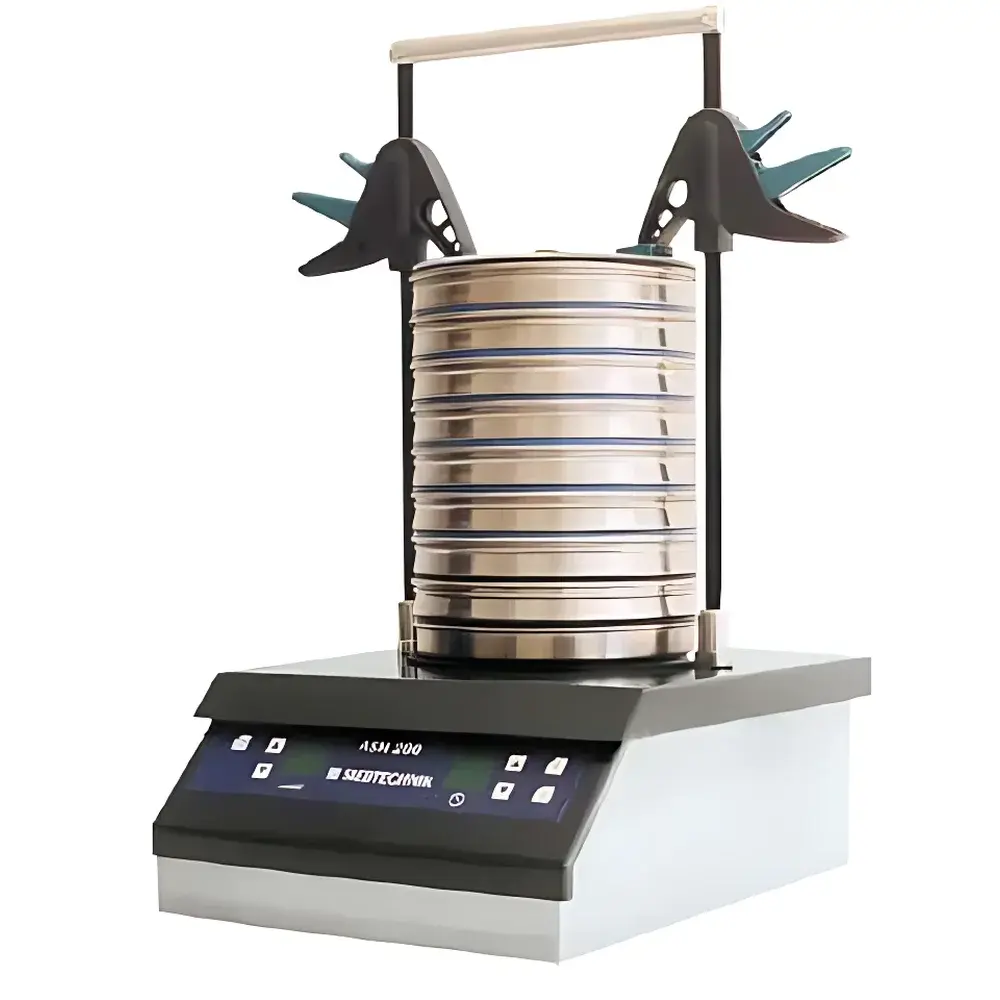
Siebtechnik ASM200 Advanced Vibratory Sieve Analyzer
| Brand | Siebtechnik |
|---|---|
| Origin | Germany |
| Model | ASM200 |
| Measurement Range | 20 µm – 25 mm |
| Sieve Stages | 9 |
| Vibration Frequency | 3000 min⁻¹ |
| Adjustable Amplitude | 0–2.5 mm |
| Timing Range | 1–99 min |
| Sieve Diameter Options | 100 mm, 150 mm, 200 mm, 203 mm (8") |
| Sieving Principle | Three-dimensional throw motion |
| Compliance | ISO 3310-1, DIN EN 10204.21, ASTM E11 |
Overview
The Siebtechnik ASM200 Advanced Vibratory Sieve Analyzer is an engineered solution for precise, reproducible dry and wet particle size distribution analysis in R&D laboratories and industrial quality control environments. Based on the well-established principle of three-dimensional throw motion—where the sample undergoes simultaneous vertical lift, horizontal oscillation, and rotational displacement—the ASM200 ensures uniform particle exposure to sieve apertures across the entire active surface. This kinematic profile minimizes particle agglomeration, reduces blinding effects, and enhances separation efficiency, particularly for challenging materials such as fine powders, irregular granules, or slightly cohesive particulates. Designed and manufactured in Germany, the instrument adheres to rigorous engineering standards for mechanical stability, long-term calibration integrity, and operational consistency under repeated loading cycles.
Key Features
- Three-axis vibratory drive system delivering controlled 3D throw motion at a fixed frequency of 3000 min⁻¹, optimized for high-resolution sieving across the full 20 µm to 25 mm range.
- Digitally adjustable amplitude (0–2.5 mm) enabling method-specific optimization—for example, low-amplitude settings for fragile or friable materials, higher amplitudes for dense or compacted samples.
- Intuitive LCD interface with real-time display of elapsed time, set duration, and amplitude level; supports programmable run times from 1 to 99 minutes with automatic shutdown.
- Quick-lock sieve clamping mechanism ensuring repeatable mounting pressure and minimal lateral displacement during operation—critical for inter-laboratory comparability.
- Transparent polycarbonate lid with integrated safety interlock, permitting continuous visual monitoring without interrupting the sieving process or compromising operator safety.
- Modular sieve tray configuration supporting up to nine stacked sieves; compatible with standard diameters including 100 mm, 150 mm, 200 mm, and 203 mm (8-inch), facilitating alignment with global method protocols.
- Robust housing constructed from wear-resistant steel with corrosion-inhibiting epoxy-polyester coating, suitable for routine use in analytical labs and production floor environments.
Sample Compatibility & Compliance
The ASM200 accommodates a broad spectrum of free-flowing and semi-cohesive particulate materials—including mineral sands, agricultural grains, pharmaceutical excipients, metal and ceramic powders, polymer resins, fertilizers, and food-grade ingredients—under both dry and wet sieving conditions. Wet sieving capability requires optional liquid containment accessories and is validated for suspension-based analysis of fine particles prone to electrostatic aggregation. All sieve meshes comply with internationally recognized metrological standards: ISO 3310-1 (test sieves—technical requirements and testing), ASTM E11 (standard specification for wire cloth and sieves for testing purposes), and DIN EN 10204.21 (material certification for metallic products). These certifications ensure traceable aperture tolerances, documented mesh geometry, and batch-specific calibration documentation—essential for GLP-compliant reporting and regulatory submissions.
Software & Data Management
While the ASM200 operates as a standalone hardware platform, its standardized output format (mass retained per sieve fraction) integrates seamlessly into laboratory information management systems (LIMS) and statistical process control (SPC) workflows. Sieving parameters—including time, amplitude, and sieve stack configuration—are manually logged per test sequence in accordance with ISO/IEC 17025 documentation requirements. For laboratories requiring electronic audit trails, the instrument’s consistent timing and amplitude control supports integration with external data acquisition modules compliant with FDA 21 CFR Part 11 when paired with validated third-party software solutions. Routine maintenance logs, calibration verification records, and sieve certification data are maintained externally in accordance with GMP Annex 15 and ISO 9001:2015 quality system expectations.
Applications
- Particle size distribution profiling for raw material qualification in chemical, pharmaceutical, and food manufacturing.
- Batch release testing of metal powders used in additive manufacturing (AM) processes, where D10/D50/D90 metrics inform flowability and packing density predictions.
- Soil texture classification per USDA or ASTM D422 protocols in geotechnical and agronomic research.
- Quality assurance of coated pigments and fillers in paint and coating formulations, where oversize particles impact gloss and film uniformity.
- Validation of milling and micronization endpoints in API processing, supporting ICH Q5A and Q6A guidance for particulate attributes.
- Grading of construction aggregates and recycled concrete fines against EN 12620 specifications.
FAQ
What sieve materials are supported by the ASM200?
Stainless steel, brass, polymer (e.g., nylon or polyamide), and wood sieves are all mechanically compatible—selection depends on chemical resistance, abrasion tolerance, and regulatory requirements (e.g., USP for pharmaceutical sieves).
Is wet sieving possible without modification?
Wet sieving requires the optional liquid-retention pan and sealed lid assembly; the base unit does not include fluid handling components by default.
How is repeatability ensured between operators?
Consistent results rely on standardized sample mass (per ISO 3310-1), uniform sieve loading, fixed amplitude/time settings, and periodic verification using certified reference powders (e.g., NIST SRM 1990 series).
Does the ASM200 meet FDA or EU regulatory requirements for QC labs?
The instrument itself is not “certified” but is designed to support compliance with 21 CFR Part 11 (when integrated with validated software), EU GMP Annex 15, and ISO/IEC 17025 through documented procedures, calibration traceability, and adherence to standardized sieving methods.
Can the ASM200 be used for nanoparticles or sub-20 µm analysis?
No—its lower detection limit is 20 µm. Sub-micron particle sizing requires laser diffraction (ISO 13320) or dynamic light scattering (ISO 22412) instrumentation.



