
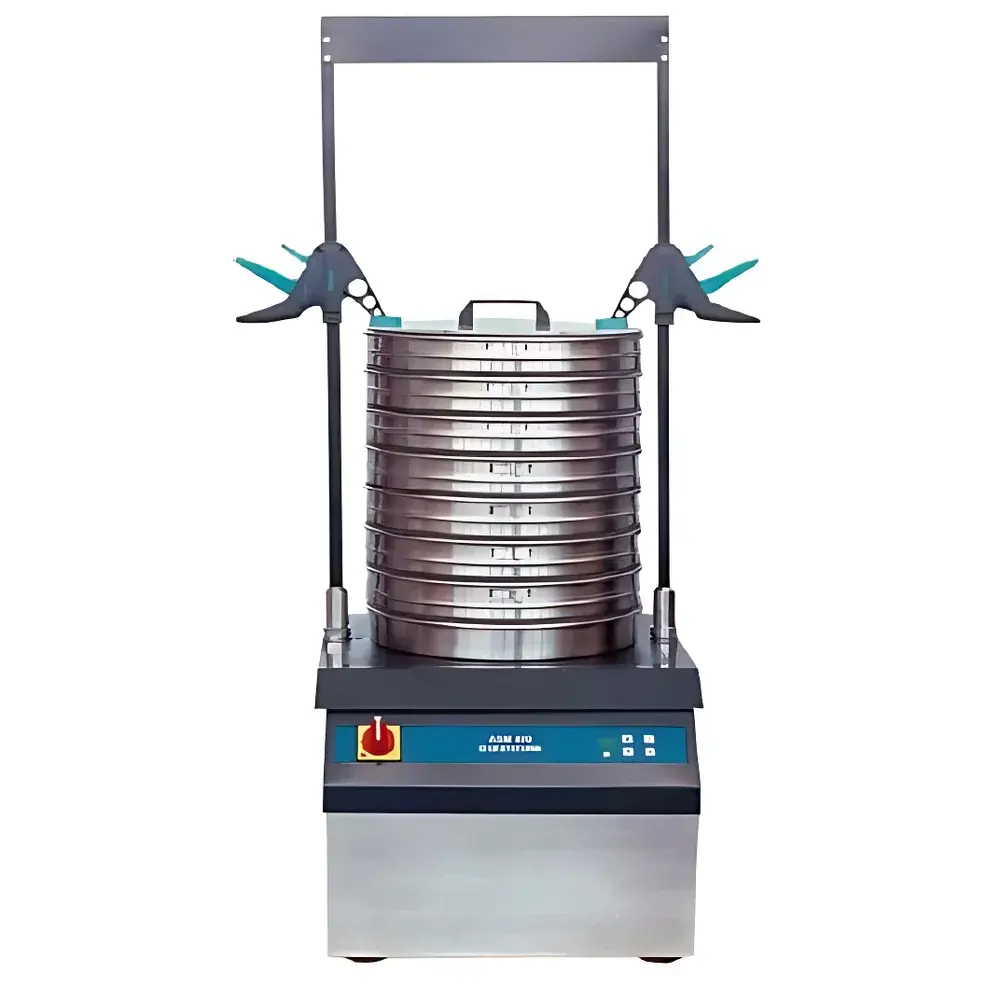
Siebtechnik ASM400 Advanced Vibratory Sieve Analyzer
| Brand | Siebtechnik |
|---|---|
| Origin | Germany |
| Model | ASM400 |
| Measurement Range | 63 µm – 90 mm |
| Sieve Stages | 11 |
| Vibration Frequency | 3000 min⁻¹ |
| Max Amplitude | 3 mm |
| Timer Range | 1–99 min |
| Sieve Diameter Options | 100 mm, 150 mm, 200 mm, 203 mm (8"), 400 mm |
| Sieving Principle | High-Efficiency 3D Throwing Motion |
| Compliance | ISO 3310-1, DIN EN 10204.21, ASTM E11 |
| Dimensions (L×W×H) | 51 cm × 60 cm × 140 cm |
| Construction | Corrosion-Resistant Powder-Coated Steel Frame, Transparent Polycarbonate Lid |
| Sieve Material Options | Stainless Steel, Brass, Polymer, Wood |
Overview
The Siebtechnik ASM400 Advanced Vibratory Sieve Analyzer is a precision-engineered laboratory and industrial-grade particle size distribution analyzer designed for reproducible, high-throughput dry and wet sieving of free-flowing bulk solids. Based on the well-established 3D throwing motion principle—where material undergoes simultaneous vertical lift, horizontal displacement, and rotational agitation—the ASM400 achieves rapid stratification and efficient particle passage through stacked sieve decks. This dynamic motion minimizes blinding, prevents agglomeration, and ensures uniform sample exposure across the entire sieve surface, delivering statistically robust results compliant with standardized test protocols. As a CE-marked instrument manufactured in Germany, the ASM400 meets stringent requirements for use in quality control laboratories operating under ISO/IEC 17025, GMP, and GLP frameworks, particularly where traceability, operator independence, and method validation are essential.
Key Features
- High-intensity vibratory drive system delivering consistent 3000 min⁻¹ frequency and 3 mm peak-to-peak amplitude for accelerated separation of coarse to fine fractions.
- Modular sieve stack configuration supporting up to 11 nested sieve levels with interchangeable diameters (100 mm to 400 mm), enabling flexible method development across diverse sample matrices.
- Digital timer with 1–99 minute programmable duration and real-time countdown display, ensuring precise process repeatability across shifts and operators.
- Quick-clamp sieve retention mechanism engineered for tool-free assembly/disassembly, minimizing setup time and reducing mechanical stress on sieve meshes during repeated handling.
- Robust structural frame fabricated from powder-coated steel with integrated vibration-damping feet; fully enclosed polycarbonate viewing lid provides unobstructed process monitoring without compromising safety or dust containment.
- Multi-material sieve compatibility—including stainless steel (ISO 3310-1 compliant), brass, food-grade polymer, and wood—ensures chemical inertness, regulatory suitability (e.g., FDA-contact applications), and long-term dimensional stability.
Sample Compatibility & Compliance
The ASM400 accommodates a broad spectrum of granular and particulate materials, including but not limited to mineral aggregates, cement clinker, coal fines, agricultural seeds, pharmaceutical granules, metal powders, ceramic precursors, and polymer flakes. Its 63 µm – 90 mm analytical range covers applications from fine pigment classification to coarse aggregate grading. All standard sieve sets conform to ISO 3310-1 (test sieves — technical requirements and testing), ASTM E11 (Standard Specification for Woven Wire Test Sieve Cloth and Test Sieves), and DIN EN 10204.21 (inspection documents for metallic products). The instrument’s mechanical design supports both dry sieving under ambient conditions and wet sieving with integrated liquid dispersion nozzles (optional accessory), satisfying method requirements outlined in ISO 2591-1 and ASTM C136/C702.
Software & Data Management
While the base ASM400 operates via standalone digital control, it is fully compatible with Siebtechnik’s optional SieveSoft™ data acquisition module—a Windows-based software platform supporting automated result logging, PDF report generation, statistical analysis (mean particle size, D10/D50/D90, cumulative undersize curves), and export to CSV or LIMS-compatible formats. Audit trail functionality records operator ID, timestamp, sieve stack configuration, and parameter settings per run—meeting documentation requirements under FDA 21 CFR Part 11 for electronic records and signatures when deployed in regulated environments. Calibration certificates traceable to national metrology institutes (e.g., PTB Germany) are available upon request.
Applications
- Quality assurance of raw materials and final products in cement, metallurgy, and mining operations—particularly for Blaine fineness correlation and slag grading.
- R&D screening of novel battery electrode powders, additive manufacturing feedstocks, and catalyst supports requiring strict particle size distribution control.
- Regulatory compliance testing for fertilizers (ISO 8683), animal feed (EN 15209), and construction sand (EN 12620) according to statutory particle size limits.
- Process optimization in food processing lines—e.g., flour milling verification, spice particle homogeneity assessment, and coffee grind consistency evaluation.
- Environmental lab analysis of soil texture classification (USDA triangle), sediment sorting, and airborne particulate fractionation prior to gravimetric or elemental analysis.
FAQ
What sieve standards does the ASM400 support?
The ASM400 is compatible with all ISO 3310-1, ASTM E11, and DIN 4188-compliant test sieves, including those with woven wire mesh, electroformed mesh, and perforated plate configurations.
Can the ASM400 perform wet sieving?
Yes—when equipped with the optional wet sieving kit (including spray manifold, drain pan, and liquid-tight seal), the ASM400 complies with ISO 2591-1 and ASTM C702 for suspended-solids classification.
Is the instrument suitable for GMP-regulated pharmaceutical labs?
With SieveSoft™ software enabled and appropriate IQ/OQ documentation packages, the ASM400 satisfies key elements of Annex 11 and USP for mechanical sieving equipment used in particle characterization of drug substances and excipients.
How is calibration verified for the vibration motor?
Vibration amplitude and frequency are factory-certified using laser Doppler vibrometry; annual recalibration services include traceable verification against NIST-traceable accelerometers and tachometers.
What maintenance is required for long-term reliability?
Routine inspection of clamp mechanisms and sieve mesh integrity is recommended; the brushless AC motor requires no scheduled lubrication and is rated for >20,000 hours of continuous operation under standard load conditions.



