
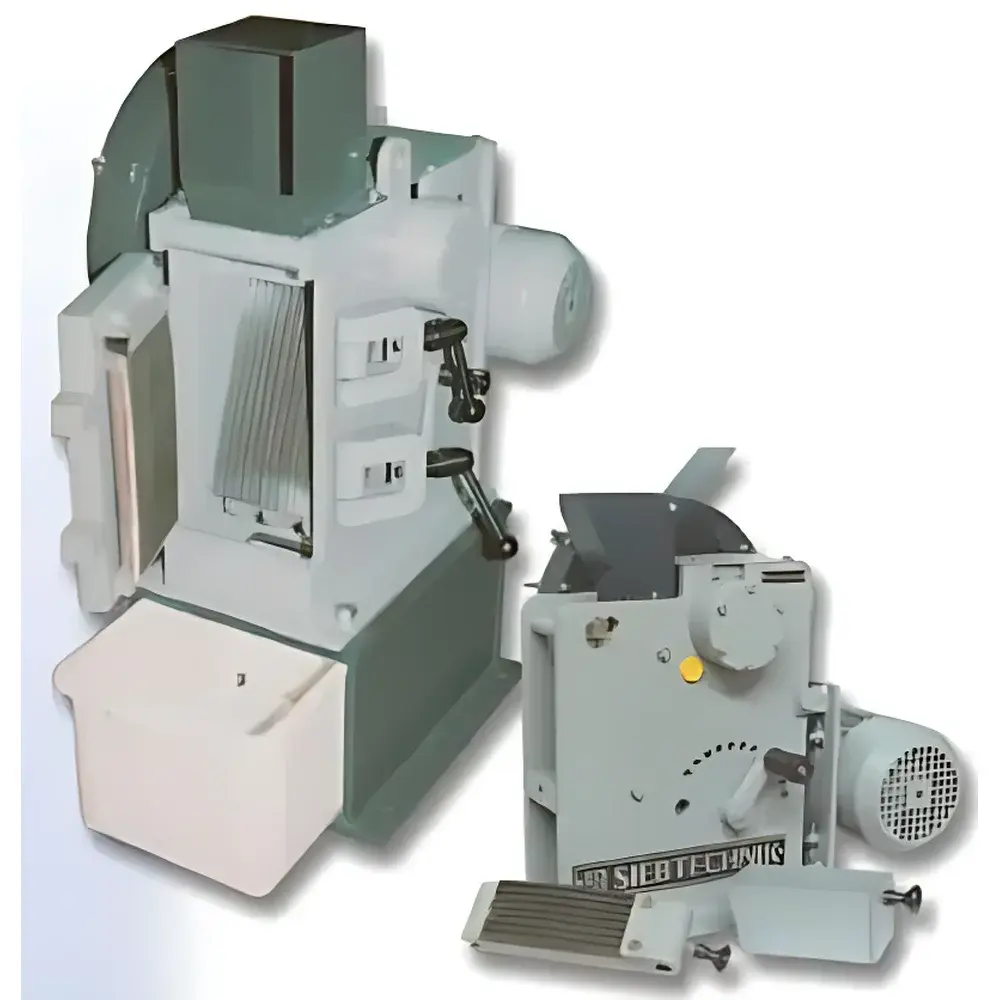
Siebtechnik EB15/10 Universal Jaw Crusher
| Brand | Siebtechnik |
|---|---|
| Origin | Germany |
| Model | EB15/10 |
| Max. Feed Size | 90 mm |
| Max. Inlet Opening | 150 mm × 100 mm |
| Final Particle Size | < 5 mm |
| Adjustable Jaw Gap | 5–15 mm |
| Throughput | 100–350 kg/h |
| Motor Power | 2.2 kW (3-phase) |
| Jaw Materials | Hardened Steel, Stainless Steel, Tungsten Carbide, Zirconia Oxide |
| Dimensions (with base & collection box) | 430 mm × 880 mm × 955 mm |
| Compliance | CE |
Overview
The Siebtechnik EB15/10 Universal Jaw Crusher is a robust, industrial-grade primary crushing instrument engineered for reliable size reduction of medium-hard to hard, brittle, and non-ductile materials in laboratory, pilot-scale, and process-integrated environments. Based on the proven principle of compressive crushing—where material is subjected to high mechanical stress between two opposing jaw plates—one stationary and one dynamically oscillating in a three-dimensional compound motion—the EB15/10 achieves consistent particle size reduction through controlled mechanical attrition and shear forces. Unlike rotary or impact-based grinders, this jaw crusher operates without high-speed rotating components or centrifugal forces, delivering inherently stable, low-vibration performance suitable for continuous operation in demanding settings such as mining QA/QC labs, geological survey facilities, cement and aggregate R&D centers, and raw material preprocessing lines. Its design prioritizes mechanical integrity, operator safety, and long-term dimensional stability under repeated load cycles.
Key Features
- Three-dimensional compound motion of the movable jaw eliminates material bridging and jamming—critical when processing irregularly shaped or layered samples like shale, slag, or sintered ceramics.
- Adjustable jaw gap (5–15 mm) enables precise control over final particle size distribution without requiring component replacement; calibrated scale allows repeatable setting retention across shifts.
- Interchangeable jaw plates with optimized corrugated surface geometry enhance grinding efficiency by increasing effective contact area and reducing slippage—resulting in lower specific energy consumption per kilogram processed compared to flat-surface alternatives.
- 180° reversible jaw plates double service life and reduce consumables cost; wear patterns are symmetrical and predictable, supporting predictive maintenance scheduling.
- Front-access crushing chamber facilitates rapid jaw plate installation, removal, and cavity cleaning—minimizing cross-contamination risk between heterogeneous sample batches (e.g., multi-element geochemical assays or multi-lot mineralogical analysis).
- CE-compliant motor with integrated thermal overload protection ensures safe operation under variable load conditions; electrical enclosure meets IP54 rating for dust and splash resistance.
- Structural frame fabricated from cast iron with reinforced mounting points provides torsional rigidity during high-torque crushing events, maintaining alignment tolerance (10,000 operating hours.
Sample Compatibility & Compliance
The EB15/10 accepts feed materials with Mohs hardness up to 7 (e.g., quartz, feldspar, basalt) and compressive strength up to 250 MPa. It is routinely deployed for sample preparation prior to XRF, XRD, ICP-OES, and sieve analysis in accordance with ASTM D2974 (moisture and ash in coal), ISO 6874 (coal sampling), and USP (particle size determination). Jaw plate material options—including tungsten carbide and zirconia oxide—are selected based on sample chemistry to prevent metallic contamination during analysis of trace elements (e.g., Pb, As, Cd in environmental soil testing). All configurations comply with EU Machinery Directive 2006/42/EC and electromagnetic compatibility requirements per EN 61000-6-2/-6-4.
Software & Data Management
While the EB15/10 is a mechanically actuated, non-digitalized crusher, it integrates seamlessly into GLP/GMP-compliant workflows via optional accessories: a certified digital torque meter (calibrated per ISO/IEC 17025) can be mounted inline to log real-time motor load profiles; paired with LIMS-compatible data acquisition modules, these logs support audit trails for batch-wise sample preparation validation. Jaw plate usage history, maintenance intervals, and calibration records may be tracked using Siebtechnik’s optional AssetLink™ documentation package—a cloud-synced, CFR Part 11-ready template set for equipment qualification (IQ/OQ/PQ) and change control documentation.
Applications
- Geochemical laboratories: Primary crushing of core samples, drill cuttings, and bulk ore prior to homogenization and subsampling.
- Cement and construction materials testing: Reduction of clinker, limestone, and fly ash to <5 mm for Blaine fineness or Le Chatelier expansion testing.
- Environmental monitoring labs: Preparation of contaminated soils and sediments for TCLP extraction or sequential leaching protocols.
- Recycling R&D: Size reduction of end-of-life PV panels, CRT glass, and ceramic electronic substrates for compositional screening.
- Academic materials science: Controlled fragmentation of synthetic ceramics and refractory composites for microstructural correlation studies.
FAQ
What safety certifications does the EB15/10 hold?
It complies with CE marking requirements under the EU Machinery Directive 2006/42/EC and carries full conformity documentation including EC Declaration of Conformity and risk assessment reports.
Can the crusher handle wet or sticky materials?
No—it is designed exclusively for dry, free-flowing, brittle feedstocks; moisture content exceeding 2% w/w may cause adhesion and clogging in the crushing chamber.
Is remote monitoring or IoT integration supported?
The base unit lacks embedded electronics, but third-party vibration sensors, current transducers, and PLC gateways can be retrofitted for condition-based monitoring in Industry 4.0 environments.
How often should jaw plates be inspected?
Visual inspection is recommended after every 200 operational hours; thickness measurement at three standardized locations ensures wear uniformity and supports predictive replacement planning.
Does Siebtechnik provide jaw plate regrinding services?
Yes—certified reconditioning (including profile restoration and hardness verification) is available through authorized service centers with turnaround times under 10 business days.



