
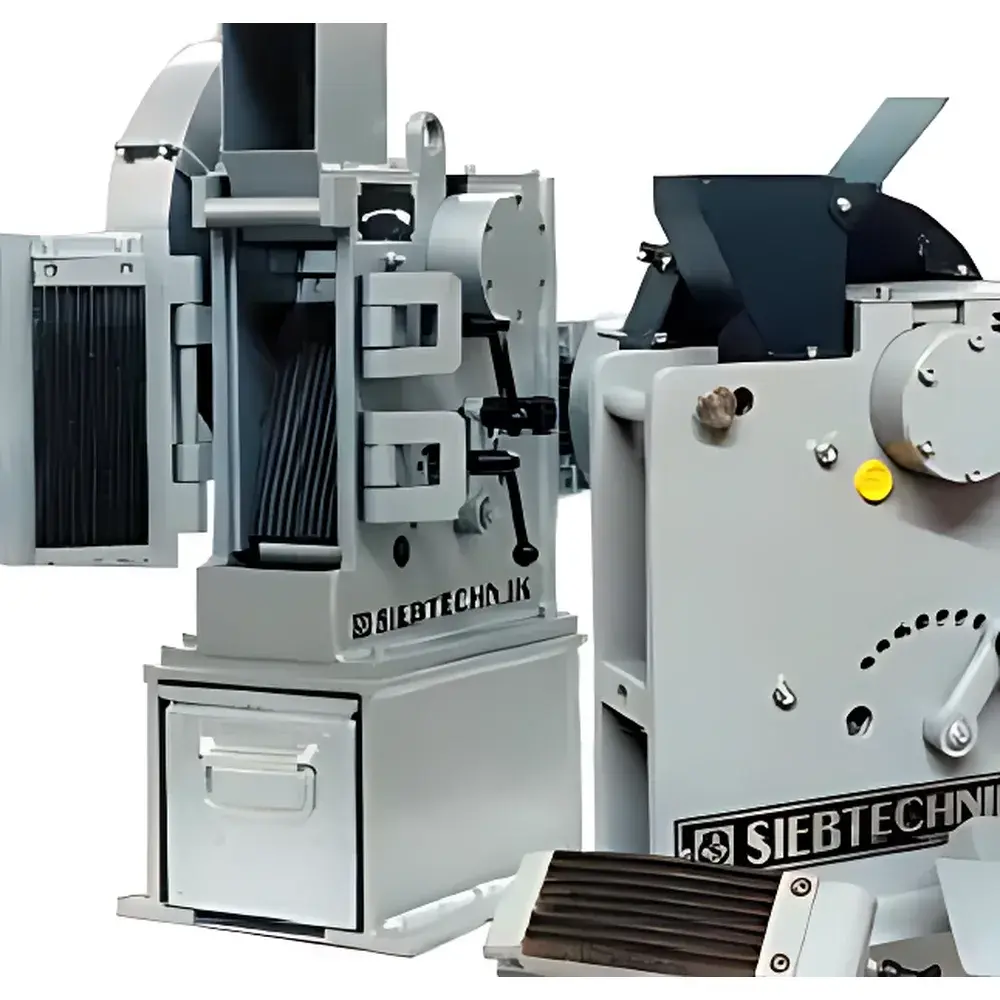
Siebtechnik EB20/12.5 Heavy-Duty Jaw Crusher
| Brand | Siebtechnik |
|---|---|
| Origin | Germany |
| Model | EB20/12.5 Jaw Crusher |
| Max. Feed Size | 125 mm |
| Feed Opening | 200 mm × 125 mm |
| Final Particle Size | < 5 mm |
| Adjustable Jaw Gap | 5–40 mm |
| Throughput Capacity | 500–1800 kg/h |
| Drive Motor | 3-Phase, 4000 W |
| Jaw Materials | Hardened Steel, Stainless Steel, Tungsten Carbide, Zirconia |
| Dimensions (with Base & Collection Tray) | 686 mm × 1100 mm × 1160 mm |
| Compliance | CE Marked, EN 61000-6-2 / EN 61000-6-4 |
Overview
The Siebtechnik EB20/12.5 Heavy-Duty Jaw Crusher is a robust, industrial-grade primary crushing system engineered for reliable size reduction of medium-hard to hard, brittle, and non-ductile materials in laboratory, pilot-scale, and continuous process environments. Based on the classic toggle-jaw principle, it operates via a fixed jaw and a dynamically oscillating moving jaw executing a three-dimensional compound motion—combining compression, shearing, and controlled attrition—to achieve efficient particle breakdown without excessive heat generation or plastic deformation. This mechanical design ensures high reproducibility across batch-to-batch operations and eliminates material bridging or jamming—a common limitation in simpler eccentric-driven crushers. Designed and manufactured in Germany to stringent DIN and ISO quality standards, the EB20/12.5 meets CE requirements for electromagnetic compatibility (EN 61000-6-2 and EN 61000-6-4) and incorporates integrated motor protection with thermal overload cutoff, making it suitable for unattended operation in demanding settings such as mining QA/QC labs, geological survey facilities, cement raw material preparation lines, and R&D centers developing construction aggregates or refractory ceramics.
Key Features
- High-capacity throughput of 500–1800 kg/h enables seamless integration into pre-processing workflows prior to downstream analysis (e.g., XRF, XRD, ICP-OES sample preparation) or industrial feedstock conditioning.
- Adjustable jaw gap (5–40 mm) allows precise control over final particle size distribution—critical for achieving consistent feed specifications required by sieve analysis (ASTM E11), laser diffraction (ISO 13320), or subsequent grinding stages.
- Interchangeable jaw plates with optimized corrugated surface geometry enhance crushing efficiency while minimizing high-frequency friction noise—reducing ambient sound pressure levels to ≤85 dB(A) at 1 m distance under full load.
- 180° reversible jaw plate mounting doubles service life and reduces scheduled maintenance intervals; wear-resistant material options—including tungsten carbide and zirconia—extend operational longevity when processing abrasive samples like quartz, slag, or sintered ceramics.
- Front-access crusher chamber facilitates rapid jaw replacement, internal cleaning, and residue removal—supporting GLP-compliant sample integrity protocols and minimizing cross-contamination risk between heterogeneous geological or metallurgical specimens.
- Integrated safety interlock system deactivates drive motor upon chamber door opening, complying with Machinery Directive 2006/42/EC; all electrical components conform to IP54 ingress protection rating for dust and splash resistance.
Sample Compatibility & Compliance
The EB20/12.5 is validated for comminution of brittle, non-fibrous, non-sticky materials including but not limited to: iron ore, bauxite, limestone, basalt, coal, coke, fly ash, furnace slag, fired clay bricks, borosilicate glass, technical ceramics, fused silica, and weathered soil matrices. It is unsuitable for ductile metals, elastomers, fibrous biomass, or hygroscopic substances prone to caking. All structural welds adhere to EN 1090-2 execution class EXC2; jaw plate materials are certified per EN 10027 and ISO 4949 for traceability. The unit supports compliance with ISO/IEC 17025:2017 clause 6.4.3 (equipment suitability verification) and is routinely deployed in laboratories operating under ASTM D2974 (coal and coke analysis), ISO 14688-1 (geotechnical classification), and USP <1174> (particle size reduction for pharmaceutical excipients—when used in non-GMP pre-formulation screening).
Software & Data Management
As a standalone mechanical crusher, the EB20/12.5 does not incorporate embedded digital controls or proprietary software. However, its deterministic mechanical behavior—consistent throughput, repeatable gap setting, and predictable power draw—enables straightforward integration into LIMS or MES platforms via optional analog 4–20 mA current output (available upon request) for real-time motor load monitoring. Operators may log jaw gap position, cumulative runtime, and batch-specific feed mass using standardized SOP templates aligned with FDA 21 CFR Part 11 Annex 11 audit trail requirements. Maintenance records—including jaw plate rotation cycles and wear measurements—can be tracked manually or imported into CMMS systems supporting ISO 55001 asset management frameworks.
Applications
- Geological core sample preparation for geochemical assay (ICP-MS, AAS) and petrographic thin-sectioning.
- Routine QA/QC crushing of bulk mineral concentrates prior to homogenization and subsampling per ISO 3082.
- Pre-treatment of construction waste and demolition debris for LEED-certified recycling stream characterization.
- Feed size conditioning for vertical roller mills and ball mills in cement and lime production pilot plants.
- Particle size standardization of reference materials (RM) used in proficiency testing schemes accredited to ISO/IEC 17043.
- Crushing of spent catalysts and metallurgical slags for leaching studies compliant with TCLP (EPA Method 1311) or EN 12457.
FAQ
What is the maximum allowable moisture content for feed material?
The EB20/12.5 is designed for dry or low-moisture (8% water content.
Can the crusher be mounted on a vibration-isolated frame?
Yes—its rigid base configuration supports bolt-down installation on reinforced concrete pads or spring-mounted isolation platforms meeting ISO 2041 vibration class V2 specifications.
Is calibration required before first use?
No formal calibration is needed; however, users must verify jaw gap accuracy using certified gauge blocks per ISO 3650 and document initial mechanical setup in accordance with ISO/IEC 17025 clause 7.8.2.
What routine maintenance is recommended?
Daily visual inspection of jaw alignment and fastener tightness; bi-weekly lubrication of toggle mechanism with EP2 grease (DIN 51502); quarterly torque verification of jaw mounting bolts per manufacturer’s specified values.
Does Siebtechnik provide application support for method development?
Yes—technical documentation includes recommended jaw gap settings vs. target d90 for 20+ common materials, and application engineers offer remote consultation for throughput optimization and contamination mitigation strategies.



