
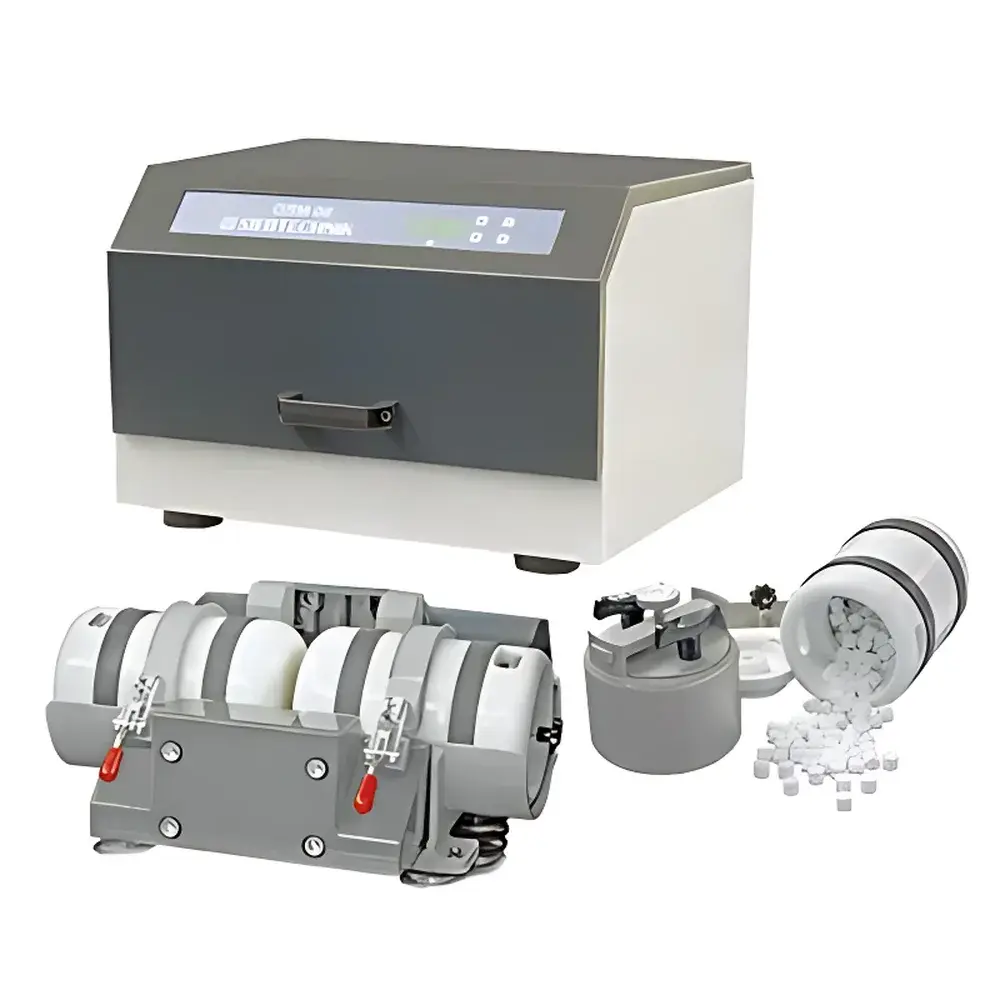
Siebtechnik GSM 06 Desktop Vibratory Ball Mill
| Brand | Siebtechnik |
|---|---|
| Origin | Germany |
| Equipment Type | Vibratory Ball Mill |
| Max Feed Size | < 10–20 mm |
| Final Particle Size | < 1 µm (material-dependent) |
| Sample Capacity | ≤ 2 × 300 mL (per 500 mL jar) |
| Drive Power | 190 W |
| Vibration Frequency | 1500 min⁻¹ |
| Amplitude Range | 0–6 mm |
| Timer | Digital, LCD-displayed |
| Jar Materials | Stainless Steel, Ceramic |
| Dimensions (W×D×H) | 570 × 504 × 374 mm |
| Compliance | CE, ISO 9001-manufactured equipment |
Overview
The Siebtechnik GSM 06 Desktop Vibratory Ball Mill is an engineered laboratory-scale comminution system designed for high-energy, controlled-size reduction of brittle and fibrous materials. Operating on the principle of high-frequency unbalanced vibration, the instrument subjects samples to multidirectional impact, friction, and shear forces generated by grinding media (balls) within sealed, rotating jars. Unlike planetary or centrifugal mills, the GSM 06 employs a radial eccentric drive mechanism that induces reproducible oscillatory motion—ensuring consistent energy transfer across batches. This architecture delivers superior repeatability in particle size distribution (PSD), making it especially suitable for quality control laboratories, R&D departments, and analytical sample preparation workflows where inter-batch comparability is critical. Its compact footprint and dual-jar configuration support parallel processing without cross-contamination, while its CE-marked construction and adherence to ISO 9001 manufacturing standards reflect compliance with European safety and quality management frameworks.
Key Features
- High-energy vibratory action with digitally adjustable amplitude (0–6 mm) and fixed frequency (1500 min⁻¹), enabling precise control over mechanical input energy.
- Dual independent grinding stations accommodate two 500 mL jars simultaneously—ideal for comparative studies, method validation, or replicate analysis under identical conditions.
- Robust motor-driven eccentric shaft system delivering 190 W nominal power, optimized for sustained operation during extended grinding cycles.
- Sealed grinding chamber design minimizes acoustic emission and prevents aerosol dispersion—critical for handling hazardous, hygroscopic, or volatile samples.
- Intuitive digital timer with LCD interface allows pre-programmed grinding duration (up to 99 hours, 59 minutes), with automatic shutdown and audible alert.
- Quick-release jar clamping mechanism facilitates rapid jar exchange and cleaning; compatible with stainless steel and ceramic jars for chemical inertness and wear resistance.
- No external cooling required for standard dry/wet grinding protocols—thermal load remains within safe operational limits due to efficient energy coupling and intermittent duty cycles.
Sample Compatibility & Compliance
The GSM 06 supports both dry and wet grinding protocols across a broad spectrum of inorganic and organic matrices—including ceramics, minerals, ores, soils, plant tissues, pigments, pharmaceutical excipients, and composite precursors. Its ability to process feed particles up to 20 mm (depending on hardness and brittleness) and achieve final particle sizes below 1 µm (as verified by laser diffraction or SEM analysis) aligns with common requirements in ASTM C136 (sieve analysis), ISO 13320 (laser diffraction particle sizing), and USP <788> (particulate matter testing). The instrument’s sealed operation and material compatibility (e.g., ceramic jars for fluoride-containing or alkali-sensitive samples) support GLP-compliant sample preparation workflows. All electrical components meet IEC 61000-6-3 (EMC) and IEC 61000-6-2 (immunity) standards; mechanical safety conforms to EN 61000-6-4.
Software & Data Management
While the GSM 06 operates as a standalone benchtop unit without embedded PC-based software, its digital timer provides audit-ready time-stamped operation logs via front-panel display. For integration into regulated environments (e.g., GMP or FDA 21 CFR Part 11-compliant labs), users may pair the mill with external data acquisition systems using optional relay output modules (available upon request). Calibration records for amplitude verification, vibration frequency measurement, and timer accuracy are maintained per ISO/IEC 17025 guidelines. Routine performance qualification (PQ) can be conducted using certified reference materials (e.g., NIST SRM 1980) to validate PSD reproducibility across multiple operators and shifts.
Applications
- Preparation of homogenized powders for X-ray fluorescence (XRF) and X-ray diffraction (XRD) analysis.
- Size reduction of geological core samples prior to geochemical assay (ICP-MS/OES).
- Cell disruption and tissue homogenization in botanical and agricultural research.
- Blending and activation of catalyst precursors and battery electrode materials.
- Production of standardized suspensions for rheological characterization and coating formulation development.
- Method development for regulatory submissions requiring documented particle size control (e.g., inhalable drug products, nanomaterials).
FAQ
Can the GSM 06 handle heat-sensitive materials?
Yes—by selecting shorter grinding intervals, lower amplitudes, or cryogenic jar liners (optional), thermal degradation can be minimized. Wet grinding with ethanol or liquid nitrogen-cooled solvents further mitigates temperature rise.
Is the instrument suitable for abrasive materials like silicon carbide or tungsten carbide?
When equipped with zirconia or alumina ceramic jars and matching grinding media, the GSM 06 maintains dimensional stability and low contamination risk during prolonged processing of highly abrasive substances.
How is reproducibility ensured between operators?
Amplitude calibration, timer synchronization, jar loading consistency (mass ratio of balls-to-sample), and defined rest periods between runs are documented in SOPs aligned with ISO 5725-2 precision criteria.
Does the mill support vacuum or inert atmosphere grinding?
Standard jars are not vacuum-rated; however, custom-sealed jars with gas purge ports (N₂, Ar) can be supplied for oxygen-sensitive applications upon technical consultation.
What maintenance is required for long-term reliability?
Annual inspection of eccentric drive bearings, torque verification of clamping mechanisms, and periodic amplitude verification using calibrated laser vibrometry are recommended per manufacturer service protocol.
Related Products



