
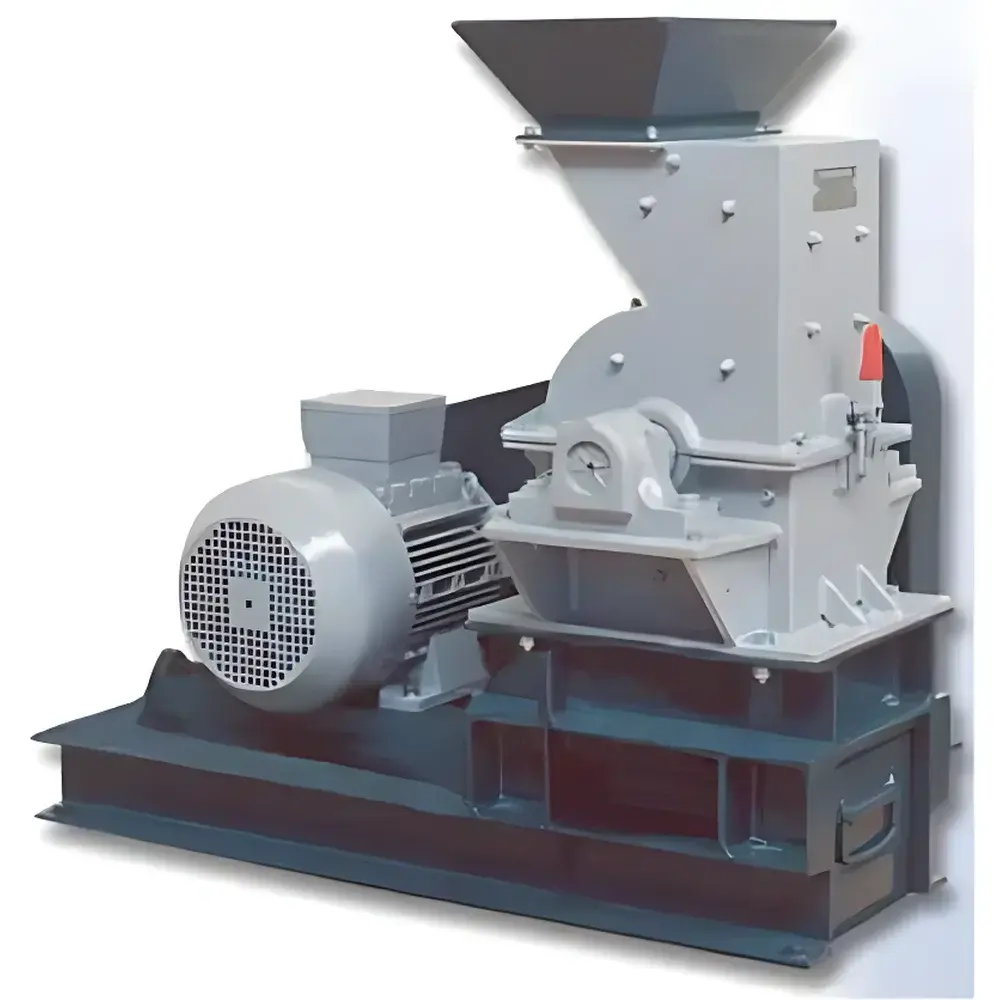
Siebtechnik HM 1 Hammer Mill
| Brand | Siebtechnik |
|---|---|
| Origin | Germany |
| Model | HM 1 |
| Max. Feed Size | <50 mm |
| Final Particle Size | 2–30 mm |
| Grate Aperture Options | 1, 2, 3, 4, 5, 8, 10 mm |
| Throughput Capacity | 1000 kg/h |
| Motor Power | 5500 W |
| Rotor & Grate Material | Stainless Steel |
| Dimensions (L×W×H) | 990 × 570 × 900 mm |
| Compliance | CE Marked |
| Application Range | Soft to Medium-Hard Materials (Mohs 2–5) |
Overview
The Siebtechnik HM 1 Hammer Mill is a robust, batch- or continuous-feed laboratory and pilot-scale comminution system engineered for reliable pre-crushing and fine crushing of solid materials with Mohs hardness up to 5. Based on the principle of high-speed impact comminution, the HM 1 employs a dynamically balanced rotor assembly fitted with hardened steel hammers that rotate at controlled peripheral velocities. As feed material enters the grinding chamber via the top hopper, it undergoes repeated impact, compression, shear, and attrition against both the rotating hammers and the fixed stainless-steel grate basket. Particles larger than the selected grate aperture are retained within the chamber for further size reduction until they pass through the grate and discharge into the collection bin. This closed-loop retention mechanism ensures consistent particle size distribution and minimizes overgrinding—critical for analytical reproducibility in quality control and R&D workflows.
Key Features
- High-throughput capability of up to 1000 kg/h, suitable for both laboratory screening and pilot-scale process development
- Adjustable final particle size via interchangeable stainless-steel grate baskets (1–10 mm apertures), enabling precise control over output gradation
- Heavy-duty construction with fully stainless-steel rotor and grate components, ensuring long-term corrosion resistance and mechanical integrity under abrasive operation
- Large-volume feed hopper and full-access hinged upper housing for rapid loading, visual inspection, and tool-free cleaning—reducing cross-contamination risk between samples
- CE-compliant design with integrated safety interlocks, emergency stop circuitry, and vibration-damped mounting to meet EU Machinery Directive 2006/42/EC requirements
- Optimized hammer geometry and rotor speed profile to maximize energy transfer efficiency while minimizing heat generation and fines generation in sensitive materials
Sample Compatibility & Compliance
The HM 1 is validated for use with soft to medium-hard brittle and semi-brittle solids—including coal, limestone, gypsum, coke, slag, fertilizers, chemical intermediates, and industrial minerals. It is not intended for fibrous, elastic, sticky, or highly abrasive materials (e.g., quartz above Mohs 7). All contact surfaces comply with FDA-relevant material standards for non-reactive processing environments. The unit conforms to ISO 17025-aligned operational traceability when used in GLP/GMP-regulated laboratories, and its mechanical design supports audit-ready documentation of maintenance history, calibration intervals, and operator training records. While the HM 1 itself does not carry USP or ASTM certification, its output particle size distributions are routinely referenced in ASTM D3174 (ash in coal), ASTM D2795 (coke sizing), and ISO 6874 (limestone grading) test protocols.
Software & Data Management
The HM 1 operates as a standalone electromechanical system without embedded digital controls or proprietary software. However, its deterministic mechanical behavior—defined by fixed rotor speed, hammer mass, and grate geometry—enables full procedural documentation in LIMS or ELN platforms. Users may integrate optional external sensors (e.g., load cells, current monitors, or vibration analyzers) to log real-time power draw, throughput rate, and motor thermal profiles for trending analysis. All operational parameters—including grate selection, feed rate, and run duration—are recorded manually or via barcode-scanned SOPs to satisfy 21 CFR Part 11 audit trails when deployed in regulated QC environments. Maintenance logs and calibration certificates for torque wrenches, dial indicators, and clearance gauges used during grate installation are recommended for full compliance alignment.
Applications
- Routine sample preparation prior to elemental analysis (XRF, ICP-OES), proximate analysis (ASTM D3172), or calorimetry (ASTM D5865)
- Pilot-scale comminution trials for mineral beneficiation process optimization
- Homogenization of heterogeneous bulk materials for representative sub-sampling in geochemical or metallurgical testing
- Particle size distribution benchmarking in raw material qualification for cement, fertilizer, and ceramic manufacturing
- Preparation of reference materials with documented size fractions for method validation studies
- Research into fracture mechanics and energy-size reduction relationships in brittle solids
FAQ
What is the maximum feed particle size the HM 1 can accept?
The HM 1 accepts feed material with a maximum dimension of less than 50 mm. Oversized particles must be pre-screened or manually reduced prior to feeding.
Can the HM 1 be used for wet or moist materials?
No—the HM 1 is designed exclusively for dry, free-flowing solids. Moisture content above 5% w/w may cause clogging, grate blinding, or inconsistent throughput.
Is the HM 1 suitable for food-grade or pharmaceutical applications?
While constructed from stainless steel, the HM 1 lacks sanitary design features (e.g., polished Ra ≤ 0.8 µm surfaces, drainable geometry, or IP65-rated enclosures) required for direct food or pharma processing; it is appropriate for non-sterile R&D or QC sampling only.
How often should the hammers and grate be inspected or replaced?
Inspection frequency depends on abrasivity and throughput volume; Siebtechnik recommends visual and dimensional checks after every 200 operating hours or 50 tons processed, whichever occurs first.
Does Siebtechnik provide certified calibration services for the HM 1?
Yes—factory-certified mechanical verification (rotor balance, hammer clearance, grate aperture tolerance) is available upon request with NIST-traceable documentation.



