
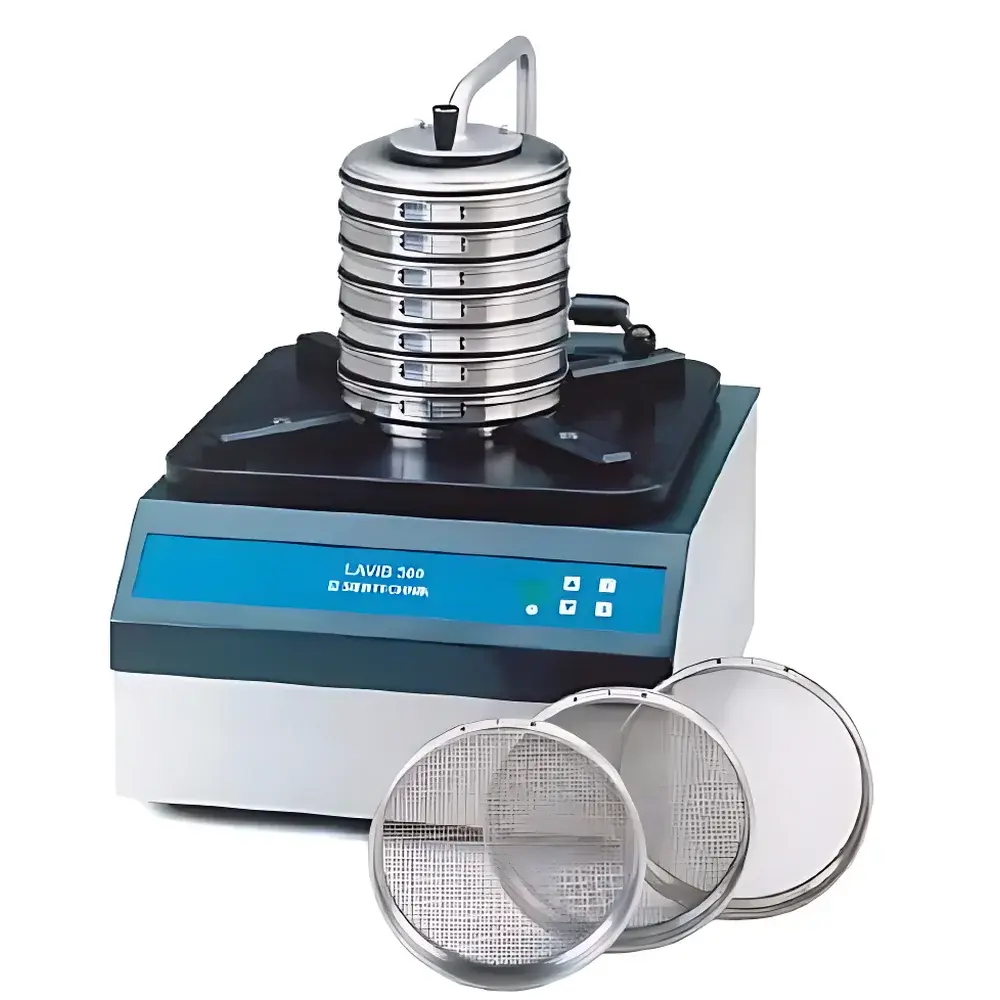
Siebtechnik LAVIB300 Horizontal Sieve Analyzer
| Brand | Siebtechnik |
|---|---|
| Origin | Germany |
| Model | LAVIB300 |
| Sieve Motion Type | Horizontal circular (regular or irregular) |
| Irregular Motion Amplitude Range | 0–30 mm |
| Frequency | 270 cycles/min |
| Sieving Time Range | 1–99 min |
| Max Sieve Diameter | 300 mm |
| Standard Sieve Sizes | 200 mm, 210 mm, 300 mm (8″ / 214 mm) |
| Sieve Standards Compliance | ISO 3310-1, DIN EN 10204.21, ASTM E11 |
| Particle Size Range | 20 µm – 125 mm |
| Number of Sieve Stages | 8 |
| Display | LCD digital timer and control interface |
| Construction | Wear-resistant metal frame with corrosion-resistant epoxy coating |
| Optional Sieve Materials | Polished stainless steel, brass, polymer |
Overview
The Siebtechnik LAVIB300 Horizontal Sieve Analyzer is an engineered solution for the precise dry sieving and particle size distribution analysis of non-spherical, anisotropic particulates—including fibrous, flake-like, needle-shaped, and elongated particles—common in agricultural, botanical, tobacco, pharmaceutical excipient, and mineral processing applications. Unlike vertical or vibratory sievers that rely on gravitational acceleration and vertical impulse, the LAVIB300 employs a controlled horizontal circular motion principle: the sieve platform moves in a defined plane, generating lateral shear forces that promote particle reorientation and layer dispersion without compaction or agglomeration. This mechanism is especially critical for materials with low aspect-ratio sensitivity—such as cereal grains, cellulose fibers, mica flakes, or crystalline platelets—where conventional sieving yields poor reproducibility due to bridging, nesting, or preferential orientation. The instrument complies with internationally recognized dry sieving standards (ISO 3310-1, ASTM E11), ensuring traceable, auditable results suitable for QC release testing and method validation under GLP/GMP frameworks.
Key Features
- Horizontally driven sieve platform with dual-mode motion: selectable regular circular orbit or adjustable irregular orbit (0–30 mm amplitude) to enhance particle mobility and reduce stratification effects.
- Fixed-frequency drive at 270 cycles per minute—optimized for kinetic energy transfer while minimizing mechanical fatigue and sample degradation.
- Digital LCD timer with programmable sieving duration (1–99 minutes), enabling method standardization across shifts and laboratories.
- Quick-lock sieve clamping system compatible with standard diameters (200 mm, 210 mm, 300 mm, and 8″/214 mm), supporting both ISO- and ASTM-compliant mesh configurations.
- Robust structural design featuring wear-resistant steel housing and electrostatically applied corrosion-inhibiting epoxy coating—engineered for long-term stability in high-humidity or dust-laden environments.
- Modular sieve material options: electropolished stainless steel (for inertness and cleanability), brass (for non-magnetic applications), or food-grade polymer (for abrasive-sensitive samples).
Sample Compatibility & Compliance
The LAVIB300 is validated for use with materials exhibiting low sphericity (sphericity 3:1), including but not limited to: cereal kernels (wheat, barley, millet), tobacco lamina and stems, plant fiber bundles (hemp, flax, bamboo), synthetic filaments, graphite flakes, and pharmaceutical granules containing rod-shaped excipients. Its horizontal motion profile prevents vertical settling bias and eliminates false “oversize” retention caused by particle alignment perpendicular to mesh openings. All test procedures align with ISO 9276-2 for particle size analysis reporting and support compliance with USP , EP 2.9.31, and FDA 21 CFR Part 11 when integrated with validated data capture workflows. Documentation packages include factory calibration certificates referencing traceable NIST-traceable reference powders.
Software & Data Management
While the LAVIB300 operates as a stand-alone mechanical analyzer, its timed operation and standardized sieve stack configuration enable seamless integration into laboratory information management systems (LIMS) via manual entry or optional RS-232/USB interface modules (sold separately). Sieving protocols—including amplitude mode, duration, sieve sequence, and environmental conditions—are recorded in accordance with ALCOA+ principles (Attributable, Legible, Contemporaneous, Original, Accurate, Complete, Consistent, Enduring, Available). Audit trails for parameter changes are maintained when used in conjunction with Siebtechnik’s optional LabSieve Control Suite, which supports electronic signatures, user access levels, and export to CSV/PDF formats compliant with 21 CFR Part 11 Annex 11 requirements.
Applications
- Quality control of raw agricultural feedstocks: quantifying broken kernel content in milling operations or foreign material fractions in grain intake.
- R&D of functional food ingredients: characterizing particle morphology impact on hydration kinetics and mouthfeel in flake-based cereals or extruded snacks.
- Tobacco processing: grading cut filler uniformity, evaluating stem-to-leaf ratio, and validating shred geometry for combustion consistency.
- Pharmaceutical solid dosage development: assessing blend homogeneity of anisotropic active ingredients and determining flow aid efficacy in direct compression formulations.
- Mineral and pigment manufacturing: verifying flake thickness distribution in mica or talc batches to ensure optical performance consistency in coatings and cosmetics.
FAQ
What types of materials are best suited for horizontal sieving on the LAVIB300?
Materials with irregular shape, high aspect ratio, or cohesive tendency—such as fibers, flakes, needles, or agglomerated powders—that exhibit poor passage through vertically vibrated sieves.
Can the LAVIB300 be used for wet sieving?
No. The LAVIB300 is designed exclusively for dry sieving applications. Wet sieving requires dedicated equipment with fluid handling, drainage, and drying capabilities.
Is calibration required before each use?
Periodic verification using certified reference standards (e.g., glass bead sets traceable to ISO 17025-accredited labs) is recommended per internal SOPs; daily operational checks include timer accuracy and amplitude consistency.
How does irregular motion improve sieving efficiency?
Irregular horizontal motion introduces multi-directional shear and gentle impacts against sieve walls, disrupting particle alignment and reducing mesh blinding—particularly effective for fibrous or interlocking particulates.
Does the LAVIB300 meet regulatory requirements for pharmaceutical QC?
Yes—when operated within validated methods and documented per GMP Annex 15, its mechanical design, repeatability, and compliance with ISO/ASTM standards support regulatory submissions for particle size specifications in drug product monographs.



