
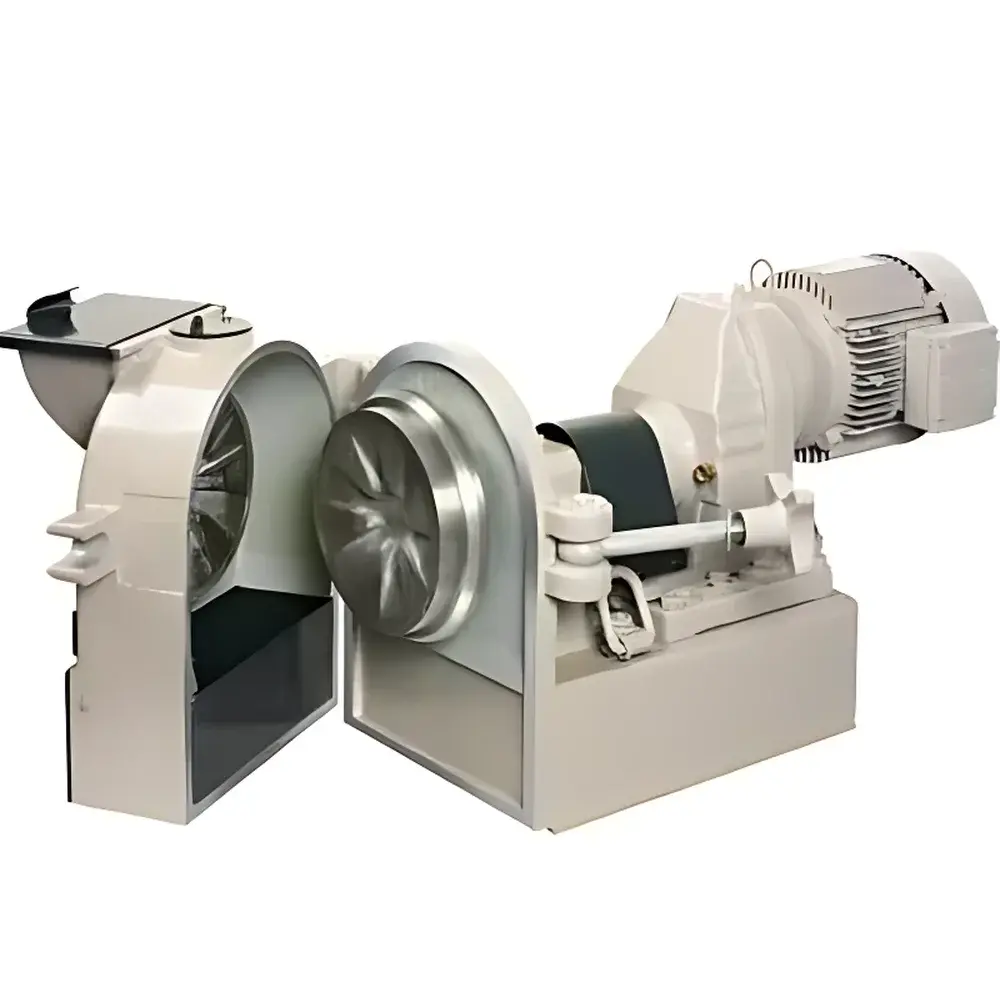
Siebtechnik SB200 Disc Mill
| Brand | Siebtechnik |
|---|---|
| Origin | Germany |
| Model | SB200 Disc Mill |
| Maximum Feed Size | < 20 mm |
| Final Particle Size | < 100 µm |
| Adjustable Disc Gap | 0.1–6 mm |
| Throughput | 2–150 kg/h |
| Disc Speed | 400 rpm |
| Drive Power | 1500 W |
| Disc Materials | Hardened Steel, Tungsten Carbide, Zirconia |
| Dimensions (L×W×H) | 825 × 400 × 430 mm |
Overview
The Siebtechnik SB200 Disc Mill is a precision-engineered laboratory disc mill designed for controlled, high-reproducibility size reduction of solid materials ranging from soft and brittle to extremely hard (up to Mohs hardness 8). Based on the principle of compressive and shear stress generation between two vertically aligned, counter-rotating (one fixed, one rotating) corrugated discs, the SB200 delivers consistent particle size distribution through progressive mechanical attrition. Its robust cast-iron housing, precision-machined disc alignment system, and dust-tight grinding chamber ensure operational safety, long-term dimensional stability, and compliance with ISO 17025–aligned sample preparation workflows. Unlike impact-based mills, the SB200 avoids thermal degradation and amorphization risks—making it especially suitable for metallurgical, geochemical, cement, ceramics, and regulatory-compliant QA/QC laboratories where structural integrity and chemical fidelity of ground samples must be preserved.
Key Features
- Progressive disc engagement geometry ensures uniform stress distribution across the entire grinding zone, minimizing localized overheating and particle agglomeration.
- Continuously adjustable disc gap (0.1–6 mm) enables precise, repeatable control over final particle size without hardware modification or recalibration.
- Three standard disc material options—hardened tool steel (standard), tungsten carbide (for abrasive ores and refractories), and yttria-stabilized zirconia (for ultra-trace metal analysis and contamination-sensitive matrices)—support application-specific cross-contamination mitigation.
- Full-access hinged grinding chamber facilitates rapid visual inspection, residue removal, and GMP-aligned cleaning validation per ASTM E2911 and USP <1118> guidelines.
- Integrated dust suppression design meets EN 60529 IP54 enclosure requirements and complies with OSHA PEL and EU Directive 2004/37/EC (carcinogens and mutagens) exposure limits during routine operation.
- Direct-coupled 1500 W motor with thermal overload protection ensures stable torque delivery at 400 rpm under variable load conditions typical of heterogeneous feedstocks (e.g., coal blends, slag composites, or mixed mineral ores).
Sample Compatibility & Compliance
The SB200 accepts feed particles up to 20 mm in maximum dimension and consistently reduces them to sub-100 µm output—ideal for XRF fusion bead preparation, ICP-MS digestion homogenization, and sieve analysis calibration standards. It processes brittle, medium-hard, and hard materials including but not limited to: iron ore pellets, bauxite, quartzite, feldspar, fly ash, foundry sand, sintered ceramics, tempered glass shards, and geological core fragments. All wet- or dry-compatible configurations conform to CE marking requirements under Machinery Directive 2006/42/EC and Electromagnetic Compatibility Directive 2014/30/EU. Optional integration with the Siebtechnik EB20/12.5 jaw crusher enables fully automated primary + secondary comminution—from 110 mm feed down to ≤200 µm output—in accordance with ISO 8501-1 and ASTM D2974 protocols for bulk solids characterization.
Software & Data Management
While the SB200 operates as a stand-alone electromechanical instrument, its mechanical parameters (disc gap setting, runtime, batch weight) are documented manually within laboratory notebooks or integrated into LIMS via optional digital logbook modules (e.g., LabWare LIMS or Thermo Fisher SampleManager). The mill’s deterministic mechanical behavior supports full traceability under GLP and 21 CFR Part 11–compliant environments when paired with audit-trail-enabled electronic records systems. Calibration verification is performed using certified reference materials (CRMs) traceable to NIST SRM 1976B (silicon carbide grit) or BAM Q1 (quartz powder), with gap-setting repeatability verified to ±0.05 mm using calibrated micrometer gauges.
Applications
- Preparation of homogenized sub-samples for X-ray fluorescence (XRF) and wavelength-dispersive spectroscopy (WDS) analysis in mining and exploration labs.
- Size reduction of refractory ceramics prior to SEM-EDS cross-sectioning and phase mapping.
- Production of standardized particulate fractions for ASTM C109 compressive strength testing of hydraulic cements.
- Routine grinding of environmental soil and sediment cores for EPA Method 6010D (ICP-OES) and 6020B (ICP-MS) digestion protocols.
- Controlled comminution of pharmaceutical excipients and active ingredients for dissolution rate correlation studies (per USP <711>).
FAQ
What is the recommended maintenance interval for the SB200 disc mill?
Routine inspection of disc surface wear, gap calibration, and bearing lubrication is advised every 200 operating hours or per quarterly preventive maintenance schedule aligned with ISO/IEC 17025 Clause 6.4.2.
Can the SB200 be used for cryogenic grinding?
No—the SB200 is not rated for sub-ambient operation. For low-temperature applications requiring embrittlement of polymers or thermolabile organics, refer to Siebtechnik’s cryo-capable MM series planetary ball mills.
Is operator training required prior to use?
Yes. Siebtechnik provides factory-certified installation qualification (IQ) and operational qualification (OQ) documentation, along with hands-on user training covering safe loading procedures, gap adjustment methodology, and cleaning validation protocols.
Does the SB200 support automatic feed rate control?
Not natively. However, volumetric vibratory feeders (e.g., Siebtechnik VF-150) can be interfaced externally to maintain consistent throughput across multi-batch campaigns.
How is particle size distribution verified post-grinding?
Final output is validated using laser diffraction (ISO 13320), dynamic image analysis (ISO 13322-2), or sieve cascade analysis (ASTM E11), with results logged against pre-defined acceptance criteria in the lab’s SOP.



