
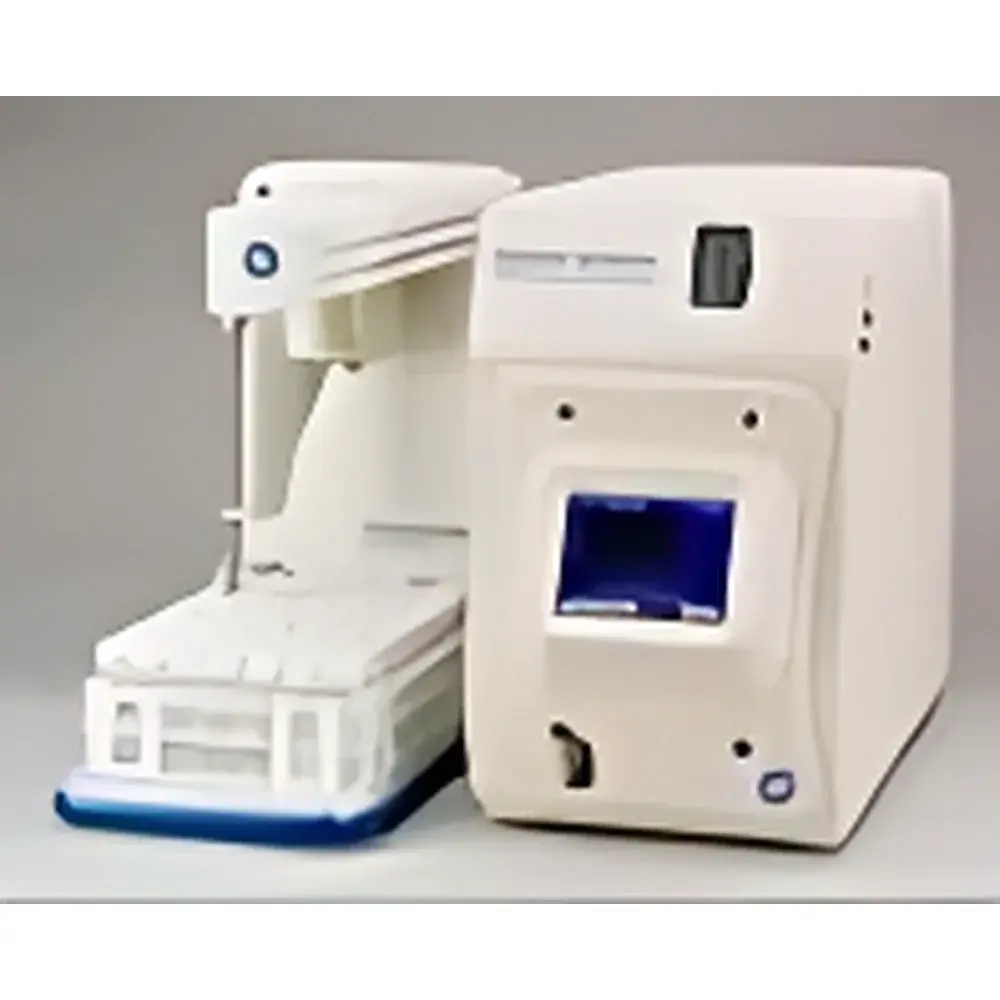
Sievers InnovOx Laboratory-Grade Total Organic Carbon Analyzer
| Brand | Sievers (Veolia) |
|---|---|
| Origin | USA |
| Model | InnovOx |
| Detection Range | 0.05–50,000 ppm TOC |
| LOD | 0.05 ppm TOC |
| Accuracy | ±3% at 50 mg/L NPOC |
| Precision | RSD <5% at 50 mg/L NPOC |
| Linearity | R² >0.995 |
| Analysis Time | 2.2–7.3 min |
| Calibration Stability | 6 months |
| Particle Tolerance | <800 µm |
| Operating Temp | 10–40 °C |
| Sample Temp | 10–60 °C |
| Humidity | ≤95% RH (non-condensing) |
| Power | 100–240 VAC ±10%, 400 W, 50/60 Hz |
| Dimensions | 52.05 × 32.26 × 58.42 cm |
| Weight | 22.4 kg |
| Interface | Ethernet + 3 USB ports |
| Display | Color touchscreen |
Overview
The Sievers® InnovOx Laboratory-Grade Total Organic Carbon (TOC) Analyzer is a high-performance, oxidation-based analytical instrument engineered for precise quantification of organic carbon in challenging aqueous matrices. It employs advanced supercritical water oxidation (SCWO) technology—distinct from traditional UV/persulfate or high-temperature catalytic combustion methods—to achieve complete and reproducible oxidation of recalcitrant organic compounds, including those found in saline, fiber-laden, or highly variable industrial wastewater streams. Designed specifically for laboratory environments serving environmental monitoring, pharmaceutical water system validation, semiconductor ultrapure water qualification, and process water integrity assessment, the InnovOx delivers robust measurement integrity across a wide dynamic range (0.05–50,000 ppm TOC) without dilution or method switching. Its SCWO core enables reliable analysis of samples with up to 28% salinity and suspended particulates up to 800 µm in diameter—conditions that commonly cause fouling or incomplete oxidation in conventional TOC systems.
Key Features
- Supercritical water oxidation (SCWO) at 500 °C and 22 MPa ensures >99% oxidation efficiency for refractory organics, humic substances, and complex polymers—even in high-salinity or turbid samples.
- Automated calibration verification and drift correction, supported by six-month calibration stability—reducing operational overhead and enhancing long-term data continuity.
- Multi-parameter reporting: simultaneous quantification of Total Carbon (TC), Total Inorganic Carbon (TIC), Non-Purgeable Organic Carbon (NPOC), and Total Organic Carbon (TOC) within a single run.
- Intuitive color touchscreen interface with embedded method templates compliant with ASTM D5903, USP , EP 2.2.44, and ISO 8245.
- Low-maintenance architecture: no catalysts, ozone generators, or UV lamps; consumables limited to standard acid/base reagents and quartz sample vials.
- Integrated Ethernet connectivity and three USB ports enable seamless data export, remote diagnostics, and audit-ready file transfer compatible with LIMS and electronic lab notebooks.
Sample Compatibility & Compliance
The InnovOx is validated for direct injection of undiluted, unfiltered samples containing up to 28% NaCl equivalent, suspended solids ≤800 µm, and temperatures between 10–60 °C. It meets regulatory expectations for data integrity under FDA 21 CFR Part 11 when configured with user access controls, electronic signatures, and full audit trail logging. Instrument performance adheres to GLP/GMP-aligned operational protocols and supports compliance with EPA Method 415.3, ISO 8245:1999, and pharmacopeial requirements for purified water, water for injection (WFI), and clean steam condensate testing. All calibration and system suitability tests are traceable to NIST-certified potassium hydrogen phthalate (KHP) standards.
Software & Data Management
Operated via the proprietary Sievers Analytical Software Suite, the InnovOx provides real-time chromatographic visualization, automated peak integration, and customizable report generation—including raw signal plots, calibration curves (R² >0.995), and QC summary dashboards. Data files are stored in secure, timestamped binary format with SHA-256 hash verification. The software supports role-based permissions, electronic signature workflows, and configurable retention policies aligned with ALCOA+ principles. Export options include CSV, PDF, and XML formats compatible with enterprise data archiving systems and statistical process control (SPC) platforms.
Applications
- Regulatory compliance monitoring of municipal and industrial wastewater effluents per NPDES permit requirements.
- Validation and routine surveillance of pharmaceutical water systems (PW, WFI, Pure Steam) per USP and EU GMP Annex 1.
- Process water characterization in microelectronics fabrication, where low-level TOC interference can impact etch rates and film adhesion.
- Research applications involving biodegradation kinetics, landfill leachate profiling, and marine biogeochemical cycling studies.
- Environmental fate and transport studies requiring accurate TOC/NPOC differentiation in sediment pore water and hypersaline groundwater.
FAQ
Does the InnovOx require external gas supplies or compressed air?
No—the SCWO process is self-contained and does not rely on carrier gases, oxygen cylinders, or compressed air sources.
Can the system analyze samples with visible particulates or fibers?
Yes, it tolerates particles up to 800 µm in diameter and has been validated for pulp-and-paper mill effluents and textile dye bath waters.
Is method validation support available for regulated industries?
Yes—Veolia provides IQ/OQ documentation packages, URS templates, and protocol development assistance aligned with FDA, EMA, and PMDA expectations.
What is the recommended frequency for system suitability testing?
Daily system suitability checks are advised for GMP environments; weekly verification suffices for environmental labs operating under EPA or ISO frameworks.
How is data security maintained during network transmission?
All Ethernet communications use TLS 1.2 encryption; local storage employs AES-256 encryption with hardware-enforced write-protection for audit logs.
Related Products







