
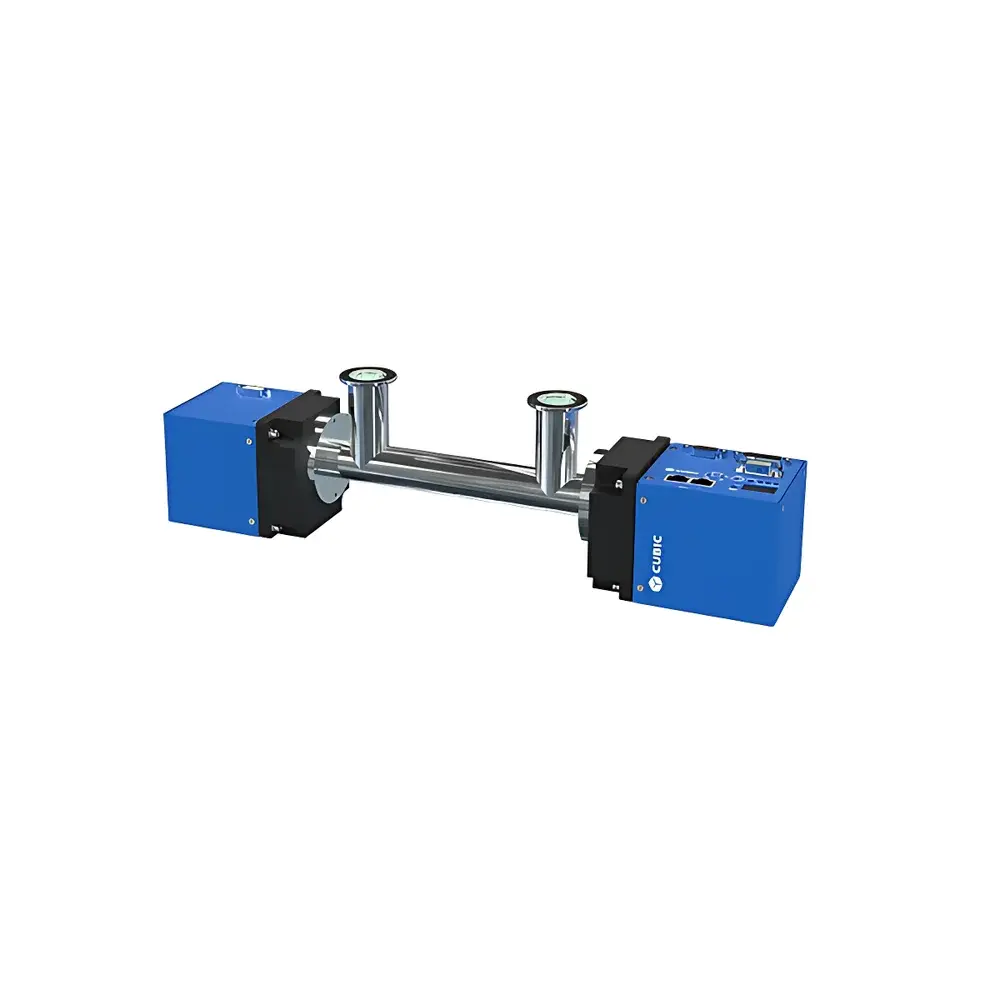
SiF4 Gas Sensor by Cubic – NDIR-Based Multi-Gas Monitoring Module for Semiconductor Process Chambers
| Key | Brand: Cubic |
|---|---|
| Origin | Hubei, China |
| Detection Principle | Non-Dispersive Infrared (NDIR) |
| Target Gases | SiF₄, WF₆, CF₄, SF₆, NF₃, CO₂ |
| Range | 1–264 ppm (0–200 mTorr) |
| Repeatability | ±0.5% of reading |
| Linearity | ±1% F.S. |
| Detection Limit | 1 ppm |
| Output | Analog (4–20 mA) and Digital (RS-485 Modbus RTU) |
| Design | Modular, OEM-integrated form factor with standard flange interface (CF-35 or KF-40 compatible) |
| Power Supply | 12–24 VDC |
| Operating Temperature | 0–50 °C |
| Enclosure Rating | IP65 |
Overview
The SiF4 Gas Sensor by Cubic is a purpose-engineered, non-dispersive infrared (NDIR) gas detection module designed for real-time, in-situ monitoring of corrosive and process-critical gases in semiconductor manufacturing environments. Unlike electrochemical or catalytic bead sensors, this NDIR-based platform delivers stable, drift-free quantification of silicon tetrafluoride (SiF4)—a key byproduct of chamber cleaning cycles using NF3 or SF6 plasmas—as well as co-present process gases including tungsten hexafluoride (WF6), carbon tetrafluoride (CF4), sulfur hexafluoride (SF6), nitrogen trifluoride (NF3), and carbon dioxide (CO2). Its optical architecture leverages dual-wavelength referencing to compensate for optical aging, window fouling, and ambient temperature fluctuations—critical for maintaining measurement integrity over extended tool uptime. The sensor operates within vacuum-compatible pressure ranges (0–200 mTorr), enabling direct integration into CVD, PECVD, and ALD reactor chambers without external sampling lines or dilution systems.
Key Features
- Multi-gas NDIR detection optimized for fluorinated compounds: simultaneous spectral discrimination of SiF4, WF6, CF4, SF6, NF3, and CO2 using dedicated absorption band filtering (e.g., SiF4 at 9.2 µm, SF6 at 10.6 µm)
- Sub-second response time (T90 < 1.5 s) under dynamic process conditions, supporting endpoint detection for plasma clean sequences
- No consumables or reagents: solid-state IR source and pyroelectric detector ensure >5-year operational lifetime with minimal calibration drift
- Modular mechanical design with standardized vacuum flange interfaces (CF-35 or KF-40), compliant with SEMI E172 guidelines for chamber-mounted instrumentation
- Dual-output capability: isolated 4–20 mA analog signal for PLC integration + RS-485 Modbus RTU digital interface for bidirectional configuration and diagnostics
- Integrated temperature and pressure compensation algorithms aligned with ISO 14644-8 Annex D requirements for cleanroom process gas monitoring
Sample Compatibility & Compliance
The sensor is validated for use in aggressive chemical environments typical of high-density plasma etch and deposition tools. Its wetted materials—including gold-plated stainless steel body, sapphire optical windows, and PTFE-sealed O-rings—are resistant to HF, F2, and anhydrous HF precursors. It meets SEMI S2-0215 safety guidelines for semiconductor equipment and complies with CE marking requirements per EN 61000-6-2 (EMC immunity) and EN 61000-6-4 (EMC emissions). While not intrinsically safe certified for Zone 0/1, it is rated IP65 for front-panel protection and suitable for Class 1000 (ISO 6) tool-side mounting. Data logging and alarm thresholds are configurable to support GLP-compliant audit trails when integrated with host SCADA systems adhering to FDA 21 CFR Part 11 electronic record controls.
Software & Data Management
The sensor operates autonomously but supports remote parameterization via Modbus register mapping, including zero/span calibration triggers, alarm setpoints (high/low, latching/non-latching), and diagnostic status reporting (e.g., signal-to-noise ratio, lamp intensity decay). When deployed in Fab-wide sensor networks, it feeds time-stamped concentration data into MES platforms such as Applied Materials EnduraLink or Lam Research 3D-Sense via OPC UA gateways. Firmware updates are delivered over-the-air (OTA) using signed binary packages to ensure traceability. All calibration events and fault logs are timestamped with UTC sync and stored locally for ≥30 days—sufficient for root-cause analysis during yield excursions or preventive maintenance reviews.
Applications
- Endpoint detection in NF3/SF6 plasma chamber cleans for etch and deposition tools (e.g., TEL Unity, Lam Exelan, AMAT Centris)
- In-chamber monitoring of SiF4 evolution during silicon nitride or oxide etch processes to optimize step uniformity
- Leak detection and purge verification in gas delivery subsystems handling WF6 or CF4
- Real-time CO2 tracking in abatement system inlet streams to verify destruction efficiency per EPA Method 25A
- Multi-gas trending for predictive maintenance of RF generators and matching networks based on fluorine-species ratios
FAQ
What gases does this sensor detect, and how is cross-sensitivity managed?
It detects SiF4, WF6, CF4, SF6, NF3, and CO2 using spectrally resolved NDIR channels. Cross-interference is minimized via narrow-band optical filters and multivariate compensation algorithms trained on reference gas mixtures per ISO 12039.
Can the sensor operate under vacuum or low-pressure conditions?
Yes—it is calibrated and validated for continuous operation from atmospheric pressure down to 0 mTorr (high vacuum), with linear response maintained across the full 0–200 mTorr range specified.
Is field calibration required, and what is the recommended interval?
Zero calibration using N2 or Ar purge is recommended every 3 months; span calibration with certified SiF4 standard gas (±2% uncertainty) is advised annually or after major maintenance events.
How is the sensor mounted inside a process chamber?
It uses industry-standard vacuum flanges (CF-35 or KF-40) and requires only two M4 mounting screws and a single electrical feedthrough—no additional cooling, purging, or bypass lines are needed.
Does the device support integration with SECS/GEM protocols?
Not natively—but its Modbus RTU interface can be bridged to SECS/GEM via third-party protocol converters compliant with SEMI E30/E37 standards.
Related Products







