
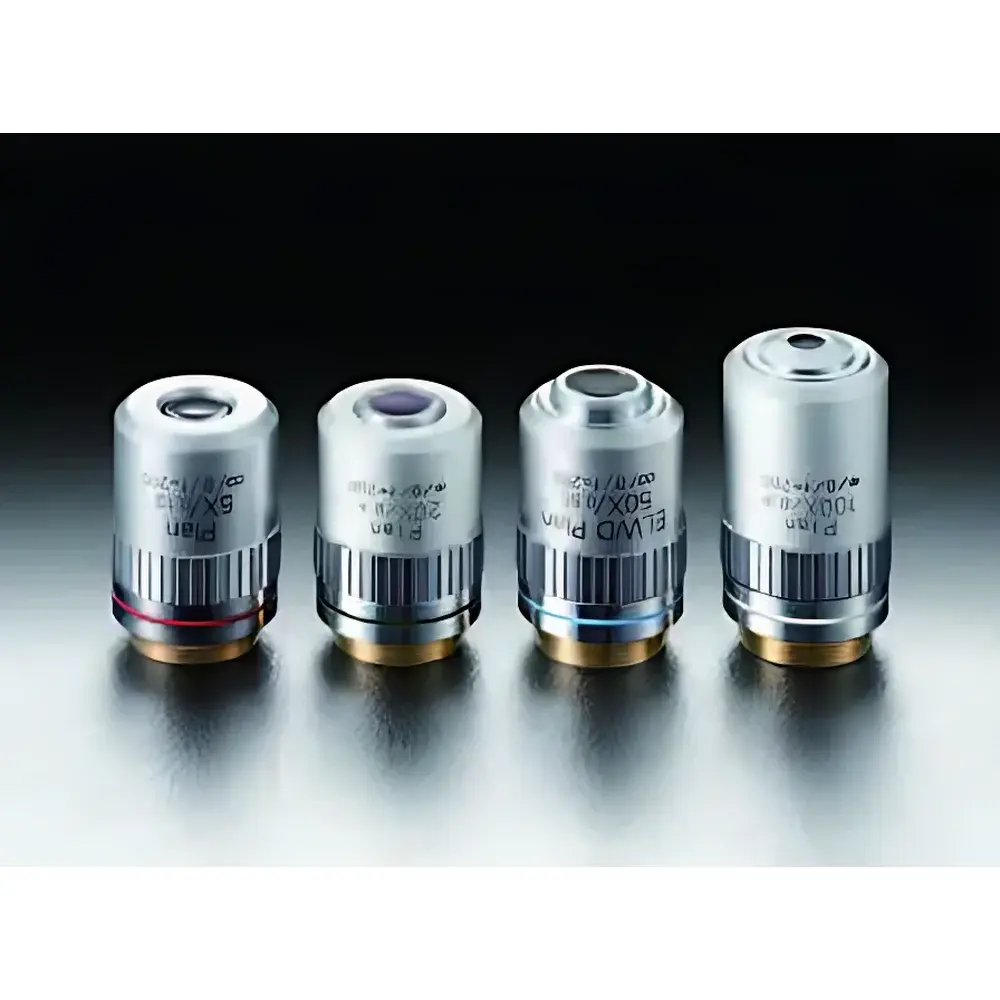
Sigma EPL Series Long Working Distance Microscope Objective
| Brand | Sigma |
|---|---|
| Origin | Japan |
| Model | EPL |
| Type | Achromatic Infinity-Corrected Objective Lens |
| Design | Long Working Distance (LWD), Lightweight Mechanical Construction |
| Spectral Range | 400–700 nm (Achromatically Corrected) |
| Compatibility | Designed for f = 200 mm Tube Lenses (Standard Magnification Reference) |
| Application Context | Coaxial Imaging, Laser Beam Delivery & Focusing, Automated Focus Systems |
Overview
The Sigma EPL Series is a line of high-precision, infinity-corrected long working distance (LWD) microscope objectives engineered for demanding optical integration tasks in research and industrial settings. Unlike standard finite-conjugate objectives, the EPL series employs an infinite-conjugate optical design—requiring a tube lens to form a focused image at the camera or detector plane. This architecture enables flexible optical path configuration, essential for coaxial observation systems, laser beam delivery, and hybrid imaging–processing setups. The objective is optimized for the visible spectrum (400–700 nm), with achromatic correction minimizing lateral color shift and axial chromatic aberration across this range. Its lightweight mechanical construction—particularly in the EPL and EPLE variants—reduces inertia during dynamic positioning, supporting high-speed autofocus mechanisms such as Sigma’s SFS-OBL and SFAI-OBL objective drive units. The design prioritizes thermal and mechanical stability under continuous illumination, making it suitable for both static microscopy and time-resolved optical experiments.
Key Features
- Achromatic correction over 400–700 nm, ensuring consistent focus and minimal color fringing in broadband visible-light applications.
- Long working distance (WD) architecture—typically ≥15 mm depending on focal length—enabling unobstructed access to samples, integration with translation stages, and safe coupling of laser beams into confined spaces.
- Infinity-corrected optical design compatible with standard 200 mm focal length tube lenses; magnification scales linearly with tube lens focal length (e.g., using a 150 mm tube lens yields ~75% of nominal magnification).
- Low-mass barrel construction optimized for rapid actuation in closed-loop autofocus systems, reducing settling time and improving positional repeatability.
- Anti-reflection coated optical surfaces (standard MgF₂ or optional multi-layer broadband AR coatings) to maximize transmission and minimize ghosting in reflective or multi-pass configurations.
Sample Compatibility & Compliance
The EPL objective is designed for non-contact, high-resolution imaging and precision laser focusing—not for immersion or direct sample contact. It complies with ISO 10110-7 (surface imperfections) and ISO 9022-3 (environmental testing for optical instruments) standards for manufacturing quality control. While not certified to FDA 21 CFR Part 11 or IEC 61000-4 electromagnetic immunity by default, its passive optical design ensures compatibility with GLP/GMP-aligned laboratory environments when integrated into validated instrument platforms. Users deploying the objective in laser-based material processing must adhere to ANSI Z136.1 safety guidelines: beam diameter (1/e² intensity) should be expanded to approximately 50% of the objective’s entrance pupil diameter prior to incidence to avoid localized thermal damage and ensure diffraction-limited focusing. Protective window insertion is strongly recommended when particulate ejection (e.g., ablation debris) is anticipated.
Software & Data Management
As a passive optical component, the EPL objective does not incorporate embedded firmware or digital interfaces. Its performance parameters—including effective focal length, field number, numerical aperture (NA), and working distance—are documented in Sigma’s technical datasheets and are fully integrable into optical design software packages (e.g., Zemax OpticStudio, CODE V, FRED). When used in automated systems, calibration data (e.g., magnification vs. tube lens focal length, parfocal distance tolerance ±0.02 mm) supports accurate coordinate mapping between image space and object space. Traceable metrology reports (upon request) include wavefront error (RMS ≤ λ/8 @ 632.8 nm) and modulation transfer function (MTF) curves at spatial frequencies up to 100 lp/mm.
Applications
- Coaxial brightfield/darkfield inspection in semiconductor wafer metrology and PCB assembly verification.
- Laser beam shaping and tight focusing in micro-machining, thin-film ablation, and photopolymerization systems.
- Integration into custom-built confocal or structured-light profilometers requiring extended working clearance.
- High-speed autofocus modules for in-line quality inspection stations where mechanical responsiveness directly impacts throughput.
- Visible-light optical coherence tomography (OCT) sample arms requiring low-dispersion, achromatized relay optics.
FAQ
What is the nominal magnification of the EPL objective?
Nominal magnification is specified relative to a 200 mm focal length tube lens. Actual magnification = (Tube Lens Focal Length / 200 mm) × Nominal Magnification. Always verify the tube lens specification in your system.
Can the EPL objective be used with UV or NIR wavelengths?
No—the standard EPL series is optimized and coated for 400–700 nm. Transmission drops significantly outside this range. For UV or NIR work, consult Sigma’s specialized EPX or ELN series objectives.
Is the objective suitable for high-power laser applications?
It may be used with CW or pulsed lasers in the visible band, provided beam diameter, power density, and pulse energy remain within ISO 21254 damage threshold limits for fused silica and MgF₂ coatings. Always perform empirical damage testing under representative conditions.
How is working distance (WD) affected by tube lens selection?
WD is an intrinsic property of the objective and remains constant regardless of tube lens choice. However, field of view and magnification scale inversely with tube lens focal length.
Does Sigma provide mounting adapters or alignment fixtures?
Yes—standard C-mount, SM1-threaded, and RMS-threaded adapters are available. Custom kinematic mounts and collimation alignment jigs can be supplied upon engineering consultation.






