
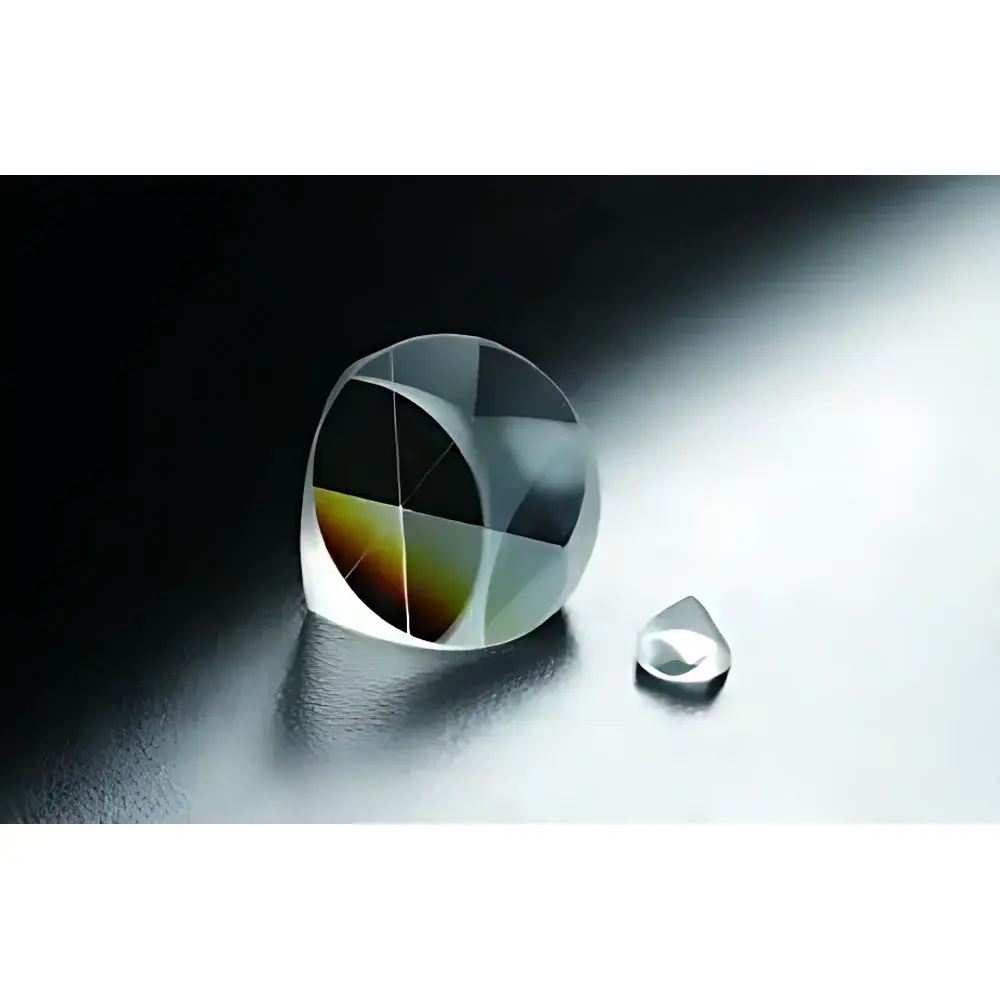
Sigma Japan Corner Cube Retroreflector (ZOLIX OPR Series)
| Brand | ZOLIX |
|---|---|
| Origin | Beijing, China |
| Manufacturer Type | Direct Manufacturer |
| Product Category | Optical Component |
| Model | OPR Series |
| Price Range | USD 70 – 140 (FOB) |
| Coating Options | Uncoated or AR-Coated (CCB-M variant) |
| Material | Fused Silica or N-BK7 (standard) |
| Surface Quality | 10–5 scratch-dig |
| Clear Aperture | ≥90% of face diameter |
Overview
The Sigma Japan Corner Cube Retroreflector (ZOLIX OPR Series) is a precision optical component engineered for high-fidelity retroreflection in metrology, interferometry, and space-grade alignment systems. Based on the principle of triple orthogonal reflection, this retroreflector ensures that any incident collimated beam—regardless of incident angle within its acceptance cone—is reflected back along its exact input path, with negligible lateral displacement and angular deviation. This property, known as *retrodirective behavior*, arises from the geometric orthogonality of its three mutually perpendicular reflective faces meeting at a single apex. Unlike flat mirrors or cat’s-eye reflectors, the corner cube maintains return-path stability even under rotational misalignment—making it indispensable in dynamic measurement environments such as laser interferometric distance measurement (LIDM), satellite laser ranging (SLR), and gravitational wave detector alignment (e.g., LIGO-style beam paths). The OPR series adheres to legacy Sigma Japan design specifications, incorporating tight tolerances on dihedral angles (≤1 arcsecond error) and apex deviation (≤3 µm), enabling sub-microradian beam retrace fidelity.
Key Features
- Precision-fused monolithic construction using high-homogeneity fused silica or N-BK7 substrate, minimizing thermal drift and birefringence
- λ/10 surface flatness and 10–5 scratch-dig surface quality across all reflecting faces
- Uncoated version optimized for total internal reflection (TIR) at standard wavelengths (e.g., 632.8 nm HeNe, 1064 nm Nd:YAG); CCB-M variant features broadband anti-reflection (AR) coating (R < 0.25% per surface, 400–1100 nm)
- Beveled apex edges to prevent chipping and suppress stray light—visible as six non-reflective radial lines when viewed normal to entrance/exit face
- Clear aperture ≥90% of nominal face dimension; specified for use with collimated beams only (divergence < 1 mrad)
- Designed to maintain retroreflection accuracy under ±2° mounting tilt—critical for field-deployable metrology setups
Sample Compatibility & Compliance
The OPR Series is compatible with standard optomechanical mounts (e.g., kinematic mirror mounts, SM1-threaded adapters) and integrates seamlessly into ISO-standard optical tables and breadboards. It meets mechanical and optical requirements outlined in ISO 10110-7 (surface imperfections), ISO 14997 (laser damage threshold testing methodology), and MIL-PRF-13830B (optical component inspection). While not certified to FDA or IEC medical device standards (as it is a passive component), its material traceability, batch-controlled manufacturing, and full dimensional test reports support GLP-compliant calibration workflows. No RoHS exemptions apply; all substrates and coatings comply with Directive 2011/65/EU.
Software & Data Management
As a passive optical element, the OPR Series requires no embedded firmware or driver software. However, its performance parameters—including measured apex deviation, dihedral error, and transmitted wavefront distortion—are documented in supplied calibration certificates compliant with ISO/IEC 17025. These reports are machine-readable (PDF/A-1b) and include traceable reference to NIST-traceable interferometric measurements. For integration into automated alignment systems, users may import nominal orientation data (e.g., vertex coordinates, face normals) via ASCII-based .opt or .zmx files compatible with Zemax OpticStudio and CODE V.
Applications
- Laser interferometric length calibration (e.g., in ISO 230-2 machine tool verification)
- Satellite and lunar laser ranging (LLR) ground station retroreflector arrays
- Autonomous vehicle LIDAR calibration targets and reference benchmarks
- Vibration-isolated optical cavity alignment in quantum optics laboratories
- High-stability beam folding in gravitational reference interferometers
- Calibration of angular encoders and autocollimators per ISO 230-1 Annex B
FAQ
What is the maximum acceptable beam diameter relative to the clear aperture?
For optimal retroreflection fidelity, incident beam diameter should not exceed 80% of the clear aperture. Overfilling risks clipping at beveled edges and introduces higher-order wavefront errors.
Can the OPR Series be used with pulsed lasers?
Yes—provided pulse energy density remains below the ISO 21254-1 LIDT threshold for fused silica (≥15 J/cm² for 10 ns, 1064 nm, 10 Hz). AR-coated variants require verification of coating LIDT at operational wavelength.
Why does polarization state change after retroreflection?
TIR at each internal interface induces differential phase shifts between s- and p-polarized components, resulting in elliptical or rotated output polarization. For polarization-sensitive applications, consider the hollow RCCB variant or external compensation with λ/2 waveplates.
Is cleaning procedure standardized?
Yes—use only spectroscopic-grade acetone followed by IPA, applied with Class 100 cleanroom swabs. Never touch uncoated TIR surfaces; fingerprint residue disrupts critical-angle conditions and degrades return efficiency.
Does ZOLIX provide custom coating or substrate options?
Yes—custom MgF₂ V-coats for UV (248 nm), HR coatings for CO₂ (10.6 µm), or CaF₂ substrates for deep-UV operation are available under OEM agreement with lead-time extension.





