
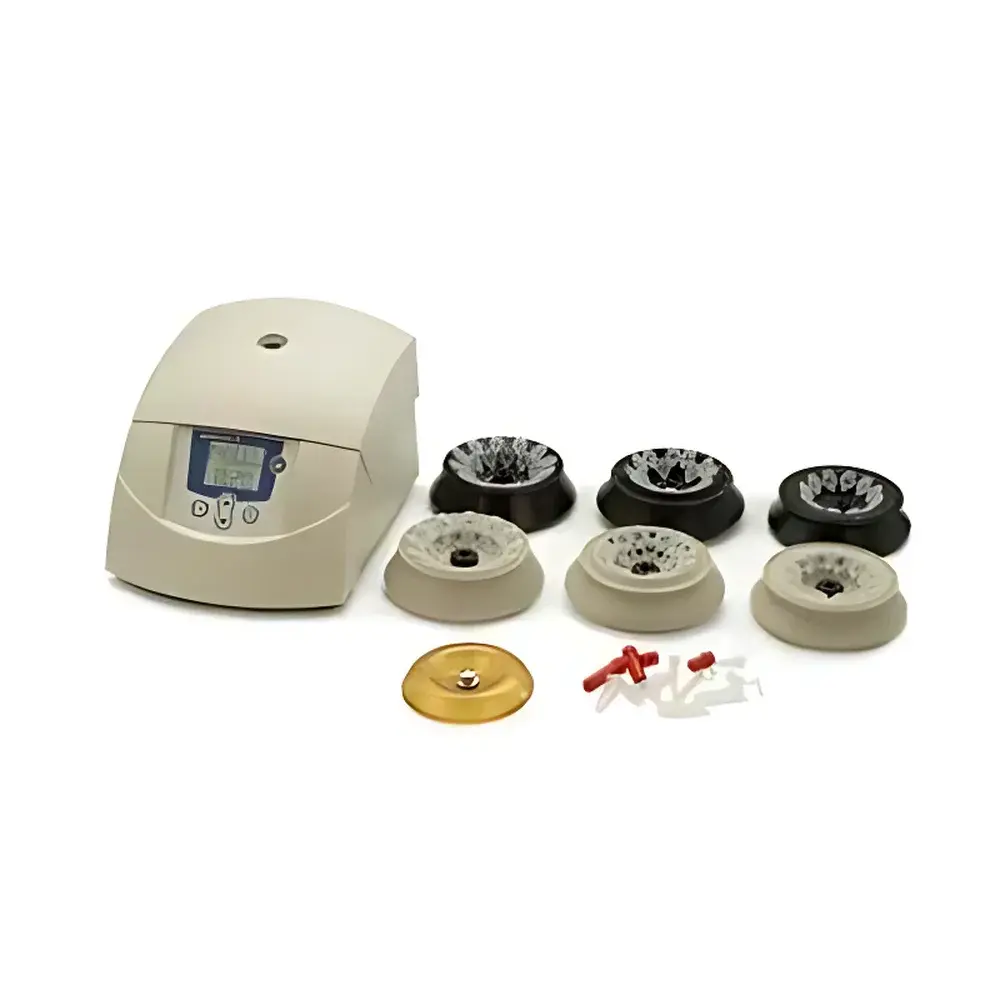
Sigma Sigma1-14 Benchtop High-Speed Centrifuge
| Brand | Sigma |
|---|---|
| Origin | Germany |
| Model | Sigma1-14 |
| Maximum Capacity | 24 × 2.2 mL |
| Maximum Speed | 14,800 rpm |
| Dimensions (H×W×D) | 176 × 226 × 212 mm |
| Power Consumption | 95 W |
| Noise Level | < 60 dBA |
| Acceleration/Deceleration Profiles | 2 programmable curves |
| Time Control | 0–99 min 59 s / Continuous / Short-spin mode |
| RCF Range | 2 × g to 16,163 × g |
| Motor Type | Brushless DC |
| EMC Compliance | EN 55011 Class B |
| Interference Immunity | EN 61326 |
| Weight (without rotor) | 5.4 kg |
| Max Kinetic Energy | 1721 N·m |
Overview
The Sigma Sigma1-14 Benchtop High-Speed Centrifuge is an engineered solution for precise, reproducible separation of biological macromolecules and sensitive particulates in research and clinical laboratory environments. Utilizing a brushless DC motor architecture, it delivers high-speed rotational dynamics with exceptional thermal stability and mechanical reliability—critical for applications involving microvolume samples where temperature rise and mechanical stress must be minimized. Designed specifically for centrifugation of tubes ranging from 0.2 mL PCR strips to 2.2 mL microcentrifuge tubes, the Sigma1-14 operates across a broad speed range (200–14,800 rpm), corresponding to a relative centrifugal force (RCF) span of 2 × g to 16,163 × g. Its compact footprint (176 × 226 × 212 mm) and low acoustic signature (< 60 dBA) make it suitable for shared benchtop spaces, including biosafety cabinets and laminar flow hoods, without compromising operational integrity or user comfort.
Key Features
- Brushless DC motor ensuring extended service life, minimal maintenance, and consistent torque delivery across the full speed range
- Programmable acceleration and deceleration profiles (2 preset curves) to protect delicate pellets and reduce sample resuspension
- Automatic lid locking mechanism with motor-driven engagement; lid opens automatically upon completion and features emergency manual release during power failure
- Short-spin function enabling rapid, repeatable centrifugation cycles (e.g., quick spin-down of condensate or column eluates)
- Large backlit LCD display showing real-time parameters: speed (rpm), RCF (×g), elapsed time, remaining time, and active program status
- Aerodynamically optimized chamber design minimizing air resistance and heat generation—critical for maintaining sample integrity during prolonged runs
- Compliance with electromagnetic compatibility standards EN 55011 Class B and immunity standard EN 61326, ensuring stable operation in electromagnetically dense lab environments
Sample Compatibility & Compliance
The Sigma1-14 supports a comprehensive range of microvolume configurations via interchangeable rotors and adapters. Standard angular rotors accommodate up to 24 × 1.5/2.2 mL tubes (e.g., models 12094, 12084), while specialized options include 12-position capped rotors (12092), 18-position angular rotors (12083), and PCR strip carriers (12096, 8 × 0.2 mL). A dedicated capillary rotor (11026) enables hematocrit and microvolume serum separation at up to 14,800 rpm. Adapters support Eppendorf-style 0.75 mL tubes (13002), 0.25–0.4 mL reaction vials (13000), and standard 0.2 mL PCR tubes (13021). All rotors are certified for use under ISO 13485-aligned manufacturing protocols and validated for compliance with routine GLP/GMP workflows. The system meets essential requirements for clinical diagnostics per CLIA and ISO 15189 frameworks when operated with documented calibration and preventive maintenance records.
Software & Data Management
While the Sigma1-14 operates via intuitive front-panel controls without external software dependency, its firmware architecture supports audit-ready operation in regulated environments. All run parameters—including speed, time, RCF, acceleration/deceleration profile, and start/stop timestamps—are retained in non-volatile memory for the last 100 cycles. This internal logging satisfies basic traceability needs for QC/QA documentation and facilitates root-cause analysis during process deviations. Though not FDA 21 CFR Part 11–compliant out-of-the-box (as it lacks user authentication or electronic signature functionality), the device may be integrated into validated laboratory information management systems (LIMS) via RS-232 interface (optional accessory) for centralized data capture and reporting in GxP-compliant settings.
Applications
The Sigma1-14 serves as a primary workhorse in diverse life science and diagnostic domains: pelleting nucleic acids and proteins from low-volume lysates; clarifying bacterial and yeast cultures prior to DNA extraction; separating plasma from whole blood in microhematocrit assays; preparing samples for HPLC or mass spectrometry injection; concentrating viral vectors and exosomes; and performing rapid spin-downs in molecular biology workflows such as PCR setup and enzyme reactions. Its performance consistency and thermal control also support applications in pharmaceutical development labs conducting formulation stability studies requiring repeated microcentrifugation steps under controlled conditions.
FAQ
What is the maximum RCF achievable with the Sigma1-14?
The maximum relative centrifugal force is 16,163 × g, attained at 14,800 rpm with the 24 × 2.2 mL angular rotor.
Is refrigeration available for this model?
No—the Sigma1-14 is a non-refrigerated unit. For temperature-sensitive applications, users should pre-chill samples and rotors, or consider the Sigma 1-14K variant (refrigerated version) if ambient cooling is required.
Can the Sigma1-14 accommodate PCR strips?
Yes—rotor model 12096 is specifically designed for 8-position PCR strip handling (0.2 mL format).
Does the centrifuge support regulatory compliance for clinical labs?
It meets foundational electrical safety (IEC 61010-1) and EMC standards (EN 55011, EN 61326); however, full 21 CFR Part 11 compliance requires integration with validated LIMS or additional access control hardware.
What maintenance is recommended for long-term reliability?
Routine cleaning of the rotor chamber and periodic inspection of the lid lock mechanism are advised. Rotors should be inspected for corrosion or imbalance before each use and replaced per Sigma’s defined service life schedule (typically 5–7 years depending on usage intensity and rotor type).



