
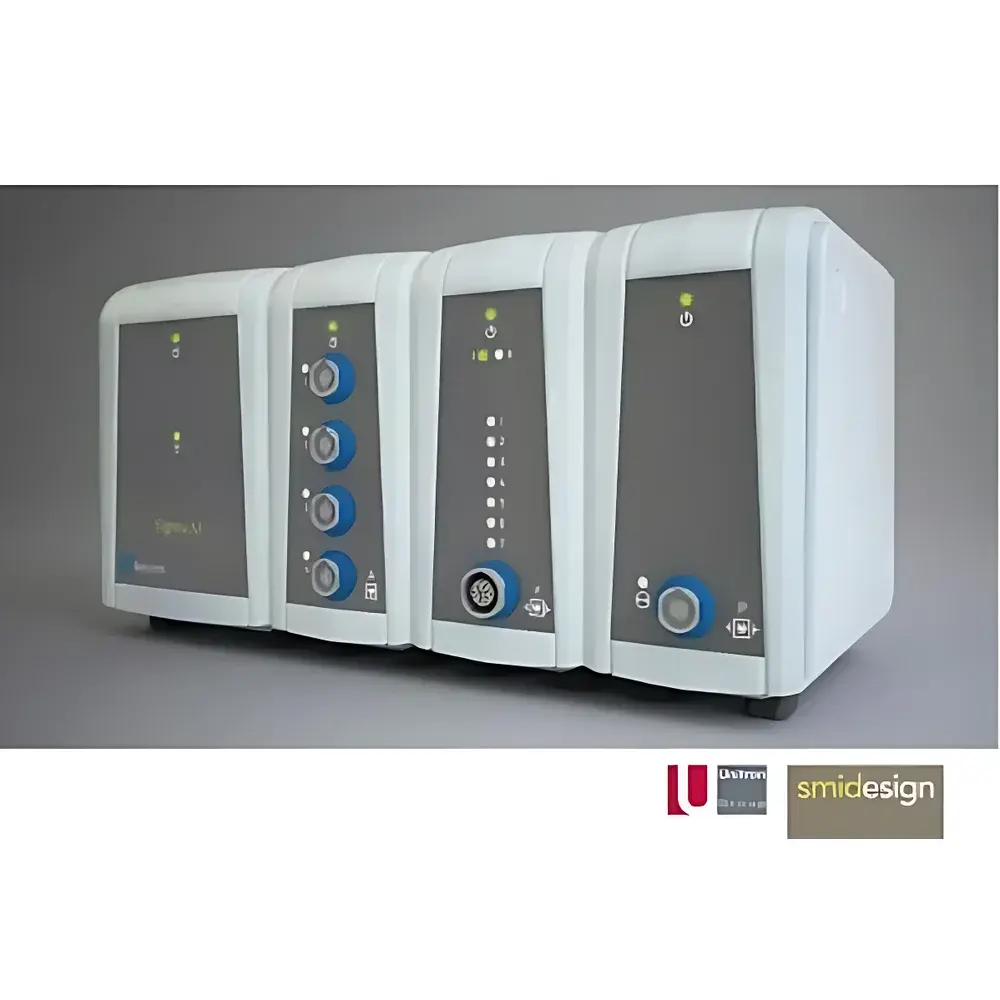
Sigma-M Ventricular Pressure-Volume Measurement System
| Origin | Netherlands |
|---|---|
| Manufacturer Type | Authorized Distributor |
| Origin Category | Imported |
| Model | Sigma-M |
| Pricing | Available Upon Request |
Overview
The Sigma-M Ventricular Pressure-Volume Measurement System is a modular, high-fidelity platform engineered for preclinical cardiovascular research in small to large animal models. It implements conductance catheter–based volumetric assessment combined with high-stability solid-state pressure sensing to generate real-time, beat-to-beat pressure-volume (PV) loops — the gold-standard physiological metric for quantifying left ventricular contractility, compliance, diastolic function, and energetics. Built upon a state-of-the-art signal conditioning architecture using surface-mount device (SMD) electronics, the Sigma-M replaces legacy analog hardware with digitally controlled, software-synchronized acquisition. Its core principle relies on the conductance method: intraventricular blood conductivity is measured via multiple electrode pairs along a catheter shaft; volume is derived from conductance using parallel conductance correction (via hypertonic saline or cuvette calibration), while simultaneous high-fidelity pressure is acquired via integrated full-bridge silicon microchip transducers. This dual-parameter acquisition enables dynamic PV loop construction at sampling rates up to 2,000 Hz with 16-bit resolution, supporting rigorous hemodynamic phenotyping under baseline, pharmacologic, or pathophysiologic conditions.
Key Features
- Modular hardware architecture scalable to up to eight functional modules — including V/P, ECG, auxiliary pressure, and analog output expansion — enabling flexible system configuration per experimental protocol.
- Full-bridge solid-state silicon pressure sensors integrated into all catheters, delivering minimal thermal drift (<0.1 mmHg/h), high linearity (±0.5% FS), and long-term stability across repeated use (up to 80 animal experiments per catheter).
- Conductance-based volume measurement with automatic parallel conductance compensation, compatible with both single- and dual-pressure sensor configurations for enhanced spatial resolution of regional wall motion.
- Real-time PV loop computation and display synchronized with raw signal acquisition — independent of user-defined time scaling or playback speed — ensuring physiologically accurate loop morphology during interventions.
- Digital signal processing with programmable digital filters (Butterworth, Bessel), adjustable anti-aliasing, and hardware-level noise suppression optimized for low-amplitude conductance signals in vivo.
- 16-channel analog output option (BNC) for integration with third-party data acquisition systems, stimulators, or closed-loop feedback devices.
Sample Compatibility & Compliance
The Sigma-M supports acute and chronic hemodynamic studies across species ranging from mice (1.9F catheters) to bovines (7F/10F catheters), with dedicated catheter families for pressure-only (6F), pressure-volume (4F, 7F), and dual-pressure-volume (split-electrode, lumen/non-lumen variants) applications. All catheters comply with ISO 10993-1 (biological evaluation of medical devices) and meet UL94-V0 flammability standards for ABS housing. The system architecture supports GLP-compliant workflows: audit-trail-enabled software (Conduct-NT) logs all parameter changes, calibration events, and user actions; raw data export in CSV format ensures traceability and interoperability with statistical analysis platforms (e.g., MATLAB, Python, Prism). Data generated meets requirements for submission to regulatory preclinical dossiers referencing ASTM F2182 (electromagnetic compatibility) and ISO/IEC 17025 (testing laboratory competence).
Software & Data Management
Conduct-NT is the native Windows-based application controlling all Sigma-M hardware functions — from real-time acquisition and online PV loop derivation to offline post-processing and report generation. It provides user-configurable acquisition templates, automated detection of end-systole/end-diastole, and calculation of >30 standard hemodynamic indices (e.g., ESPVR, EDPVR, PRSW, dP/dtmax, Tau, stroke work, external cardiac efficiency). All processed parameters are stored with metadata (animal ID, date/time, operator, protocol version) in a relational SQLite database. Export options include timestamped CSV files with channel-aligned samples, PNG/SVG loop visualizations, and batch-exportable summary tables compliant with FAIR data principles. Conduct-NT maintains backward compatibility with legacy Sigma-5DF and CFL-512 datasets, eliminating format-related bias when reanalyzing historical cohorts.
Applications
- Preclinical evaluation of novel cardiotropic compounds (positive/negative inotropes, lusitropes, vasodilators) under controlled loading conditions.
- Characterization of genetic mouse models of heart failure, hypertrophy, or arrhythmogenic cardiomyopathy via load-independent contractility indices.
- Assessment of myocardial recovery post-ischemia-reperfusion injury or stem cell therapy using pressure-volume area (PVA) and oxygen consumption correlations.
- Validation of mechanical circulatory support devices (e.g., miniaturized pumps, ventricular assist devices) through real-time unloading effects on PV loop geometry.
- Training platform for cardiovascular physiology education — enabling students to visualize Frank-Starling relationships, afterload sensitivity, and ventricular-arterial coupling in real time.
FAQ
What catheter sizes are supported for murine versus large-animal studies?
The Sigma-M accommodates 1.9F pressure-volume catheters for mice/rats, 4F for rabbits/guinea pigs, and 6F–7F configurations (with 8/10/12 mm electrode spacing) for porcine, canine, and bovine models.
Is parallel conductance correction automated or manual?
Both methods are supported: automated hypertonic saline bolus detection with user-confirmed injection timing, or manual cuvette-based calibration prior to insertion.
Can the Sigma-M integrate with existing electrophysiology or imaging systems?
Yes — via 16-channel analog output (BNC), TTL synchronization pulses, and TCP/IP API access for custom scripting in LabVIEW, MATLAB, or Python.
How is data integrity ensured during long-duration recordings?
Continuous A/D monitoring, checksum-verified data streaming, and redundant storage (RAM + SSD buffer) prevent packet loss; all acquisitions include embedded timestamps traceable to system clock with NTP sync capability.
Does the system support FDA 21 CFR Part 11 compliance?
Conduct-NT includes optional 21 CFR Part 11 add-on module with electronic signatures, role-based access control, and immutable audit trails — validated per GAMP5 guidelines.



