
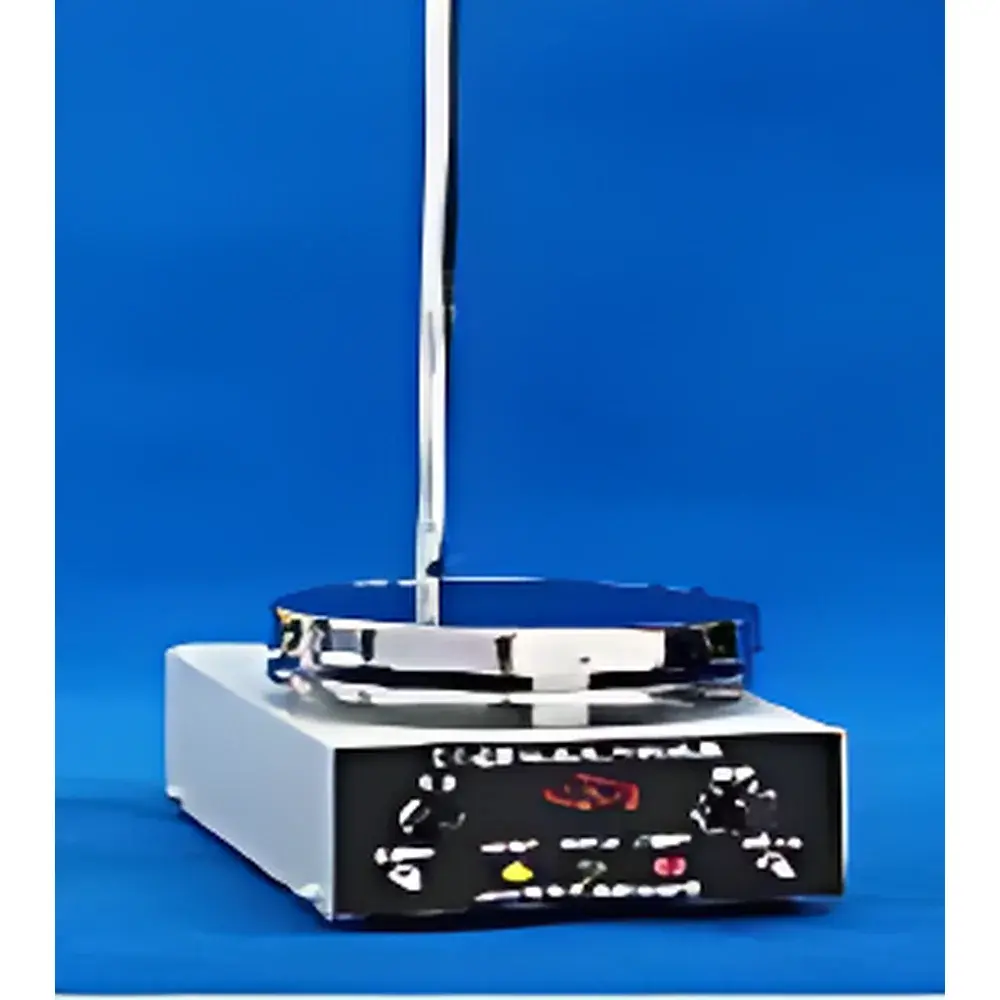
SiLe 81-2 (3L) & 85-2 (5L) Constant-Temperature Magnetic Stirrers
| Brand | SiLe |
|---|---|
| Origin | Shanghai, China |
| Model | 81-2 (3 L capacity), 85-2 (5 L capacity) |
| Maximum Stirring Volume | 3000 mL (81-2), 5000 mL (85-2) |
| Speed Range | 100–1300 rpm (81-2), 100–2000 rpm (85-2) |
| Temperature Control Range | Ambient to 100 °C |
| Temperature Accuracy | ±1 °C |
| Heating Power | 300 W (81-2), 340 W (85-2) |
| Motor Torque | 15 mN·m (81-2), 25 mN·m (85-2) |
| Plate Diameter | Ø140 mm (85-2) |
| Dimensions (L×W×H, excl. probe) | 250 × 145 × 130 mm |
| Weight | 4 kg |
| Accessories | Dual-length temperature probe holder, set of PTFE-coated magnetic stir bars |
Overview
The SiLe 81-2 and 85-2 Constant-Temperature Magnetic Stirrers are benchtop laboratory instruments engineered for precise, reproducible mixing and thermal control of liquid samples in research, quality control, and teaching laboratories. These devices operate on the principle of magnetic coupling: a rotating permanent magnet beneath a chemically inert ceramic or aluminum heating plate induces synchronous rotation of a magnetic stir bar immersed in the sample vessel. Integrated resistive heating elements enable simultaneous temperature regulation across the entire working surface. Designed for continuous-duty operation under standard ambient conditions (15–30 °C), both models maintain stable setpoints from ambient temperature up to 100 °C with ±1 °C accuracy—critical for applications requiring defined thermal profiles during dissolution, reaction kinetics, or buffer equilibration. The 81-2 supports volumes up to 3 L, while the higher-torque 85-2 accommodates up to 5 L, making them suitable for scalable protocol development and multi-vessel parallel processing.
Key Features
- Independent dual-control architecture: separate knobs or dials for speed and temperature allow intuitive, analog adjustment without software dependency
- High-stability ceramic/aluminum heating plate (Ø140 mm on 85-2) ensures uniform thermal distribution and resistance to chemical splashes and mechanical abrasion
- Brushless DC motor design delivers consistent torque output—15 mN·m (81-2) and 25 mN·m (85-2)—enabling reliable agitation of viscous or dense suspensions
- Wide speed range: 100–1300 rpm (81-2) and 100–2000 rpm (85-2), supporting low-shear homogenization and high-efficiency dispersion
- Robust mechanical construction: compact footprint (250 × 145 × 130 mm), 4 kg mass for vibration damping, and IP20-rated enclosure for general lab environments
- Standard accessories include dual-length stainless-steel probe holders and a set of PTFE-encapsulated stir bars optimized for glass and plastic vessels
Sample Compatibility & Compliance
These stirrers are compatible with standard laboratory glassware—including beakers, Erlenmeyer flasks, and jacketed reactors—up to 5 L volume, provided vessels are placed centrally on the heating plate and remain within maximum height constraints. The non-contact magnetic drive eliminates shaft seals and mechanical wear, reducing contamination risk in sterile or solvent-sensitive workflows. While not certified for hazardous area use (e.g., ATEX or IECEx), the units comply with IEC 61010-1:2010 for electrical safety in laboratory equipment. Temperature control performance meets typical requirements for ASTM E2927-22 (standard practice for calibration of liquid-in-glass thermometers) when used with traceable reference probes. No built-in data logging or audit trail functionality is provided; users deploying these instruments in regulated environments (e.g., pharmaceutical QC per USP or ISO/IEC 17025) must implement external validation protocols and manual recordkeeping.
Software & Data Management
The SiLe 81-2 and 85-2 operate exclusively via front-panel analog controls—no embedded microprocessor, digital display, USB interface, or firmware is present. Consequently, no proprietary software, drivers, or cloud connectivity are required or supported. All operational parameters (speed, temperature setpoint) are manually adjusted and visually monitored using external calibrated instrumentation (e.g., digital thermometers or contactless IR sensors). This architecture minimizes electromagnetic interference and avoids cybersecurity vulnerabilities associated with networked lab devices. For GLP/GMP-compliant labs, users must document operating conditions manually or integrate the stirrer into validated workflows using third-party environmental monitoring systems with 21 CFR Part 11-compliant electronic records.
Applications
- Buffer and reagent preparation under controlled thermal conditions for molecular biology and immunoassay workflows
- Dissolution testing of solid dosage forms in pharmacopeial methods (e.g., USP ) when paired with calibrated temperature probes
- Catalytic reaction monitoring where gentle, uniform mixing prevents catalyst settling or localized overheating
- Cell culture media warming and component solubilization prior to filtration or sterilization
- Calibration of viscometers and density meters using temperature-stabilized reference fluids
- Teaching laboratory demonstrations of heat transfer, fluid dynamics, and stoichiometric mixing principles
FAQ
Do these stirrers support external temperature probe feedback control?
No—the integrated temperature regulation relies solely on internal sensor feedback; no input port or algorithm supports external PID control via PT100 or thermocouple inputs.
Is the heating plate surface chemically resistant?
Yes—the top plate is constructed from glazed ceramic or anodized aluminum, offering resistance to common aqueous and mildly acidic/basic solutions; prolonged exposure to strong oxidizers or HF-based etchants is not recommended.
Can the stirrers be operated inside a fume hood?
Yes, provided ambient humidity remains below 80% RH and ventilation does not induce significant airflow across the heating surface, which may affect temperature stability.
What type of stir bars are included?
Each unit ships with a set of PTFE-coated magnetic stir bars in multiple sizes (10 × 3 mm, 20 × 5 mm, 30 × 8 mm), suitable for vessels ranging from 50 mL to 5 L.
Is CE or UL certification available?
The devices meet basic EMC and safety requirements per IEC 61010-1 but do not carry CE or UL marks; end-users are responsible for local regulatory verification prior to deployment.
Related Products



