
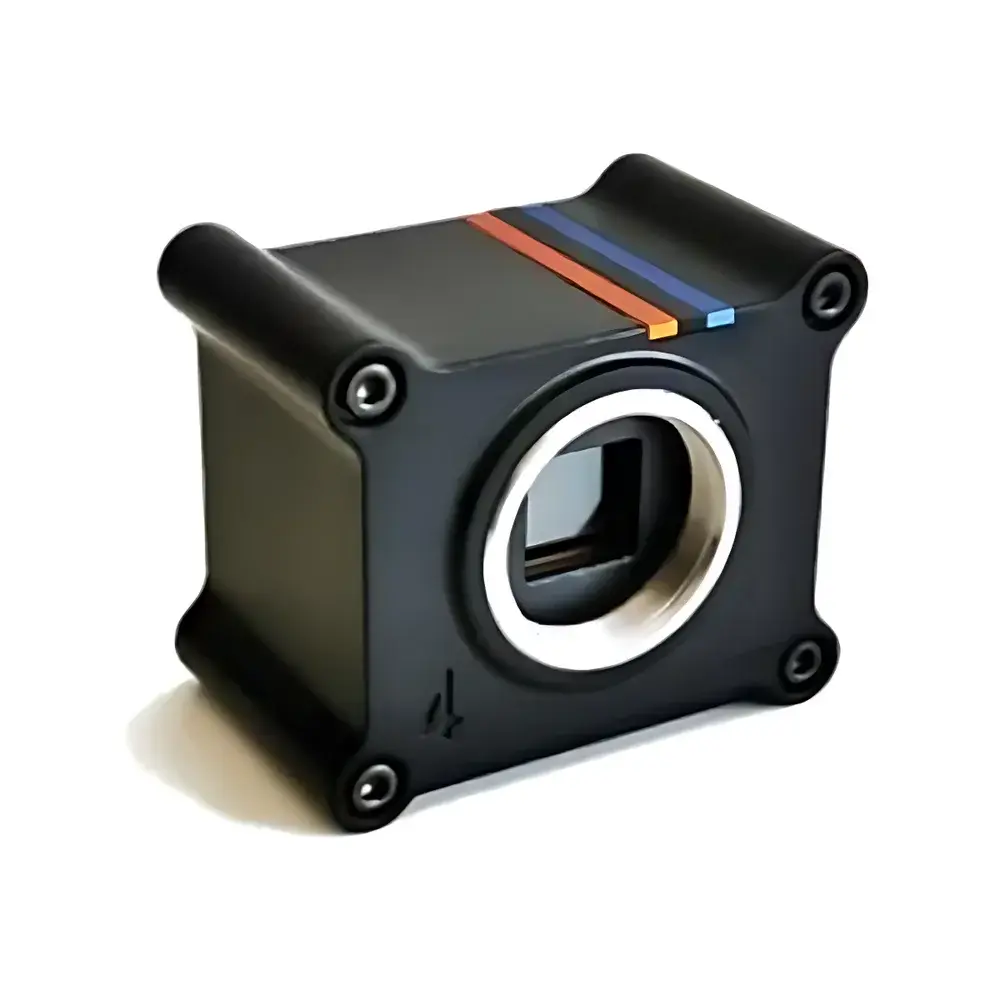
Silios TOUCAN Mosaic VNIR Snapshot Multispectral Camera
| Brand | Silios |
|---|---|
| Origin | France |
| Model | TOUCAN Mosaic |
| Spectral Range | 420–870 nm |
| Spectral Bands | 10 |
| FWHM | 30–50 nm |
| Sensor | CMOS |
| Resolution (RAW) | 2048 × 2048 |
| Spectral Image Resolution | 512 × 512 |
| Pixel Pitch | 5.5 µm |
| Frame Rate | 65 Hz (native), 20 Hz (with COLOR-SHADES Lab software) |
| Exposure Time | 100 µs – 5 s |
| Bit Depth | 10-bit |
| Interface | USB 3.0 |
| Lens Mount | CS-mount (C-mount compatible via adapter) |
| Dimensions | 52 × 63 × 40 mm |
| Weight | <180 g |
| Technology | COLOR-SHADES mosaic filter array |
Overview
The Silios TOUCAN Mosaic VNIR Snapshot Multispectral Camera is an engineered solution for real-time, spatially registered multispectral imaging across the visible and near-infrared (VNIR) spectrum (420–870 nm). Unlike scanning-based or tunable-filter systems, the TOUCAN leverages Silios’ proprietary COLOR-SHADES mosaic filter technology — a monolithic, pixel-level spectral filter array permanently bonded to the CMOS sensor surface. This architecture enables true snapshot acquisition: all 10 spectral bands are captured simultaneously in a single exposure, eliminating motion artifacts and temporal misregistration. The camera is optimized for applications requiring high spatiotemporal fidelity under dynamic conditions — including UAV-mounted remote sensing, inline industrial inspection, and laboratory-scale material characterization. Its compact form factor (52 × 63 × 40 mm) and low mass (<180 g) meet stringent payload constraints without compromising optical throughput or spectral integrity.
Key Features
- True snapshot acquisition: Simultaneous capture of 10 spectrally distinct bands within one integration period — no moving parts, no sequential filtering.
- Mosaic filter integration: COLOR-SHADES technology provides stable, factory-calibrated spectral response with minimal crosstalk and high inter-band registration accuracy.
- High spatial resolution: Native 2048 × 2048 CMOS sensor yields 512 × 512 pixels per spectral band after demosaicing — preserving sub-millimeter detail at typical working distances.
- Flexible exposure control: Adjustable integration time from 100 µs to 5 s supports both high-speed transient monitoring and low-light spectral mapping.
- USB 3.0 interface with real-time data streaming: Enables direct integration into embedded vision platforms and custom acquisition pipelines without frame grabbers.
- CS-mount lens compatibility: Facilitates rapid optical configuration using industry-standard lenses; C-mount support available via mechanical adapter.
- Robust thermal and mechanical design: Operates reliably across ambient temperatures from 0 °C to 45 °C; qualified for vibration environments typical of drone and mobile platform deployment.
Sample Compatibility & Compliance
The TOUCAN Mosaic camera is designed for non-contact, reflectance-based spectral analysis of solid, liquid, and semi-solid samples. It is routinely deployed in agricultural phenotyping (chlorophyll, water content, nitrogen status), pharmaceutical tablet coating uniformity assessment, food quality screening (ripeness, contamination), and cultural heritage documentation (pigment identification, underdrawing visualization). While not a certified medical device, its spectral performance aligns with ASTM E131 (Standard Terminology Relating to Molecular Spectroscopy) and ISO 13694 (Optics and photonics — Test methods for laser beam parameters). Data acquisition workflows may be configured to comply with GLP principles, including audit-trail-enabled metadata logging (timestamp, exposure, gain, temperature) when used with COLOR-SHADES Lab software.
Software & Data Management
The TOUCAN is supported by Silios’ COLOR-SHADES Lab software — a modular, Windows-based application for calibration, acquisition, preprocessing, and basic spectral analysis. Key capabilities include radiometric correction, flat-field compensation, spectral response normalization, and export of calibrated hyperspectral datacubes in ENVI-compatible BIL/BIP format. Application programming interfaces (APIs) are provided for C++, Python, and MATLAB, enabling integration into custom machine learning pipelines (e.g., PCA, PLS-DA, CNN-based classification). Raw data streams are timestamped and include embedded sensor metadata, supporting traceability requirements under FDA 21 CFR Part 11 when deployed in regulated environments with appropriate system validation.
Applications
- Agricultural remote sensing: Crop health monitoring, NDVI and custom vegetation index computation, stress detection (drought, disease).
- Industrial process control: Real-time sorting of recyclables, polymer identification, coating thickness estimation, defect detection in printed electronics.
- Life sciences: Label-free tissue differentiation, cell culture monitoring, fluorescence excitation profiling (with appropriate illumination).
- Art conservation: Non-invasive pigment mapping, varnish layer analysis, forgery detection via spectral signature clustering.
- Research-grade instrumentation: Integration into custom microscopes, macroscopic spectral scanners, or field-deployable environmental sensors.
FAQ
What spectral calibration options are available for the TOUCAN Mosaic camera?
Factory spectral calibration is performed using NIST-traceable tungsten-halogen and deuterium lamps. Users may perform routine recalibration using standard reflectance tiles (e.g., Spectralon®) and the COLOR-SHADES Lab software.
Can the TOUCAN operate in synchronization with external triggers or lighting systems?
Yes — the camera supports hardware triggering via TTL input (rising-edge) and offers programmable exposure delay and strobe output signals for precise timing control.
Is radiometric calibration included with the system?
A full radiometric calibration report (including absolute responsivity per band and linearity verification) is supplied with each unit. Optional on-site recalibration services are available through authorized Silios partners.
How is spectral band alignment maintained across temperature variations?
The COLOR-SHADES mosaic filter is fabricated as a monolithic thin-film structure directly on the sensor die, ensuring intrinsic pixel-to-pixel registration stability over operational temperature ranges (0–45 °C).
Does the camera support ROI-based acquisition to increase frame rate?
Yes — region-of-interest (ROI) mode allows users to define sub-frames, increasing effective frame rate beyond 20 Hz in software-controlled acquisition, while maintaining full spectral fidelity per selected pixels.






