
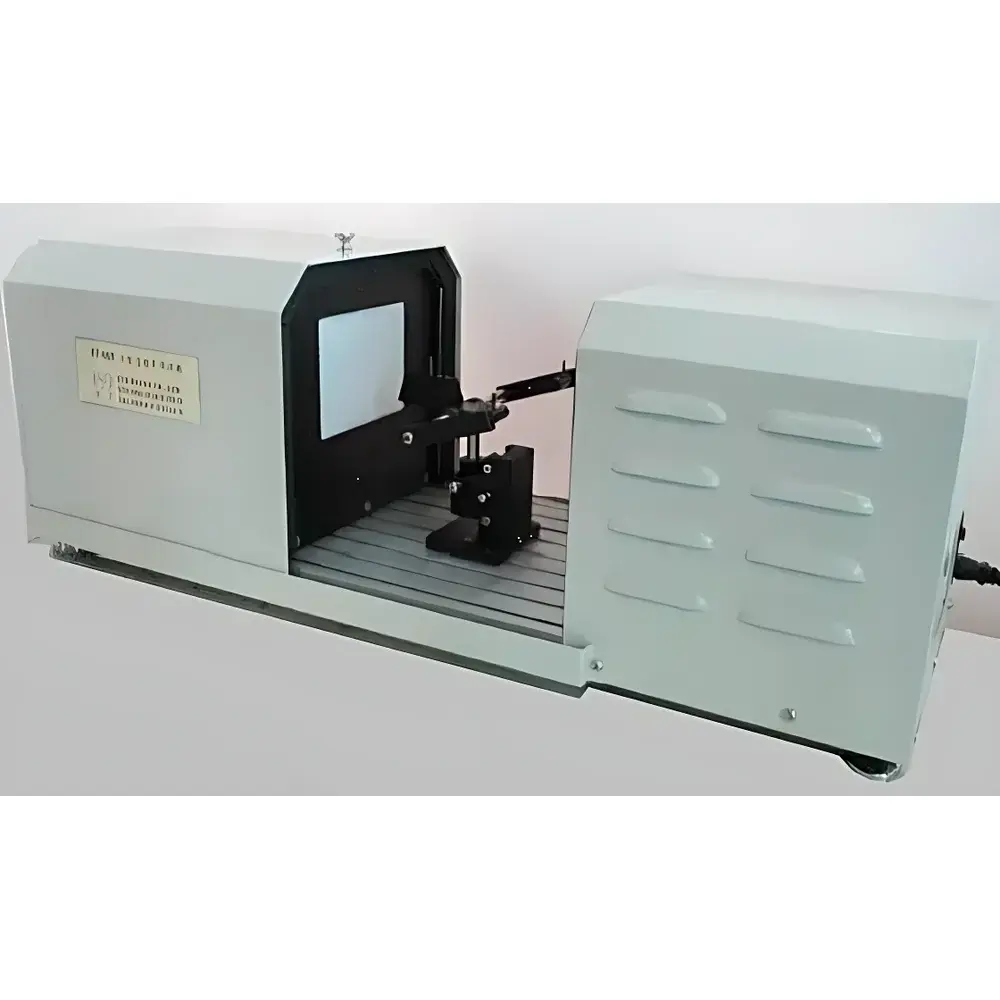
Silverzone YT-669 Transmittance Uniformity Tester
| Origin | Taiwan |
|---|---|
| Manufacturer Type | Authorized Distributor |
| Domestic Production | Yes |
| Model | YT-669 |
| Price Range | USD 28,000 – 42,500 |
| Light Source | 100 W halogen lamp |
| Illuminated Area | 140 mm × 110 mm |
| Detector | Photopic-response-calibrated CCD sensor |
| Operating System | Windows 10 embedded industrial PC |
| Software | Integrated transmittance analysis suite with report generation and data logging |
Overview
The Silverzone YT-669 Transmittance Uniformity Tester is a dedicated optical metrology system engineered for high-reproducibility spatial transmittance mapping of ophthalmic lenses. It operates on the principle of photopic-weighted luminous transmittance measurement—using a calibrated CCD sensor whose spectral response conforms to the CIE 1931 photopic luminosity function (V(λ))—ensuring quantitative alignment with human visual perception. Unlike generic spectrophotometers or single-point transmission meters, the YT-669 employs a large-area, spatially uniform halogen illumination source (140 mm × 110 mm) combined with fixed-grid or user-defined multi-point acquisition (standard 9-point grid, expandable to custom configurations), enabling rapid, non-contact evaluation of transmittance homogeneity across curved, aspheric, and progressive-addition lens surfaces. Designed for integration into QC laboratories and lens manufacturing lines, the system delivers traceable, repeatable results compliant with ISO 8980-3 (Ophthalmic optics — Uncut finished spectacle lenses — Part 3: Transmittance requirements) and supports GLP-aligned documentation workflows.
Key Features
- Photopic-response-validated CCD imaging sensor, factory-calibrated against NIST-traceable standards for luminous transmittance (Tv)
- Large-format uniform illumination field (140 mm × 110 mm) generated by a stabilized 100 W halogen source with integrated thermal management and intensity regulation
- Dual-purpose mechanical fixture system: interchangeable precision spectacle frame mount and adjustable bare-lens holder accommodating plano-curved, toric, and freeform geometries
- Embedded industrial PC running Windows 10 IoT Enterprise, eliminating external host dependency and ensuring deterministic boot and runtime behavior
- Configurable measurement grid: default 3×3 matrix with optional user-defined point sets (up to 25 locations), each with independent exposure and gain control
- Real-time transmittance deviation heatmap overlay and statistical summary (mean, SD, min/max, uniformity index ΔTv) displayed during acquisition
Sample Compatibility & Compliance
The YT-669 accommodates uncut and mounted ophthalmic lenses ranging from ±20.00 D sphere to +4.00 D add, including photochromic, polarized, anti-reflective coated, and gradient-tinted variants. Its optical path design minimizes vignetting and angular sensitivity, enabling valid measurements on base curves up to 8.5 D. The system meets functional requirements of ISO 8980-3:2017 Annex B (transmittance uniformity assessment) and supports audit-ready compliance reporting per ISO/IEC 17025:2017 clause 7.8.2 (reporting of measurement uncertainty). All firmware and software revisions are version-controlled and documented to support FDA 21 CFR Part 11-compliant environments when deployed with validated electronic signature modules.
Software & Data Management
The embedded transmittance analysis software provides full lifecycle data handling: automated calibration validation (daily dark/light reference checks), batch-wise sample registration with metadata tagging (lot ID, operator, date/time, lens type), and export of structured CSV/Excel reports containing raw pixel values, Tv per point, deviation from mean, and pass/fail flags against configurable limits. Audit trails record all parameter changes, calibration events, and report generation actions with immutable timestamps. Raw image archives (16-bit TIFF) and processed datasets are stored in segregated directories with SHA-256 checksums for integrity verification. Optional API access enables integration with LIMS or MES platforms via RESTful endpoints supporting JSON payloads.
Applications
- Final quality release testing of prescription spectacle lenses prior to edging and mounting
- In-process verification of tinting uniformity in batch-dyed organic lenses
- Validation of coating deposition homogeneity on AR/mirror-coated lenses
- Comparative analysis of transmittance drift in photochromic lenses under controlled UV exposure cycles
- Root-cause investigation of visual artifacts (e.g., “ghosting”, “banding”) linked to localized transmittance gradients
- Supporting technical documentation for CE marking (Annex II) and FDA 510(k) submissions requiring optical performance characterization
FAQ
Does the YT-669 comply with ISO 8980-3 for transmittance uniformity testing?
Yes—the optical geometry, detector spectral weighting, and measurement protocol align with the normative requirements of ISO 8980-3:2017, particularly Clause 6.3 on spatial uniformity assessment.
Can the system measure lenses with complex surface topographies, such as digitally surfaced freeforms?
Yes—the combination of wide-field illumination and telecentric imaging path ensures minimal angular dependence; validation data confirms <±0.8% Tv error across ±15° incident angles typical of modern progressive lenses.
Is calibration traceable to national metrology institutes?
Factory calibration uses NIST-traceable neutral density filters and photopic reference standards; on-site recalibration kits include certified reference tiles with uncertainty budgets ≤0.3% (k=2).
What data security and audit capabilities does the embedded software provide?
Full 21 CFR Part 11 readiness is achievable via optional configuration: role-based access control, electronic signatures, tamper-evident audit logs, and encrypted local storage compliant with IEC 62304 Class B software safety requirements.





