
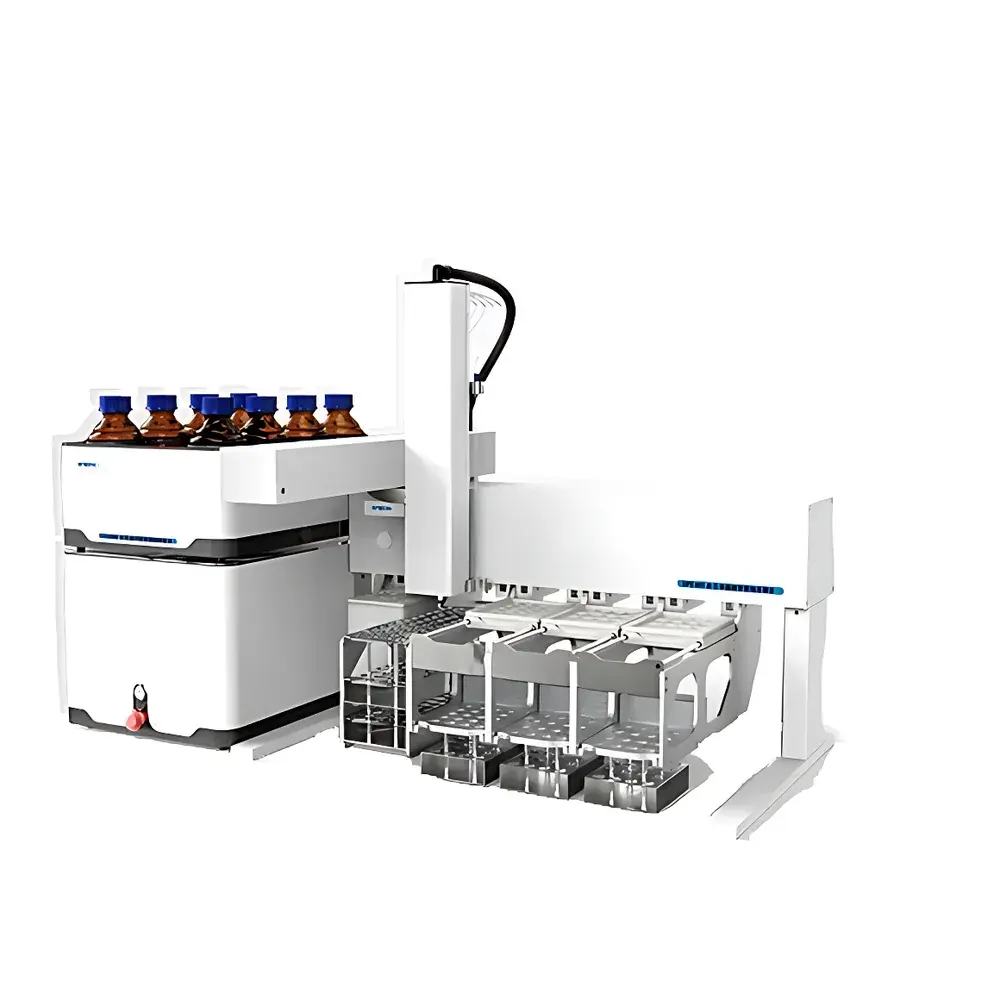
Sineo SPE100/200/400 Fully Automated Solid Phase Extraction System
| Brand | Sineo |
|---|---|
| Origin | Shandong, China |
| Model | SPE100 / SPE200 / SPE400 |
| Automation Level | Fully Automated |
| Channel Configuration | Modular — 1/2/4/6/8 independent channels |
| Extraction Method | Column-based SPE |
| Flow Rate Control | 0.1–120 mL/min |
| Solvent Capacity | 8 solvent types, each in 500 mL independent bottles |
| Sample Capacity | 52-position rack |
| Sample Loading Volume | 0.1 mL to 20 L |
| Wetted Materials | 316 stainless steel, PTFE, PFA |
| Sealing Technology | Independent cap with spring-energized PTFE (Quad-Ring) seal and H-axis compression |
| Mechanical Arm | X/Y/Z/H four-axis robotic arm (positioning accuracy: ±0.01 mm |
| Pressure Range | 0–145 psi (1.0 MPa max) |
| Online Functions | Integrated nitrogen purge drying, anhydrous Na₂SO₄ dehydration module, in-situ nitrogen blow-down concentration |
| Sample Needle | 316L stainless steel, side-bottom piercing design with liquid-level tracking |
| Waste Management | 3-channel segregated waste collection |
| Compliance | Designed for GLP-compliant workflows |
Overview
The Sineo SPE100/200/400 Fully Automated Solid Phase Extraction System is an engineered platform for high-throughput, reproducible sample preparation in environmental, pharmaceutical, food safety, and clinical laboratories. Based on positive-pressure column elution—where precise pneumatic or pump-driven flow forces solvents through sorbent beds—the system delivers consistent breakthrough performance across diverse matrix types. Unlike vacuum manifold-based systems, this instrument maintains stable, programmable flow rates (0.1–120 mL/min) under variable backpressure conditions, eliminating channel-to-channel variability and ensuring inter-run comparability. Its modular architecture allows scalable deployment from single-channel validation (SPE100) to eight-channel production environments (SPE400), all unified under a common software framework compliant with analytical data integrity principles.
Key Features
- Four-Axis Robotic Architecture: X/Y/Z/H motion control enables simultaneous positioning, column sealing, and needle insertion. The H-axis applies calibrated compression force via a spring-loaded Quad-Ring seal, achieving >1.0 MPa column pressure stability and eliminating leakage during high-flow or viscous sample loading.
- Universal Sample Handling: Supports 0.1 mL–20 L loading volumes—from trace biofluids to large-volume water extracts—without hardware modification. Integrated liquid-level tracking ensures complete aspiration even in low-volume vials; side-bottom piercing minimizes volatile loss and operator exposure.
- Multi-Mode Solvent & Waste Management: Eight independently monitored 500 mL solvent reservoirs feed via chemically inert PFA tubing. Three segregated waste lines accommodate acidic, basic, and organic fractions, supporting EPA-compliant disposal protocols.
- In-Line Sample Conditioning: Onboard nitrogen purge, anhydrous sodium sulfate cartridge integration, and programmable in-situ nitrogen blow-down concentration eliminate manual transfer steps—reducing contamination risk and evaporation artifacts.
- Intelligent Process Safeguards: Real-time pressure monitoring with configurable overpressure thresholds (5–145 psi), automatic fault escalation (log + audible alert + optional email), and emergency stop activation ensure operational continuity and personnel safety.
- Remote Operation & Data Governance: Built-in Wi-Fi/Ethernet connectivity enables remote scheduling, live status dashboards, and secure cloud-based method synchronization. Software enforces role-based access, electronic signatures, and full audit trail generation aligned with 21 CFR Part 11 expectations.
Sample Compatibility & Compliance
The system accommodates standard SPE cartridges (1, 3, 6, and 12 mL) as well as custom formats up to 25 mL. Sorbent compatibility spans C18, silica, Florisil®, SAX, SCX, and mixed-mode phases. All fluidic pathways contacting solvents or samples are constructed from 316L stainless steel, PTFE, and PFA—validated for resistance to acetonitrile, methanol, dichloromethane, ethyl acetate, and 1 M HCl/NaOH. The platform meets mechanical and electrical safety standards per IEC 61010-1 and supports laboratory accreditation under ISO/IEC 17025:2017 through documented IQ/OQ/PQ protocols. Optional validation packages include flow rate accuracy verification (±2% of setpoint), carryover testing (<0.05%), and inter-channel precision assessment (RSD <3% at n=6).
Software & Data Management
Sineo SPEControl™ v4.x provides a browser-based interface for method development, batch queuing, and real-time parameter visualization. Each method stores complete metadata—including solvent lot numbers, cartridge batch IDs, operator credentials, and environmental logs (temperature/humidity). Audit trails record every action: parameter edits, run starts/stops, alarm events, and user logins. Data export supports CSV, PDF, and XML formats compatible with LIMS and chromatography data systems (CDS). Cloud synchronization enables cross-site method harmonization and centralized IT administration without local server dependency.
Applications
- Environmental analysis: PAHs, PCBs, pesticides, and pharmaceutical residues in surface water, wastewater, and soil leachates (EPA Methods 353.2, 508.1, 525.3)
- Pharmaceutical QC: Residual solvents, genotoxic impurities, and extractables/leachables from drug substances and packaging (ICH Q3C, Q5A)
- Food safety: Mycotoxins, veterinary drug residues, and plasticizers in milk, honey, and infant formula (EU 2021/808, AOAC 2012.01)
- Clinical toxicology: Opioids, benzodiazepines, and stimulants in urine and plasma (SAMHSA guidelines)
- Forensic chemistry: Illicit drugs and metabolites in biological matrices requiring strict chain-of-custody documentation
FAQ
What regulatory standards does the SPE100/200/400 support for auditable workflows?
The system supports 21 CFR Part 11 readiness through electronic signature enforcement, immutable audit trails, and user-level permission controls. Full IQ/OQ documentation is available for ISO/IEC 17025 and GLP audits.
Can the system handle particulate-laden samples such as wastewater or homogenized tissue extracts?
Yes—its high-tolerance sample pump and large-bore fluidic path (up to 20 L continuous loading) accommodate suspended solids without clogging. Optional inline filtration modules are available for challenging matrices.
Is method transfer between SPE100 and SPE400 units straightforward?
All models share identical software logic, timing parameters, and calibration constants. Methods developed on any channel configuration are directly portable without revalidation.
How is cross-contamination prevented during high-throughput runs?
Multi-stage needle cleaning (nitrogen purge + solvent rinse + agitation wash), segregated waste routing, and pressure-triggered seal integrity checks collectively reduce carryover to <0.05% (measured per USP & EP guidelines).
Does the system integrate with third-party LC/GC autosamplers or CDS platforms?
Yes—via ASCII command protocol or OPC UA interface. Predefined triggers can initiate SPE runs upon CDS queue completion or inject ready-to-analyze fractions directly into autosampler trays.



