
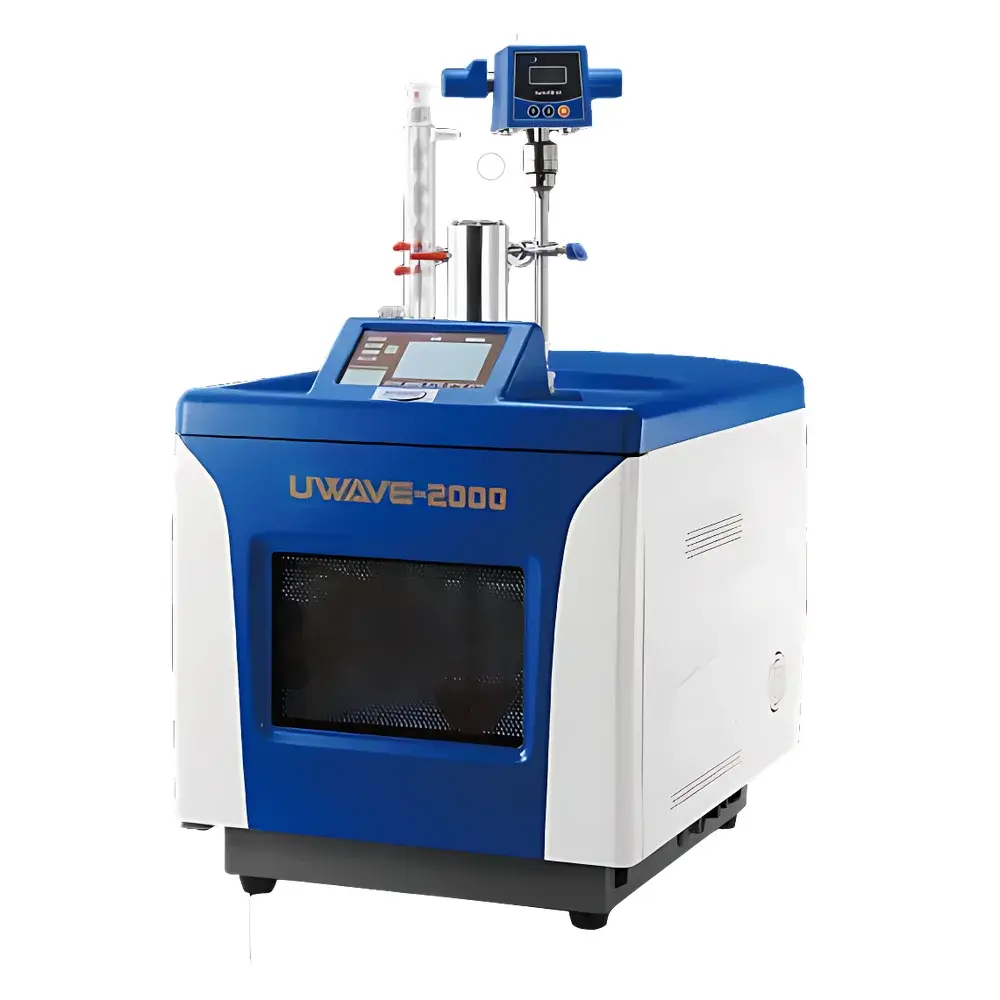
Sineo UWave-2000 Multi-Mode Synthesis and Extraction Reactor
| Brand | Sineo |
|---|---|
| Origin | Shanghai, China |
| Manufacturer Type | Original Equipment Manufacturer (OEM) |
| Country of Origin | China |
| Model | UWave-2000 |
| Temperature Range | 0–300 °C (atmospheric), 0–230 °C (pressurized) |
| Pressure Range | 0–2 MPa (rated), 0–5 MPa (sensing) |
| Microwave Power Output | 0–1000 W (PID-controlled, continuous non-pulsed) |
| Magnetron Frequency | 2450 MHz |
| Ultrasonic Power | 0–800 W |
| Ultrasonic Frequency | 28 kHz (auto-sweep & frequency-locking) |
| UV Source | LED, 0–100 W adjustable, peak wavelength 365 nm |
| Reaction Volume | up to 2000 mL (atmospheric), up to 500 mL (pressurized) |
| Safety Overpressure Release | Intelligent pressure control with real-time monitoring and automatic venting |
| External Vessel Material | Aerospace-grade carbon-fiber composite (Xtra Fiber™) with full PFA coating, burst strength ≥70 MPa, thermal resistance up to 600 °C |
| Cavity | 316L stainless steel with multi-layer PFA anti-corrosion coating |
| Cooling | 3-speed variable fan, 3 m³/min airflow |
| Control Interface | 7-inch color touchscreen (Windows-based OS), USB connectivity, remote PC control supported |
| Video Monitoring | Integrated HD color imaging system with real-time display and recording capability |
| Stirring Options | Digital constant-speed mechanical stirrer (30–1600 rpm, bidirectional, torque 300 N·m) + magnetic stirrer (0–800 rpm) |
| Compliance | Designed for GLP/GMP-aligned workflows |
Overview
The Sineo UWave-2000 Multi-Mode Synthesis and Extraction Reactor is an integrated, modular platform engineered for advanced reaction methodology development in synthetic chemistry, materials science, and pharmaceutical process research. Unlike conventional single-energy reactors, the UWave-2000 implements concurrent or sequential activation via three independent physical energy domains—microwave irradiation (2450 MHz, 0–1000 W), ultrasonic cavitation (28 kHz, 0–800 W), and near-UV photoexcitation (365 nm, 0–100 W)—within a single, unified reaction chamber. This tri-modal architecture enables precise investigation of synergistic effects such as microwave-accelerated sonochemical nucleation or UV-initiated radical generation under thermally controlled conditions. The system operates across two distinct pressure regimes: atmospheric (up to 300 °C, 2000 mL volume) and sealed-vessel pressurized mode (up to 230 °C, 500 mL, 2 MPa working pressure), supporting both exploratory screening and scalable process validation. Its design reflects over three decades of empirical refinement in microwave-assisted chemistry, building upon the award-winning UWave-1000 platform recognized at BCEIA 2009.
Key Features
- Triple-energy modularity: Independent, software-synchronized control of microwave, ultrasonic, and UV subsystems—enabling combinatorial activation protocols without hardware reconfiguration.
- Dual-pressure operation: Seamless transition between open-vessel reflux and closed-vessel hydrothermal/solvothermal synthesis using interchangeable high-borosilicate glass (50–2000 mL) or quartz (UV-transparent) vessels, plus TFM-lined high-pressure vessels (100/200/500 mL) housed in aerospace-grade Xtra Fiber™ composite outer vessels rated to 70 MPa.
- Redundant, high-fidelity process monitoring: Dual-sensor temperature control (infrared: 0–300 °C ±0.1 °C; Pt100 RTD: 0–250 °C ±0.1 °C) with Dynamic Temperature Detection (DTD) auto-switching logic; piezoelectric pressure transduction (0–5 MPa, ±0.01 MPa resolution) with active overpressure mitigation.
- Industrial-grade cavity architecture: 316L stainless steel cavity with multi-layer PFA coating resists aggressive acid vapors (e.g., HF, HNO₃); integrated 3-speed forced-air cooling (3 m³/min max) maintains thermal stability during extended exothermic runs.
- Intelligent stirring and ancillary integration: Optional dual-mode agitation—digital mechanical stirrer (30–1600 rpm, 300 N·m torque, PEEK or quartz shaft) and magnetic stirrer (0–800 rpm)—plus standardized ports for inert gas purging, condenser attachment, dropping funnels, and Dean-Stark water separation.
- Comprehensive digital interface: Windows-based 7-inch touchscreen with real-time parameter visualization, trend curves, and event-triggered video capture; full remote operation and data export via USB; compatible with LIMS integration through structured CSV/Excel output.
Sample Compatibility & Compliance
The UWave-2000 accommodates heterogeneous sample matrices—including viscous polymer melts, nanoparticle colloids, solid-supported catalysts, and biopolymer suspensions—without compromising energy coupling efficiency. Its modular vessel system supports ASTM E2877-compliant hydrothermal synthesis, ISO 13877-guided extraction protocols, and USP <1058>-aligned analytical method development. Pressure-rated vessels conform to ISO 17873 mechanical integrity standards for laboratory-scale autoclaves. When operated with validated firmware and enabled audit-trail logging, the system meets baseline requirements for FDA 21 CFR Part 11 electronic records and signatures in regulated environments. All temperature and pressure data are timestamped and stored with metadata (user ID, method name, vessel ID), satisfying GLP documentation expectations for traceability and reproducibility.
Software & Data Management
The embedded Windows OS provides deterministic real-time control with sub-second sampling intervals for all critical parameters. Method files store complete energy profiles (microwave ramp rates, UV duty cycles, sonication bursts), sensor calibrations, and safety thresholds. Data logs are saved in encrypted binary format with optional CSV export; video recordings are encoded in MP4 (H.264) with synchronized overlay of temperature/pressure/time stamps. Remote desktop access allows off-site supervision and intervention. For quality-critical applications, optional IQ/OQ documentation packages support installation and operational qualification under ISO/IEC 17025 or GMP Annex 11 frameworks.
Applications
- Organometallic and heterocyclic synthesis under accelerated microwave heating with in situ UV initiation for photo-redox catalysis.
- Green extraction of phytochemicals (e.g., polyphenols, alkaloids) using ultrasound-assisted microwave extraction (UMAE) to reduce solvent consumption and cycle time.
- Hydrothermal fabrication of metal oxides (e.g., TiO₂, WO₃), chalcogenides, and MOFs—leveraging precise pressure-temperature coupling for phase-selective crystallization.
- Protein digestion and peptide mapping in proteomics, where controlled microwave/ultrasound co-activation enhances enzymatic cleavage kinetics without denaturation.
- Polymer grafting and crosslinking studies requiring simultaneous thermal input and mechanical shear (via integrated stirrer) to manage viscosity and heat transfer limitations.
- Photocatalytic nanomaterial synthesis (e.g., CsPbBr₃ perovskites, g-C₃N₄ composites) under inert atmosphere with real-time optical monitoring.
FAQ
What safety certifications does the UWave-2000 hold?
The instrument complies with IEC 61010-1 (Safety Requirements for Electrical Equipment for Measurement, Control, and Laboratory Use) and carries CE marking for EMC and Low Voltage Directive conformity. High-pressure vessels are tested per ISO 17873 and include redundant mechanical and electronic overpressure protection.
Can the system be used for DOE (Design of Experiments) workflows?
Yes—the software supports parameter scripting with conditional branching (e.g., “if temperature > 180 °C, activate UV for 60 s”), enabling automated multi-step reaction sequences essential for statistical experimental design.
Is third-party calibration support available?
Sineo provides NIST-traceable calibration certificates for temperature and pressure sensors; accredited external labs can perform on-site verification per ISO/IEC 17025 upon request.
How is cross-contamination prevented between UV and microwave modes?
Quartz reaction vessels are optically transparent and microwave-inert; the UV module is physically isolated from the magnetron waveguide path, and the cavity’s PFA coating prevents residue adhesion during cleaning cycles.
Does the system support PAT (Process Analytical Technology) integration?
While not equipped with inline spectroscopic probes, the UWave-2000 exports time-series sensor data via USB in standard formats compatible with third-party PAT platforms (e.g., MATLAB, LabVIEW, DeltaV) for real-time multivariate analysis.



