
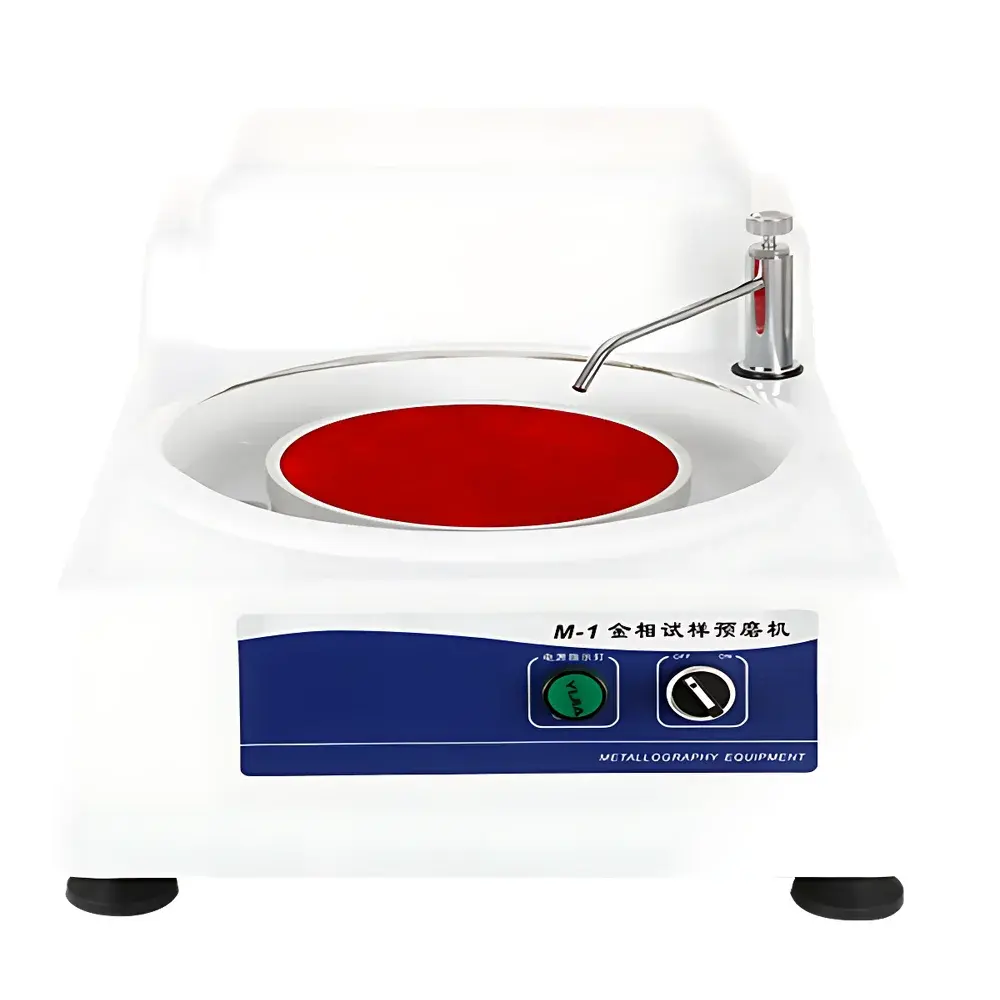
Single-Disk Specimen Pre-Polishing Machine M-1 by WEIYEE
| Brand | WEIYEE |
|---|---|
| Origin | Guangdong, China |
| Manufacturer Type | Authorized Distributor |
| Country of Origin | China |
| Model | M-1 |
| Rotational Speed | 450 rpm |
| Grinding Plate Diameter | 203 mm |
| Number of Grinding Plates | 1 |
Overview
The WEIYEE M-1 Single-Disk Specimen Pre-Polishing Machine is a compact, benchtop-mounted mechanical preparation system engineered for consistent and repeatable initial surface conditioning of metallurgical, ceramic, geological, and composite specimens prior to fine polishing or microstructural analysis. It operates on the principle of controlled abrasive grinding—where rotational motion of a rigid, flat grinding plate applies uniform shear and compressive forces to the specimen surface under applied load, removing bulk material and establishing planarity with minimal subsurface deformation. Designed specifically for pre-polishing (i.e., coarse-to-intermediate stage material removal), the M-1 avoids high-speed variable control in favor of fixed-speed operation at 450 rpm—a configuration optimized for stability, thermal management, and operator reproducibility across routine lab workflows. Its robust cast-aluminum housing and precision-machined spindle assembly ensure long-term dimensional stability and minimal runout (< 0.05 mm TIR), critical for achieving uniform stock removal rates across the full 203 mm (8-inch) grinding surface.
Key Features
- Benchtop footprint with integrated base leveling feet for vibration-dampened operation on standard laboratory countertops
- Fixed-speed motor drive delivering constant 450 rpm output—eliminates speed drift and ensures inter-laboratory method equivalence
- 203 mm (8″) precision-ground cast-iron grinding plate with standardized M16 threaded mounting interface compatible with industry-standard resin-bonded, silicon carbide, or diamond-impregnated grinding discs
- Single-plate configuration simplifies setup, cleaning, and cross-contamination control—ideal for dedicated pre-polish protocols in QC labs and academic core facilities
- CE-compliant 220 V AC, 50 Hz power input with internal thermal overload protection and electromagnetic braking for safe, rapid stoppage
- Front-accessible coolant port and integrated splash guard facilitate continuous wet grinding using aqueous or glycol-based slurries per ASTM E3-22 and ISO 13071-1 guidelines
Sample Compatibility & Compliance
The M-1 accommodates specimens ranging from 10 mm to 50 mm in diameter (or equivalent rectangular cross-sections up to 45 × 45 mm), mounted in standard thermosetting or cold-mounting resins. It supports both conductive and non-conductive materials—including ferrous and non-ferrous alloys, sintered carbides, oxide and nitride ceramics, geological thin sections, and polymer composites—provided appropriate abrasive media and coolant selection are applied. The machine conforms to general electrical safety requirements per IEC 61000-6-2 (immunity) and IEC 61000-6-4 (emissions), and its mechanical design aligns with ISO 12100:2012 principles for machinery safety. While not certified to GLP or GMP as a standalone unit, its operational consistency and traceable maintenance log support compliance with ISO/IEC 17025:2017 clause 6.4.10 (equipment verification) when integrated into validated sample preparation SOPs.
Software & Data Management
The M-1 is a manually operated, non-programmable instrument with no embedded firmware, touchscreen interface, or digital data logging capability. This analog architecture intentionally eliminates software validation burden and reduces failure points—making it suitable for regulated environments where equipment qualification focuses on mechanical performance verification rather than electronic audit trails. Operators record usage parameters (e.g., grinding time, disc type, coolant flow rate, specimen ID) in paper-based or LIMS-integrated logbooks. For laboratories requiring 21 CFR Part 11–compliant documentation, the M-1 may be paired with external time-stamped video monitoring or integrated into a broader digital workflow via barcode-scanned specimen tracking systems upstream of grinding.
Applications
- Routine pre-polishing of metallographic samples prior to final diamond polishing and etching per ASTM E3-22 and ISO 4527
- Planarization of fractured or as-cut ceramic and geological specimens for SEM backscattered electron imaging
- Removal of saw damage and recast layers from wire-EDM or abrasive waterjet-cut components in aerospace QA
- Standardized thickness reduction of battery electrode cross-sections for porosity quantification
- Preparation of coated substrate coupons for adhesion testing (e.g., ASTM D4541) where surface uniformity directly impacts pull-off results
FAQ
Is the M-1 suitable for final polishing stages?
No—the M-1 is designed exclusively for pre-polishing (coarse grinding). Final polishing requires lower-speed, flexible-disk systems with sub-micron abrasives; use of the M-1 beyond initial stock removal risks excessive edge rounding and deep scratch generation.
Can the grinding plate be replaced with a polishing plate?
Mechanically possible via M16 thread, but not recommended: the 450 rpm speed exceeds safe operating limits for most soft polishing cloths or nap-backed pads, increasing risk of delamination and inconsistent material removal.
Does WEIYEE provide calibration certificates or verification protocols?
The M-1 does not require metrological calibration; however, WEIYEE supplies a Factory Verification Report confirming rotational speed accuracy (±2 rpm), plate runout (< 0.05 mm), and electrical safety compliance—available upon request with purchase order.
What maintenance intervals are recommended?
Lubricate spindle bearings every 500 operational hours; inspect belt tension and coolant hose integrity monthly; replace grinding plate mounting hardware if thread wear exceeds 0.1 mm pitch deviation.



