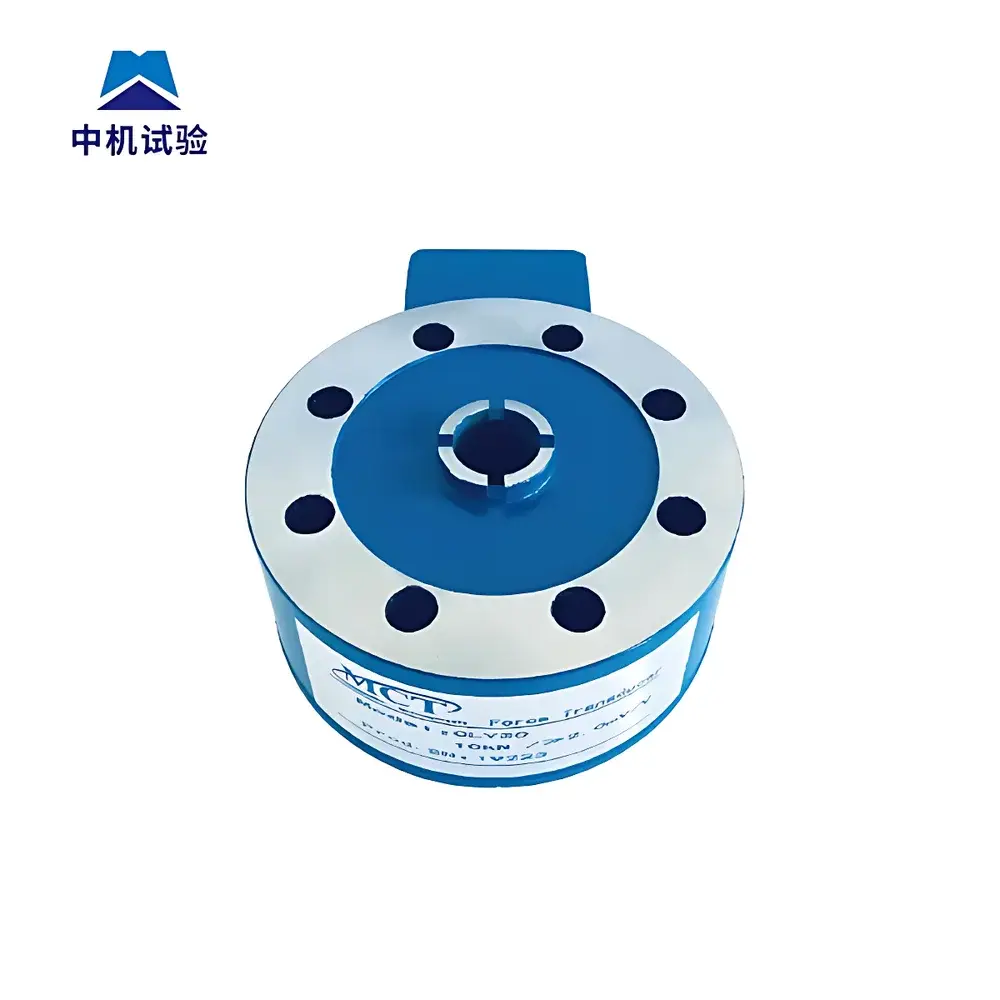
Sinotest CLY Series Dynamic Spoke-Type Tension & Compression Load Cell
| Brand | Sinotest |
|---|---|
| Origin | Jilin, China |
| Manufacturer Type | Direct Manufacturer |
| Origin Category | Domestic (China) |
| Model | CLY Series Dynamic Spoke-Type Tension & Compression Load Cell |
| Price Range | USD 420 – 690 |
| Rated Capacity Range | 10 kN to 5000 kN |
| Construction | Full Steel Monolithic Body |
| Sealing Rating | IP66 / IP68 |
| Output Configuration | 4-Wire Wheatstone Bridge |
| Lateral Load Resistance | High |
| Stability | Long-Term Drift < ±0.02 %FS/year (typical) |
| Operating Temperature | −20 °C to +85 °C |
| Compensated Temperature Range | 10 °C to 40 °C |
Overview
The Sinotest CLY Series Dynamic Spoke-Type Tension & Compression Load Cell is an industrial-grade force transducer engineered for high-accuracy static and dynamic bidirectional force measurement in demanding mechanical test environments. Based on the proven spoke-type (or “wheel-spoke”) design principle, it utilizes a precision-machined monolithic steel elastic element with strategically arranged strain gauge bridges aligned along radial spokes. This architecture delivers exceptional rigidity, minimal deflection under load, and inherent resistance to off-axis loading—critical for applications where lateral force components cannot be eliminated mechanically. The sensor operates on the Wheatstone bridge principle, converting mechanical deformation into proportional millivolt-level output (mV/V), calibrated traceably to national metrological standards. Designed for integration into universal testing machines (UTMs), fatigue test systems, structural load monitoring platforms, and industrial weighing control loops, the CLY series meets the functional requirements of ISO 376:2011 (metallic load cells for calibration), ASTM E4 (standard practices for force verification of testing machines), and supports compliance with GLP and GMP documentation workflows when paired with validated data acquisition systems.
Key Features
- Full monolithic stainless steel construction ensures long-term structural integrity, corrosion resistance, and immunity to creep-induced signal drift.
- Bidirectional measurement capability (tension and compression) within a single unit eliminates the need for separate sensor configurations in dual-mode test setups.
- High lateral load rejection ratio (>20:1 typical) minimizes cross-axis sensitivity—essential for applications involving misalignment, vibration, or multi-axial loading conditions.
- Hermetically sealed housing rated to IP66 and IP68 provides protection against dust ingress, high-pressure water jets, and temporary submersion—enabling reliable operation in foundry, outdoor structural testing, and wet-process industrial environments.
- Temperature-compensated strain gauge circuitry maintains output stability across ambient ranges from 10 °C to 40 °C, with extended operational tolerance from −20 °C to +85 °C.
- Standard 4-wire configuration simplifies field wiring while minimizing lead resistance effects; optional 6-wire variants available for remote sensing in high-precision installations.
Sample Compatibility & Compliance
The CLY series is compatible with metallic, composite, and elastomeric test specimens commonly used in materials science laboratories and manufacturing QA/QC facilities. Its robust mechanical interface—featuring standardized through-hole mounting patterns and hardened load-bearing surfaces—supports direct integration with hydraulic actuators, servo-electric crossheads, and custom fixture assemblies. All units undergo individual factory calibration with NIST-traceable reference standards, and calibration certificates include linearity, hysteresis, repeatability, and zero balance data per ISO/IEC 17025 requirements. The sensor’s design conforms to electromagnetic compatibility (EMC) directives IEC 61326-1 and mechanical safety standard ISO 12100, supporting CE marking eligibility when installed in compliant host systems.
Software & Data Management
While the CLY load cell itself is analog-output only, it is fully interoperable with industry-standard data acquisition hardware (e.g., National Instruments PXI, HBM QuantumX, or Dewesoft SIRIUS systems). When integrated into validated test software platforms—including Sinotest’s proprietary TestMaster suite or third-party solutions such as MTS TestSuite™ or LabVIEW-based custom applications—the sensor supports audit-trail-enabled data capture compliant with FDA 21 CFR Part 11 requirements. Raw mV/V signals are digitized at ≥24-bit resolution, enabling real-time force calculation with ≤0.05 %FS uncertainty (system-dependent). Calibration parameters (sensitivity, zero offset, thermal coefficients) are stored in non-volatile memory on compatible DAQ modules to ensure traceability across instrument lifecycles.
Applications
- Universal tensile/compression testing of metals, polymers, concrete, and composites per ASTM D638, ISO 6892-1, and GB/T 228.1.
- Fatigue and cyclic loading experiments in aerospace component validation and automotive suspension durability testing.
- In-situ structural health monitoring of bridges, wind turbine towers, and civil infrastructure via permanent installation with telemetry interfaces.
- Force feedback control in automated press systems, robotic end-of-arm tooling, and closed-loop material forming equipment.
- Legal-for-trade and process weighing applications where high overload capacity and environmental resilience are required (e.g., hopper scales, tank load monitoring).
FAQ
What is the recommended excitation voltage for the CLY series load cell?
Rated excitation is 10 V DC; maximum allowable is 15 V DC. Operating outside this range may affect thermal stability and calibration integrity.
Can the CLY sensor be used in vacuum or explosive atmospheres?
No—IP66/IP68 sealing does not equate to ATEX or IECEx certification. For hazardous locations, consult Sinotest’s intrinsically safe (IS) variant or explosion-proof enclosures.
Is factory recalibration required annually?
Yes—annual recalibration is recommended per ISO/IEC 17025 and internal quality management system requirements, especially after exposure to shock, overload, or extreme thermal cycling.
Does the CLY series support digital output options such as RS-485 or CAN bus?
Not natively. Digital communication requires external signal conditioning modules (e.g., HBM PMX or Phidgets VINT adapters) configured for analog-to-digital conversion and protocol translation.
What mounting hardware is included with shipment?
Standard delivery includes M12 or M16 mounting bolts (grade 8.8), alignment washers, and torque specification sheet. Custom flanges or threaded adapters are available upon request.